Asexuality in Christian marriage
Podcast: Play in new window | Download | Embed
Subscribe to the Podcast: Apple Podcasts | Spotify | Amazon Music | Android | iHeartRadio | Podchaser | Email | TuneIn | Deezer | RSS | More
As happens from time to time, someone sent a question through our anonymous “Have a Question” page, and here’s one I got asking about asexuality:
Hi Jay, thanks for all you do. I was wondering how can I tell if what I truly am is a responsive desire or am I just asexual? Any advice or break down in the differences? Thanks.
Now, it’s a great question, and we’ve talked about responsive desire often, but today I want to talk about the asexuality piece. Because asexuality isn’t something that you discover or assess. It’s something you choose, but there’s often this misconception that you can figure out which one you are.
Now, that stance is going to upset some people, I’m sure, but give me a chance to explain what I mean.
Two different things: what you feel, and what you do with it
Our world likes to conflate these two things: your temptations and your posture towards them, particularly regarding sexuality.
The first is what you feel, and the second is what you choose to do with those feelings.
Now, biblically, we have to keep those two things separate. We don’t consider temptation a sin; even Jesus was tempted. But we do consider choices, and the subsequent behaviours, to be our responsibility, and those choices are what identify us, not the desires.
“For we do not have a high priest who is unable to sympathize with our weaknesses, but one who in every respect has been tempted as we are, yet without sin.” (Hebrews 4:15, ESV)
For example, you might have a temptation to steal something, but the temptation doesn’t get you labeled a thief. Attempting to steal something will. Whether or not you’re successful, if people know or think you tried to steal something, you will be thought of as a thief. It’s not the temptation, and it doesn’t even have to be the action. It’s your posture towards your temptation: the direction you’re heading in.
That’s really what orientation means. When we think of the classical definition of orientation, it’s simply:
An orientation is the position, direction, or alignment of something relative to its surroundings.
And when it started getting used for sexual orientation (in the late 19th century), it maintained that same definition. It was the direction or alignment you chose. The temptation may or may not be a choice, but your response to it is.
Now, I say temptation may or may not be a choice, because temptations can come from a variety of things. It might be innate; it might be cultivated (by you, or someone else); it might be influenced by culture, family, friends, trauma, medication, mind-altering substances, context, or a host of other things.
How you decide to move through the world as a result of this temptation, whether you accept and adopt it or reject it and work against it, that is orientation. That is a choice.
And I know a number of people who experience same-sex attraction, both men and women, who choose to reject those temptations and live a heterosexual life, and I’ve seen them cultivate desire for the opposite sex. That doesn’t mean there isn’t some sort of struggle with same-sex attraction for some, but the point is, they made a choice to reject the temptation and orient themselves in the direction that was consistent with their worldview.
And when it comes to asexuality, the same thing is true. It’s an orientation. In this case, it’s a lack of desire instead of a desire for something, but what remains is that your attitude towards it is still a choice.
Now, this isn’t how asexuality is usually defined. For example, the Asexual Visibility and Education Network (AVEN) defines an asexual person as someone who does not experience sexual attraction. But in a world in which every romance movie involves some illicit relationship, is it any wonder that the world has no idea what fleeing from temptation actually looks like?
As Christians, we have a completely different concept of how the world works, or at least we should if we claim to follow the Bible, because we are taught, repeatedly, that we are not responsible for our temptations. We are responsible for our choices.
“No temptation has overtaken you that is not common to man. God is faithful, and he will not let you be tempted beyond your ability, but with the temptation he will also provide the way of escape, that you may be able to endure it.” (1 Corinthians 10:13, ESV)
What the experience can look like
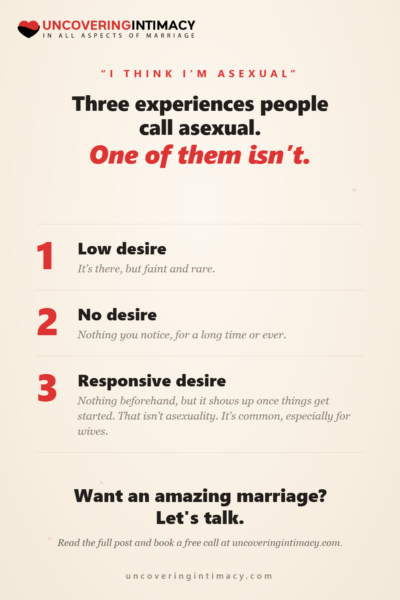
When people tell me they think they’re asexual, they usually describe one of three experiences. They have:
- Low desire. It’s there, but faint and rare.
- No desire. Nothing they can notice, for a long time or ever.
- Responsive desire. No desire beforehand, but it shows up once they enter a sexual context, whatever that means for them.
This last one gets mislabeled often.
When we surveyed our readers, 37% of wives responded that they mostly experienced responsive desire, meaning desire shows up after things get started rather than before. So if you rarely, or never, feel “in the mood” out of nowhere but enjoy sex once you’re there, that is responsive desire, not asexuality, and it’s very common for wives.
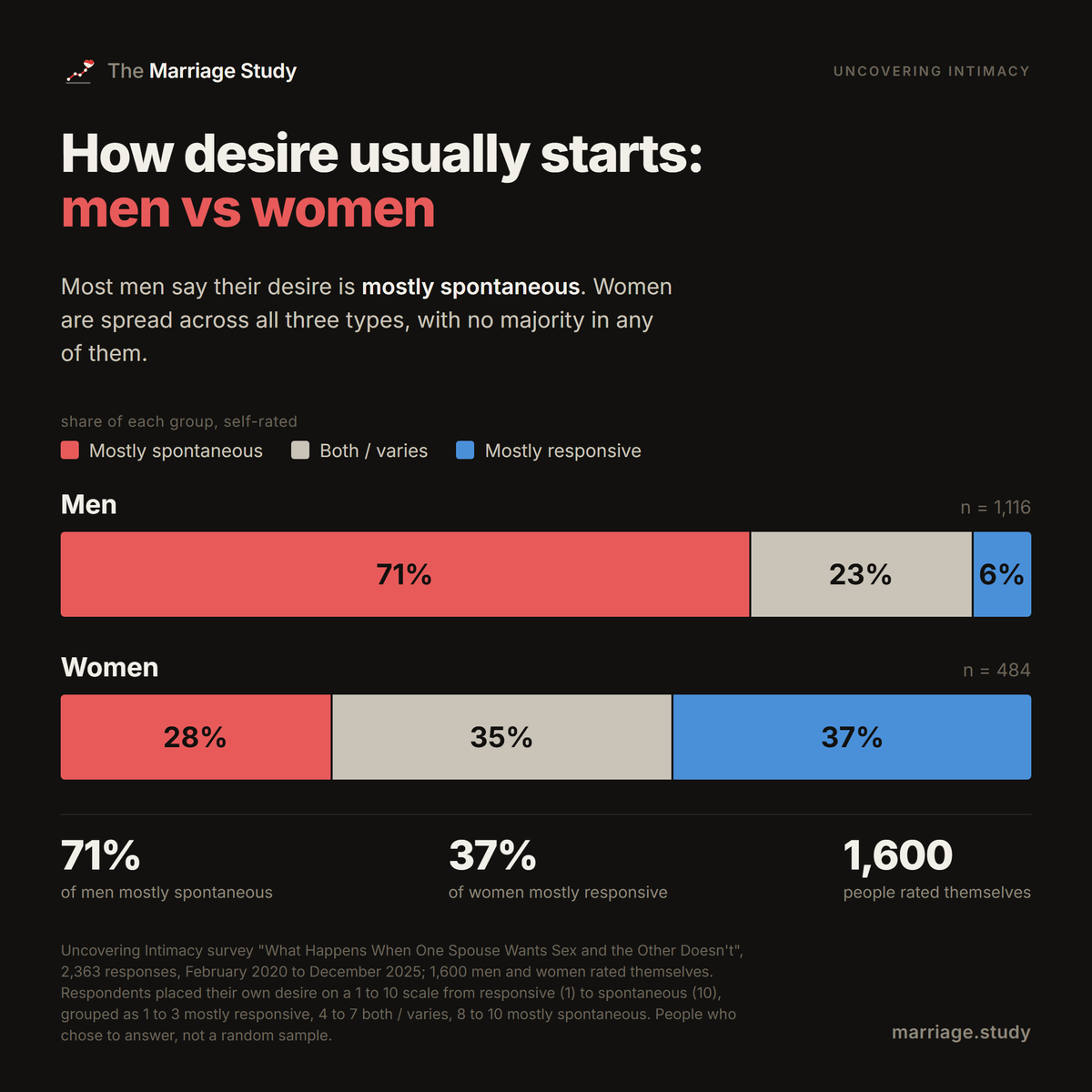
And it becomes more common as you get older, have kids, take on more responsibilities, have more stress, and so on.
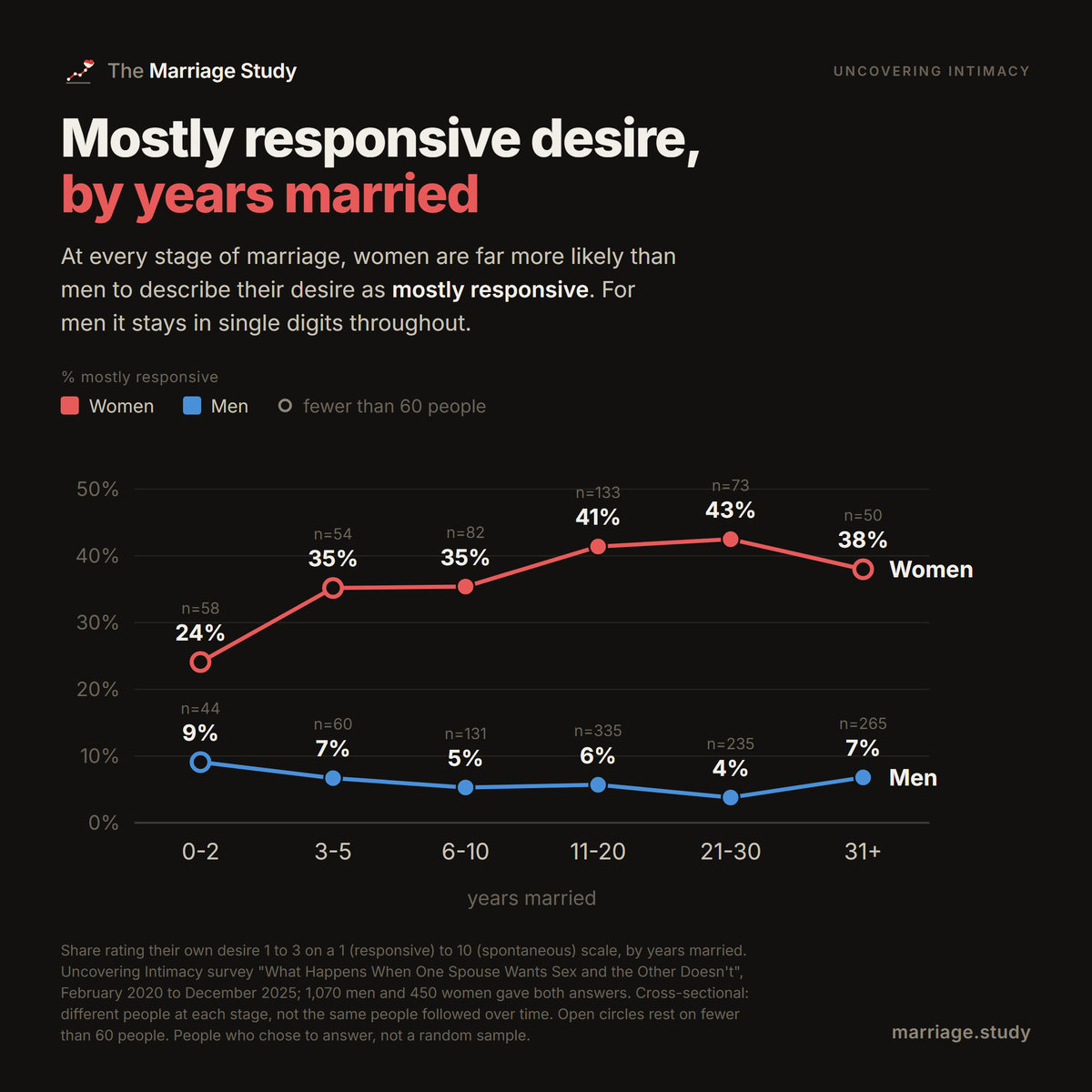
Again, that isn’t you becoming asexual, which is what I often hear therapists diagnose wives with. If it is, then it’s an epidemic. And this isn’t only something wives experience; it’s just far more prevalent for them than for husbands.
Choosing an asexual orientation
Those lower-desire spouses who choose to orient themselves towards asexuality, whether because they decided to themselves, or were influenced by social media, a therapist, a friend, or anything else, and whether or not they know the term, either way, that posture, that attitude and those behaviours become a self-fulfilling prophecy.
They tend to shut down any opportunity for their arousal to respond.
When their spouse wants to connect, they roll their eyes. A suggestion of something more exciting than missionary position in the dark gets a look of disgust. Asking to increase the frequency of sex gets the high-drive spouse labelled a sex addict. Spontaneous desire is met with suspicion.
They decline by default, they don’t initiate, or if they do, it’s because they feel like they’re supposed to and do it out of guilt or obligation.
They avoid situations where their spouse might initiate, or where they might get aroused, and over time, “I’m not interested in sex” becomes part of their identity.
This is the equivalent of a child who just decides to be difficult on a family outing, one you absolutely know they would enjoy if they just gave it a chance. But because they approach it with an attitude of not being open to joy, that’s the experience they get.
If you believe you’re not interested in sex, then you never give arousal a chance to grow. So you never get to experience responsive desire, because you’ve cut yourself off from any opportunity for it to show up.
And in a marriage, this isn’t a valid option. In fact, I’d argue it’s as bad as infidelity, because not only did you promise not to have sex with other people, you promised to have sex with your spouse, because you love them.
“For the wife does not have authority over her own body, but the husband does. Likewise the husband does not have authority over his own body, but the wife does.” (1 Corinthians 7:4, ESV)
Choosing a sexual orientation
On the other hand, if you choose a posture of being sexual, you will find that low desire doesn’t mean you can’t or don’t enjoy sex. It just means you never think about it on your own. The desire doesn’t grow within you; it’s enticed from outside of you, and often that means choosing to start, even when you don’t feel like it.
Because sometimes it feels a bit like going to the gym, or going for a run. That feeling of “ugh, I don’t really want to bother with all the effort of getting started”, but then when they do, they’re happy they did because those endorphins kick in.
And I get emails all the time from lower-desire wives (the lower-desire husbands don’t tend to email me) who adopted an orientation of being willing to be aroused rather than waiting to be in the mood, and learned that they can actually enjoy sex. A lot. The emails I get from husbands are usually in gratitude for teaching them (and their spouse) about responsive desire and working with their sex drive instead of just giving up and lamenting that it’s not like his.
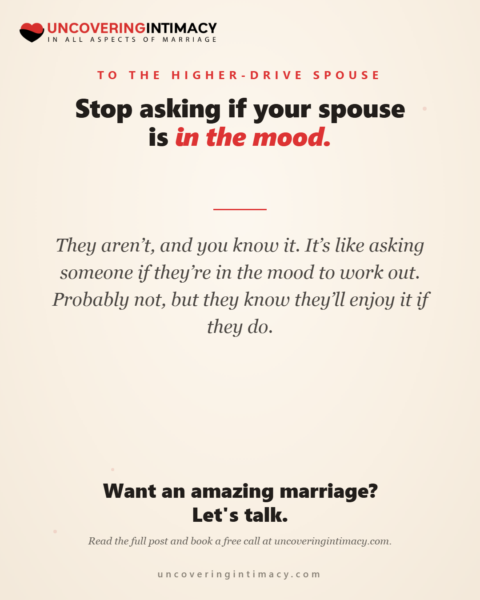
This is one of the reasons I tell higher-desire spouses to stop asking if their spouse is in the mood. They aren’t, and you know it, so stop asking. That’s like asking someone if they’re in the mood to work out. Probably not, but they know they’ll enjoy it if they do.
Because if responsive desire spouses adopt an orientation of being sexual, even if it doesn’t match their innate lack of desire, then they give arousal a chance to build rather than shutting it down.
And don’t do it because you feel like you “should”, or because it’s your duty, your obligation, or “because the Bible told me to”. Then you’re going to feel the same as that teenager on that mandatory family fun day: begrudging, not open to joy.
Instead, test God’s word. Be open to being shown the truth, not because you have to, but because you want to experience the joy that He has in mind for you.
And that choice matters. Doing it because you “want to want to”, as I hear so often, is important. That choice brings hope.
Why it matters that orientation is a choice
After all, if asexuality is a fixed fact about you or your spouse, then you both made a mistake getting married. Even if you had the spiritual gift of celibacy, your right to exercise it went out the window the moment you said “I do”. Because it is not right, moral, or loving to trap a spouse in a sexless marriage. Now, if orientation isn’t a choice, then there’s nothing you can do about it. You’re stuck in a marriage that will never be fulfilling in the way it was intended. But if orientation is a choice, as I’m suggesting, then you still have an opportunity to experience the fullness of what God intended for your marriage.
Because everyone has defaults they didn’t choose. A short temper, anxiety, depression, unwanted attractions, and more. We cannot help our sinful nature. But faithfulness has never been about not having defaults; it’s about what we do with them.
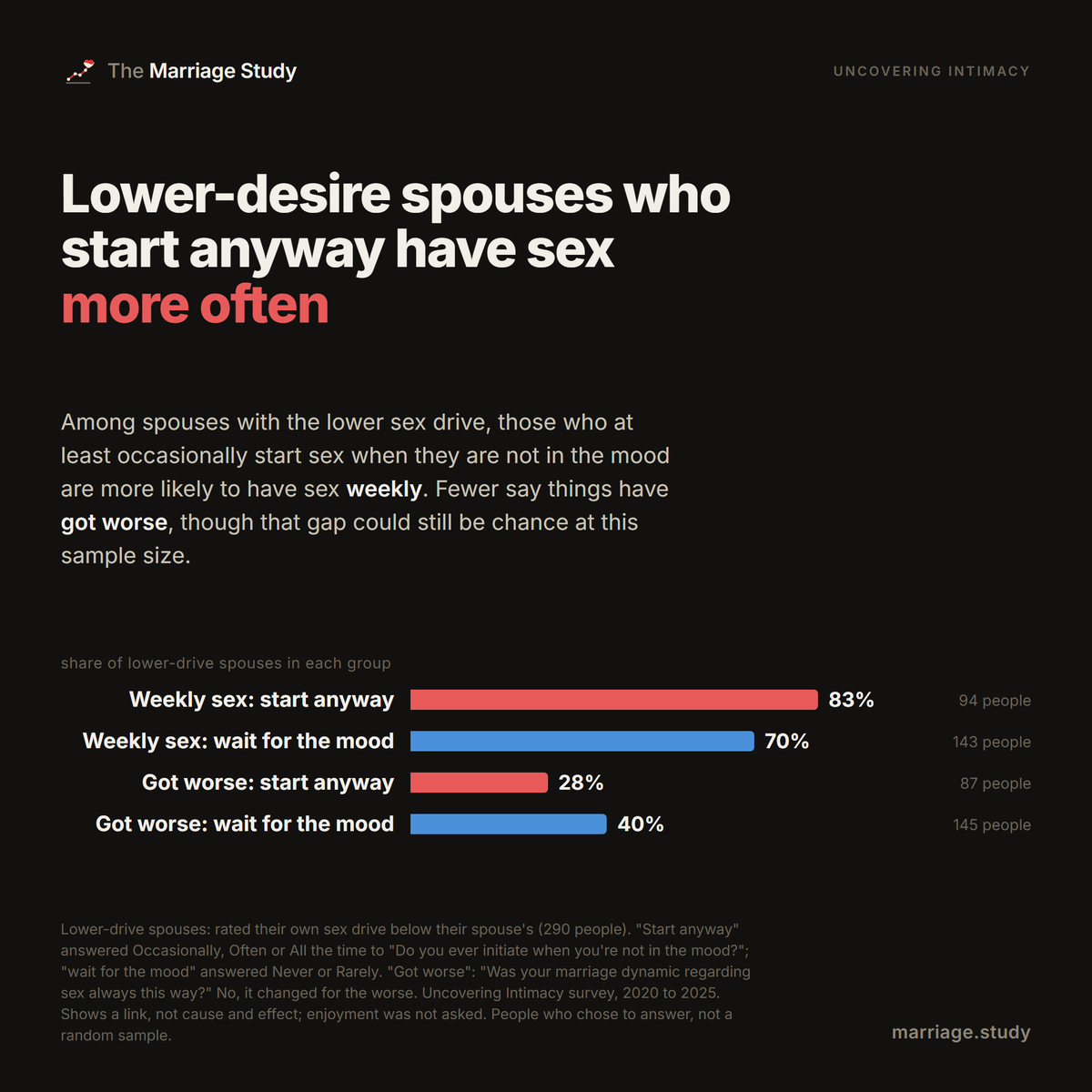
For a lot of people, choosing to be open, starting before you feel like it, is exactly how desire arrives. In our survey on mismatched drives, 37% of more than 1,400 respondents said they at least occasionally initiate when they aren’t in the mood. That’s what I’ve described as the difference between desire and willingness. Not “giving in”, but choosing to give.
That choice shouldn’t be under pressure
For higher-drive spouses, that doesn’t mean you get to pressure your spouse. Nobody should feel pressured, forced or coerced into sex, and if you try, you’ll usually see it backfire. Yes, you might get more sex, but it won’t be the sex you want. It will be begrudging and full of resentment and hurt, and you will find you have a marriage where your sex life goes in fits and starts whenever you push enough to make them feel bad, ashamed, afraid you’ll leave or otherwise pressured again. But you’ll never be satisfied, and you might remove the opportunity for you ever being satisfied if you pile enough hurt on over the years.
And if your spouse says they’re trying, be appreciative and grateful. Don’t attack them for it not being enough, or for their drive not looking like your sex drive looks, or make them feel bad for not having desire. This is a sure-fire way to lock any potential for desire in a box, and you’ll have yourself to blame for that.
For the lower-drive spouses, I have a standing rule in marriage: don’t do anything that will make you hate or resent your spouse. That includes sex. Because just giving in to keep the peace will not keep it forever. As resentment builds, you will slowly lose your love and harden your heart.
However, now the problem is that you have two rules at war with each other, and so your responsibility is to figure out what’s going on. Why is it that you can’t be open to loving your spouse? What is it that makes you want to shut down this part of your relationship?
And maybe that’s a heart issue with you. Maybe it’s due to past relationships and trauma that you need to process with a therapist. Maybe it’s due to a problem in the relationship dynamic that needs to be addressed. Maybe it’s the medication you’re on and you need to talk to your doctor about alternatives.
Whatever it is, the onus is on you to work towards resolving that as best you can. Now, some relationship dynamic issues you can’t handle entirely on your own, but what isn’t okay is just throwing up your hands and going “well, I guess we’re stuck”. There are always solutions if both spouses are willing to pursue them in love.
If you struggle with low desire or identify as asexual
For wives
Christina’s private group for wives who want to want to
Wives, if this is you, my wife Christina is starting a private group for exactly this: being open to being a sexual participant in your marriage. It’s not about manufacturing attraction, but about learning to work with responsive desire and maintaining that posture of being willing to be aroused.
Taking founding members until Nov 8, limited seats remaining
If you're married to someone who identifies as asexual
Then tread lightly. How far you can push for a solution depends on how strong your relationship is. If you have trust, if you want the best for your spouse, and aren't just fighting for what you want, and if they believe that to be true, then it might work to send them this post and ask, "What do you think of this?"
But if that's a terrifying thought, if there's something in you saying "I don't think this is going to go well", which is probably most of you, then don't send it. There's a good chance that there is work that needs to be done first, and this is only one symptom of a larger problem. If that's the case, then you're going to exacerbate the problem by sending it, because there is a good chance it will read as pressure and condemnation, not love.
Whatever you do, do not send them this article with any message that conveys, "see, you're the problem".
If you want a space where you can talk and share about your marriage and be around other men who are working on this, check out our support page and join the forum.

What you do with what you feel is what matters
What you feel, or don't feel, is your experience. What you do with it is your orientation: your choice.
And you might be able to change your experience. I know many who have managed to. I can't promise you can, but if you set your orientation to fit the experience you already have, it likely won't change. If you set it to fit the experience you want, well, at least you have an opportunity to grow in that direction.
"I don't wait to want to. I act on what I know to be true and not how I feel." (Anonymous wife in our survey on mismatched drives)