Manual Sex, Oral Sex, Mutual & Solo Masturbation: The Full Survey Results
In July and August we ran a survey on the four sexual activities most couples never quite get around to talking about: manual sex, oral sex, mutual masturbation, and solo masturbation. After data cleanup, we ended up with 1,058 complete responses, pulled from people who follow Uncovering Intimacy, mostly married Christians, with a wide range of ages and time-married.
I’ve already written three posts pulling specific stories out of this data:
- Does masturbation help or hurt your marriage? Here’s what the data says: solo vs. mutual masturbation, and what each does to satisfaction.
- Do all husbands want more oral sex?: the gap between what husbands want and what wives think they want.
- Why don’t we ever talk about what we actually want in bed?: communication comfort and the satisfaction gap that follows it.
A lot of you have asked for the rest of the data, the kind of full survey breakdown I’ve done before for the BDSM survey and previous surveys. So here it is. Less narrative, more numbers.
I’ll briefly summarize the headlines from those three earlier posts as we hit the relevant sections, but the main job here is to walk through what we haven’t covered yet: who answered, how often these activities happen, what couples actually use, where things end up, what rituals (if any) people follow, what they wish were different, and where the survey surfaced patterns that genuinely surprised me.
If charts make your eyes glaze over, skim the bold sentences. If charts are your thing, you’re going to enjoy this one.
Who answered
Before any of the data: who you’re hearing from matters. This survey leaned heavily male (in line with most of our previous surveys, where men are typically more willing to answer) and heavily married.
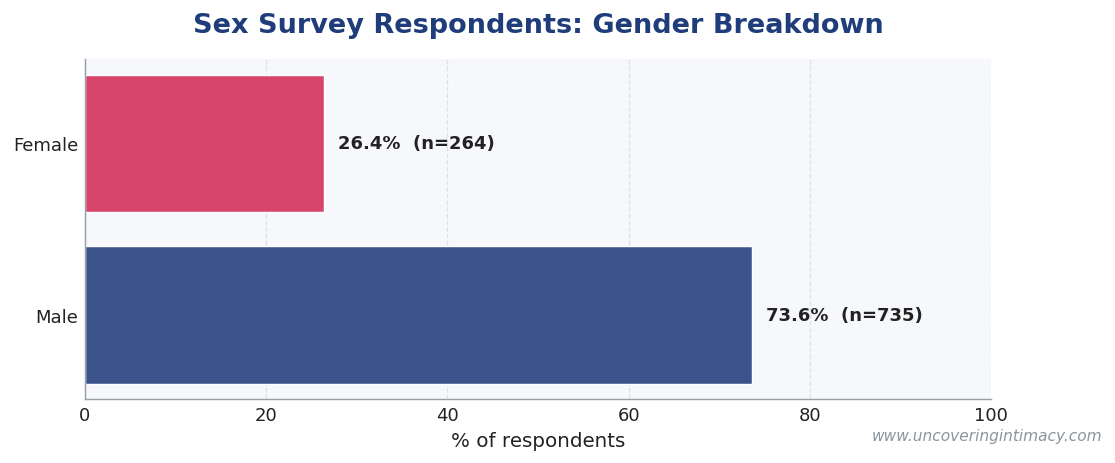
735 men, 264 women (another 59 skipped the gender question, leaving 999 who specified). An even heavier male skew than our BDSM survey (786 men, 356 women), and worth flagging. When you see a “men report X%” finding below, it’s drawn from a much larger pool than the equivalent number for women, so women’s numbers carry a wider margin of error. Still, 264 women is a substantial sample.
Age skewed older than I expected:
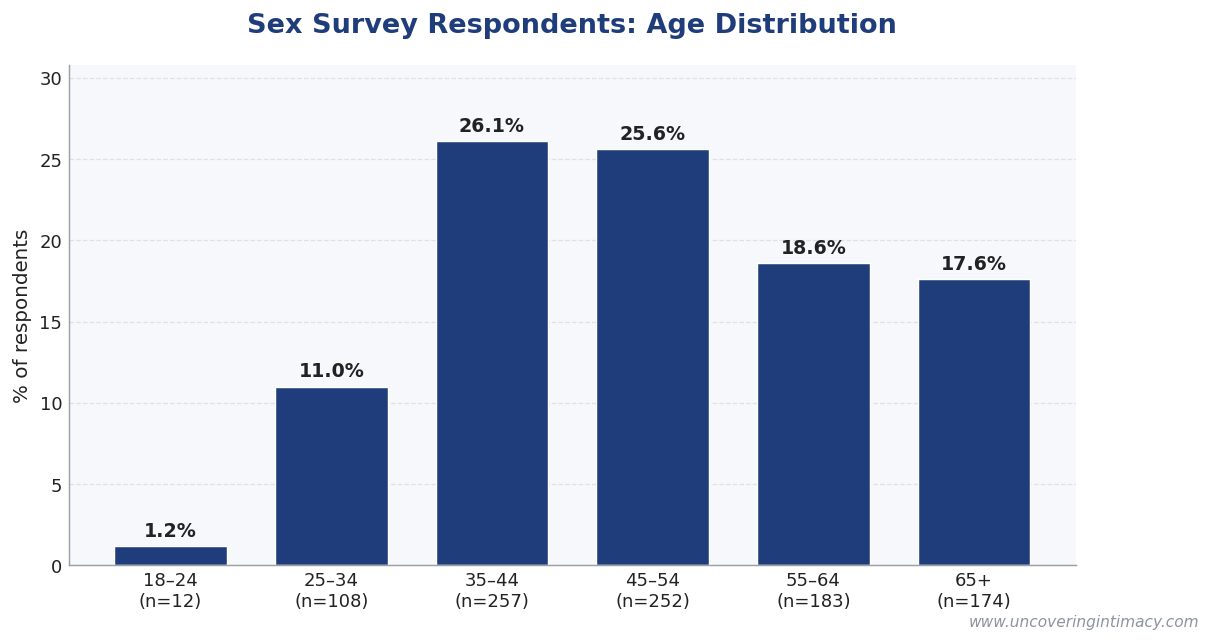
Median age: 48. 70% of respondents were 35–64. Less than 2% were under 25. This is a married-Christian-grown-ups crowd, which is to say: pretty much our usual readership.
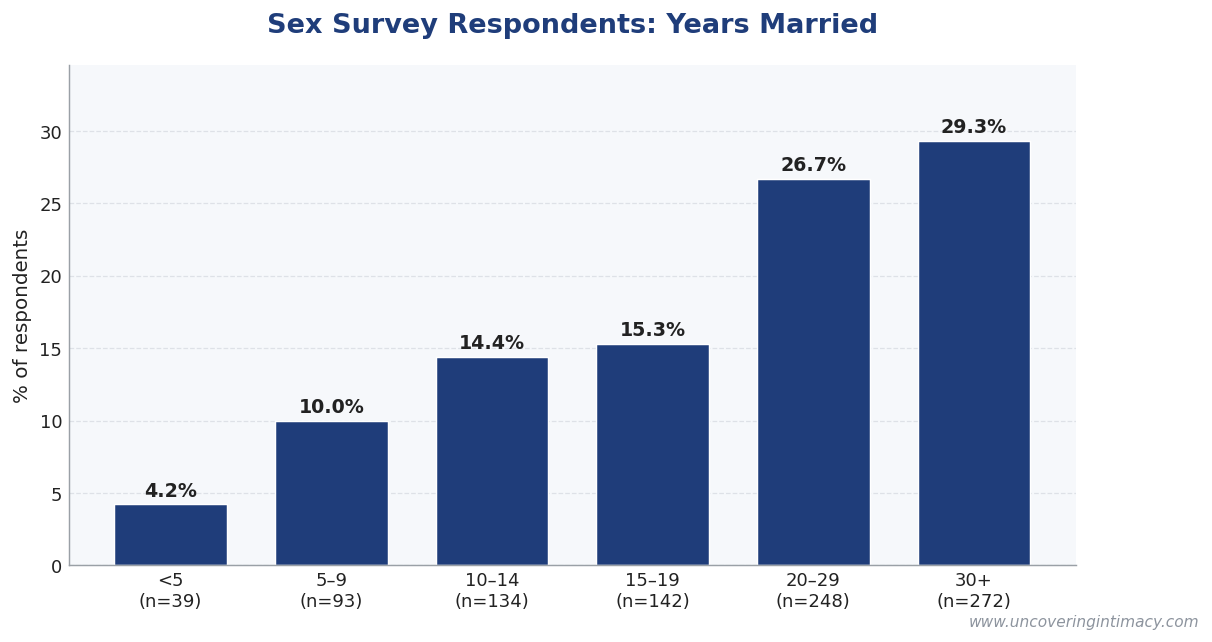
Median time married: 21 years. Over half had been married 20+ years. Whatever else this survey tells us, it isn’t honeymooners describing what they think sex is going to be like. It’s people who’ve been at it a long time.
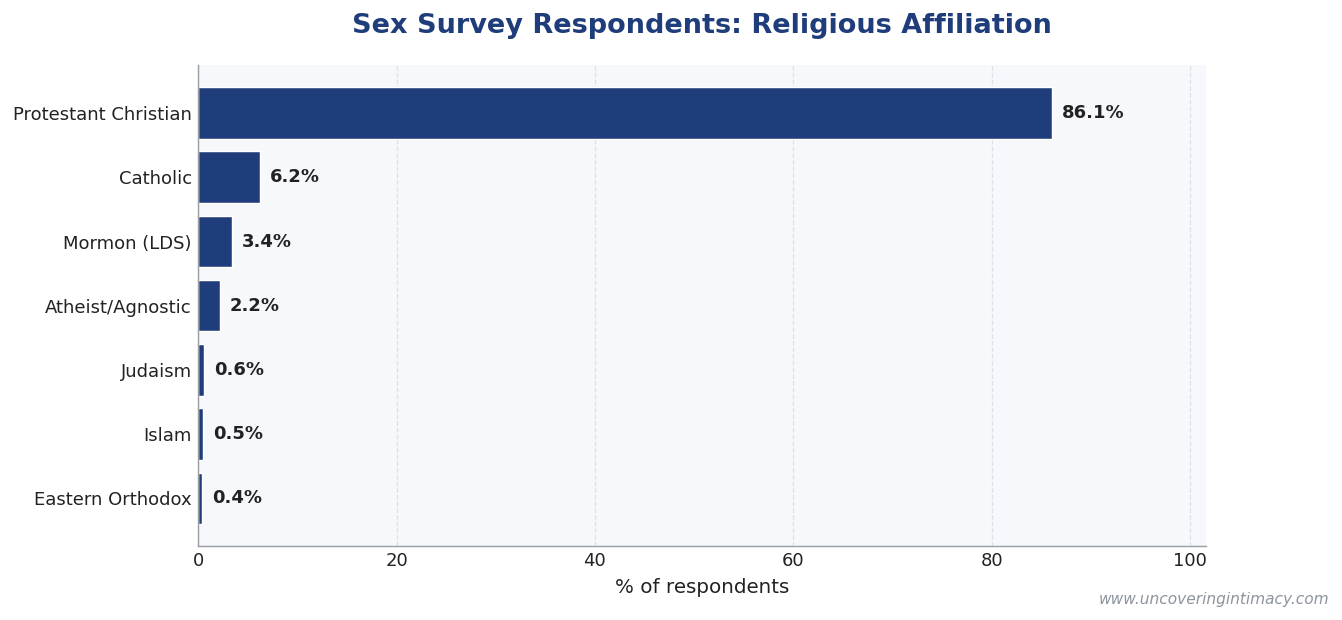
86% Protestant, 6% Catholic, 3% LDS, 2% Atheist/Agnostic. Combine the explicitly Christian categories and you’re at ~96% of respondents. So when I talk about “what couples in the survey think,” read that as “what mostly-Protestant-Christian couples think.” If you’re looking for a representative sample of Americans, this isn’t it. If you’re looking for a representative sample of our readership, this is exactly that.
How often these things happen
Let’s get the big-picture frequency question out of the way first.
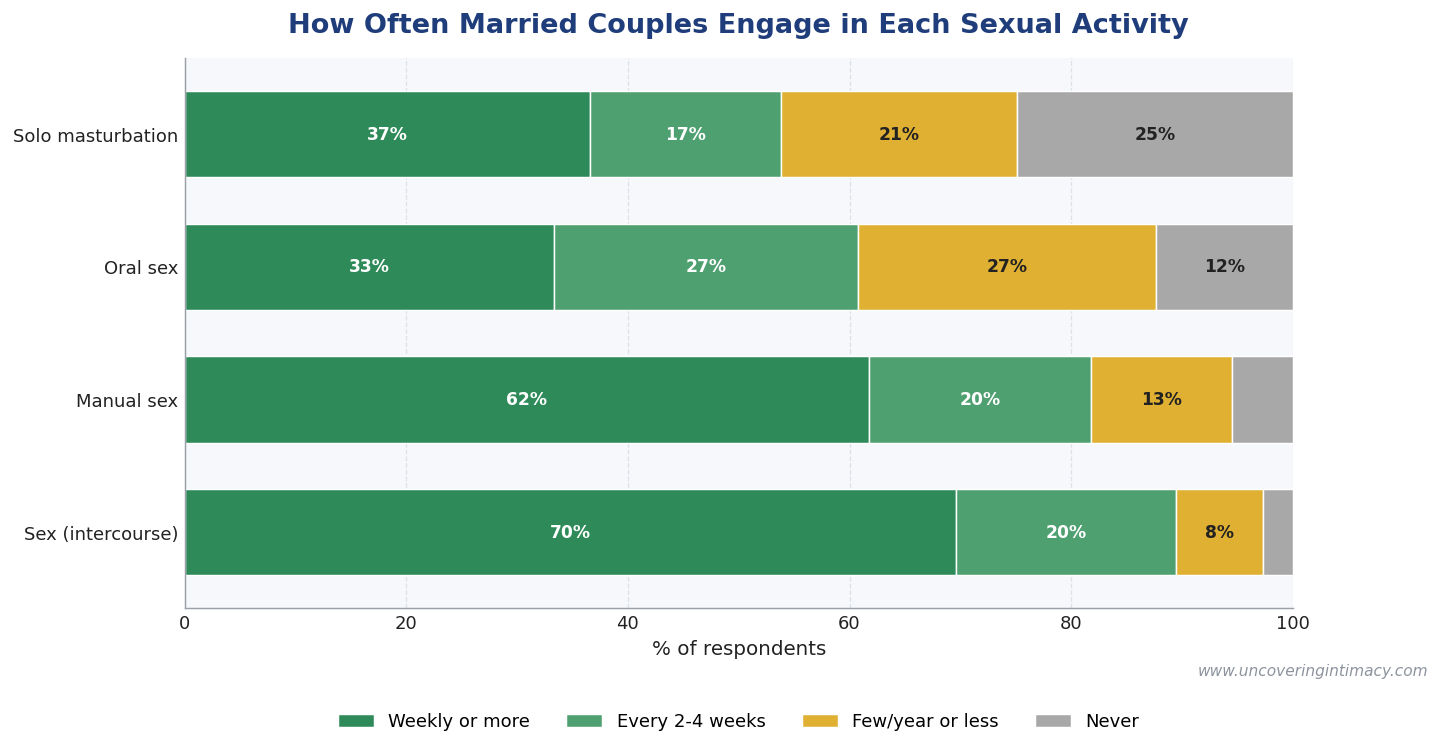
Sex (intercourse) clocked in at 70% weekly or more frequent (about what we’ve seen in past surveys). The really interesting numbers are the other three rows.
- Manual sex is the runaway second-most-common activity. 62% of couples engage in it weekly or more often, and only 5.5% say “we don’t engage in manual sex.” For a topic almost no one talks about, it shows up in most marriages on a weekly basis.
- Oral sex is the most polarized. A third do it weekly+; a quarter do it just a few times a year or less; 12% don’t do it at all. It’s the activity with the biggest “we just don’t” group.
- Solo masturbation is the most divided. 25% of respondents say they never masturbate alone, a number I would have predicted lower in a married-couples survey. 37% do it weekly or more. (That 25% overall hides a wide gender gap, which we’ll come back to in the sex-toy section.)
The averages hide a lot of variance. The comments are full of couples describing rhythms that don’t match the chart:
“I would prefer to have sex every day or every other day. On average we have sex twice a week, but sometimes that a few times close together and then nothing for two or three weeks. That inconsistency is difficult for me.” (Female, 39)
“We might have sex 5-6x per year. Used to be per month. But over the years, especially since having kids, our sexual frequency has waned incredibly.” (Male, 41)
I covered the satisfaction implications of solo vs. mutual masturbation in this earlier post. Short version: more solo masturbation correlates with lower sexual satisfaction, more mutual masturbation correlates with higher. We’ll get to mutual masturbation specifically in a moment, because it has its own story.
Manual sex
Of the four activities this survey covered, manual sex (using hands to stimulate your partner) is by far the one couples engage in most and talk about least.
Where things end up
I expected most people to say “into a tissue.” I was wrong.
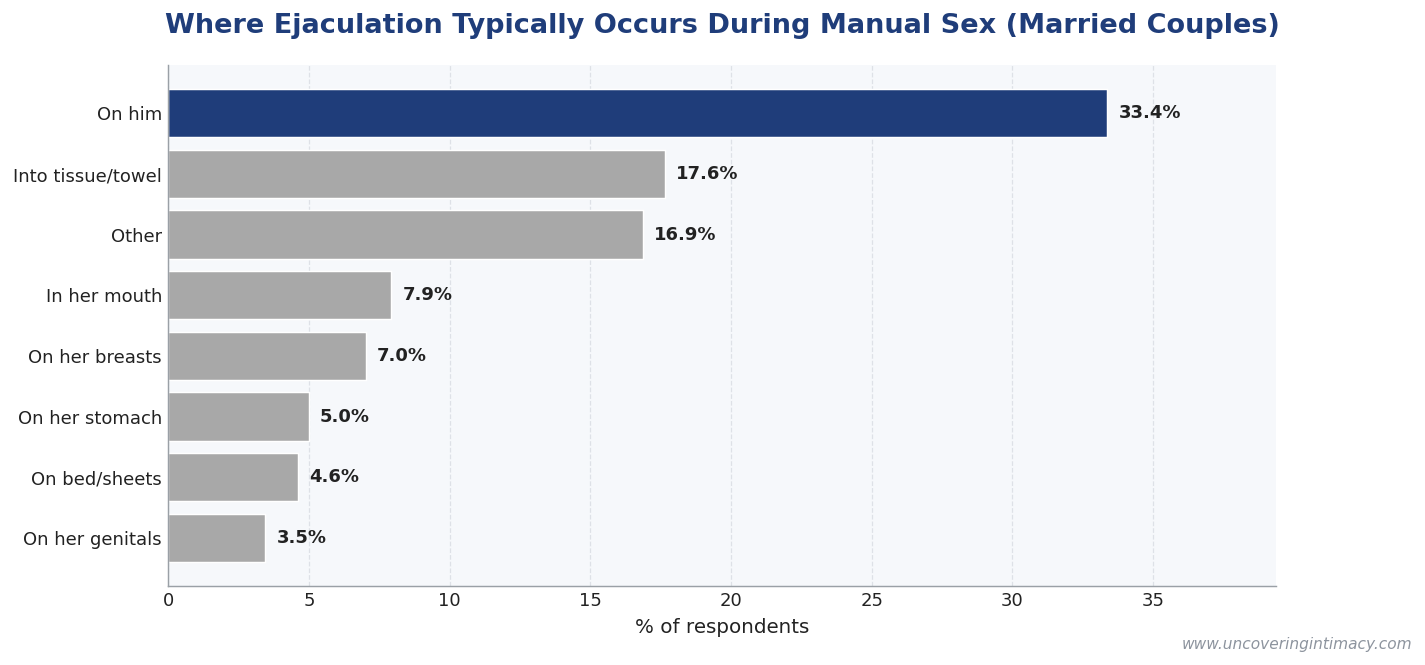
One-third of couples have ejaculation happen “on him,” meaning the man is the recipient of his own ejaculate. That’s the single most common answer, more than tissues, towels, sheets, or anywhere on the female partner. I genuinely had not predicted that. Look at the survey logic for a moment and it makes sense: when a wife is giving her husband manual sex, the natural geometry tends to put it back on him. But until you see the number, it doesn’t feel obvious, at least it didn’t to me.
Cleanup and lube
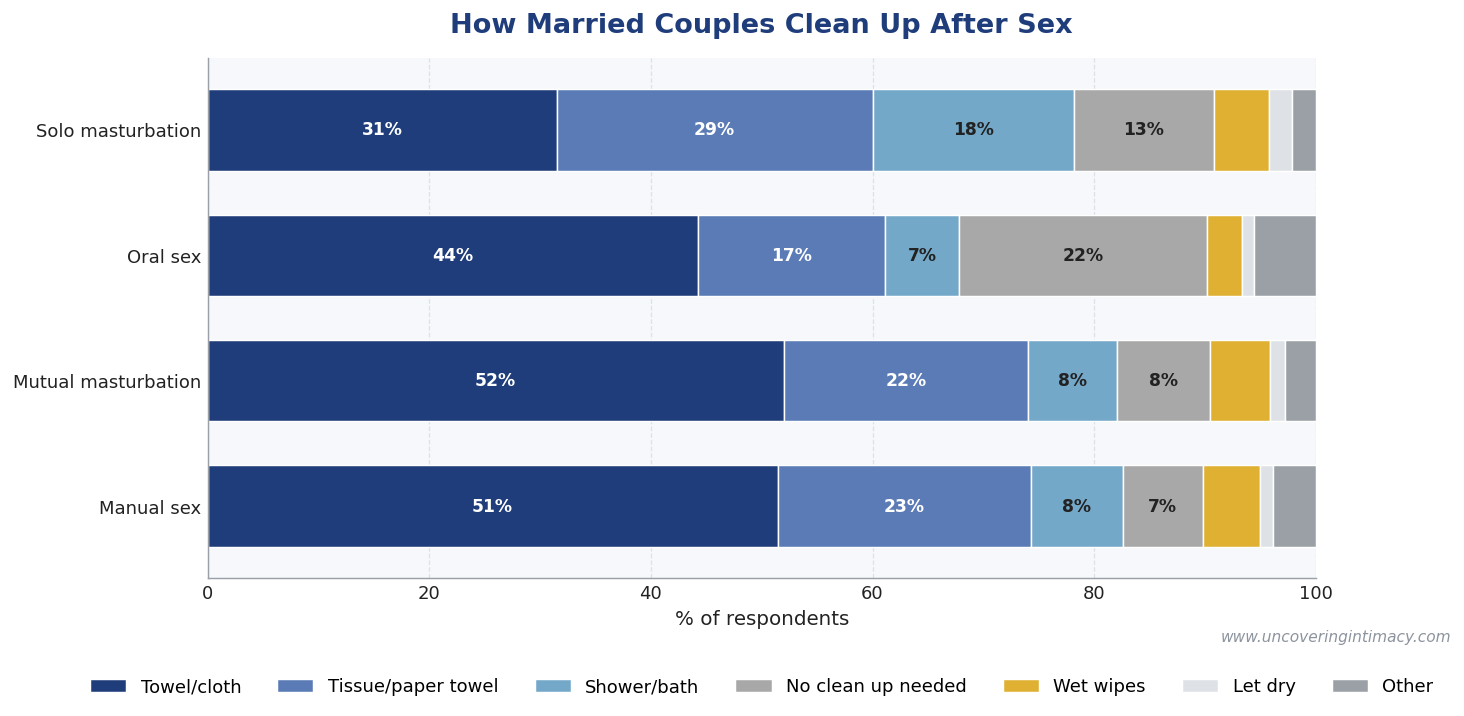
Towel/cloth wins across every activity. The towel is the unsung hero of married sex.
The lubricant question is one of the most actionable in the whole survey. About 23% of couples use lube every time during manual sex, another 21% use it most of the time, and 23% use it sometimes. Adding those together: about two-thirds of couples reach for it at least sometimes. The other third (split between “rarely” and “never”) included 3% who said “Never – but I wish we did” for manual sex specifically.
When people do reach for something, here’s what they reach for:
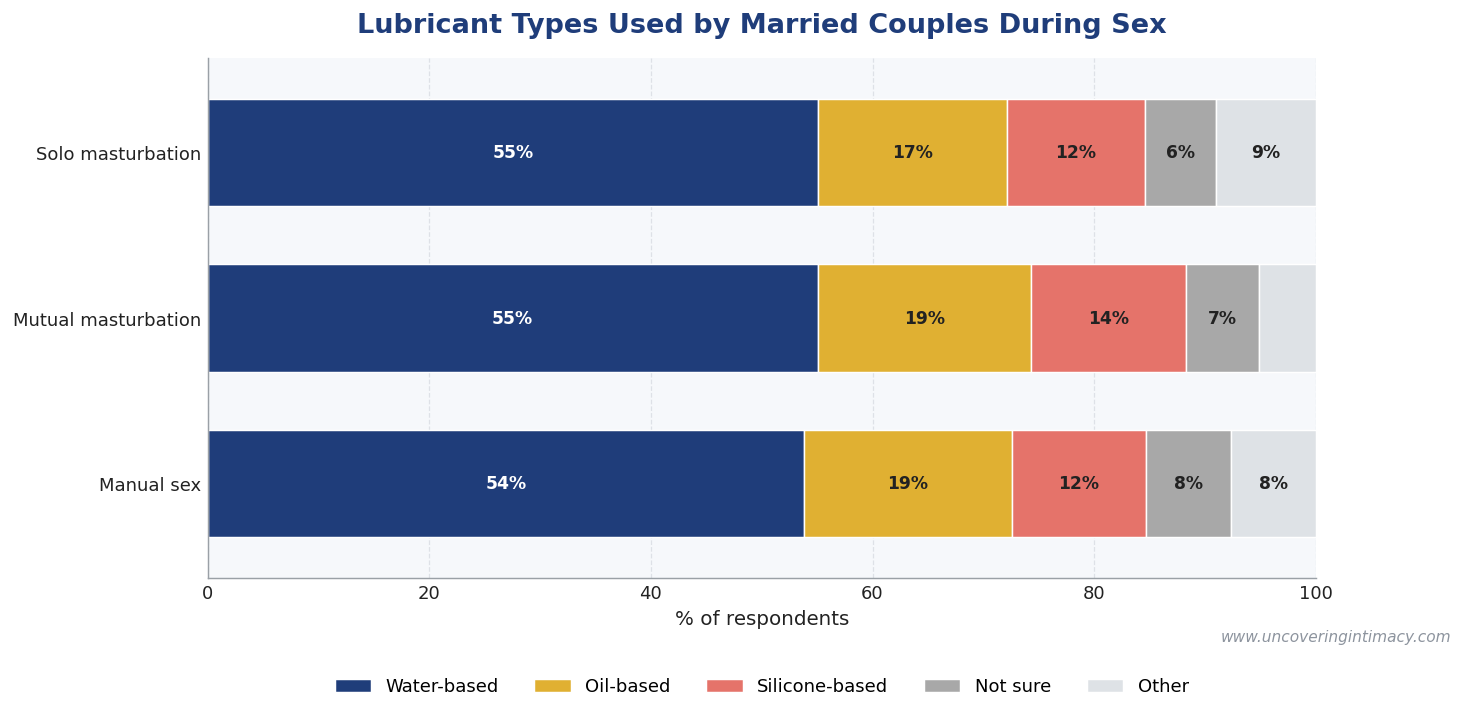
Water-based wins decisively, then oil, then silicone. This is roughly what the sex-product industry would predict, but worth noting: 7.7% of lube users for manual sex said “Not sure” what kind they were using. That’s a meaningful slice of people who don’t know, and it matters if you’re using condoms (oil breaks them) or silicone toys (silicone-based lube degrades them).
Pre-sex rituals
This question asked which preparations couples follow before each activity:
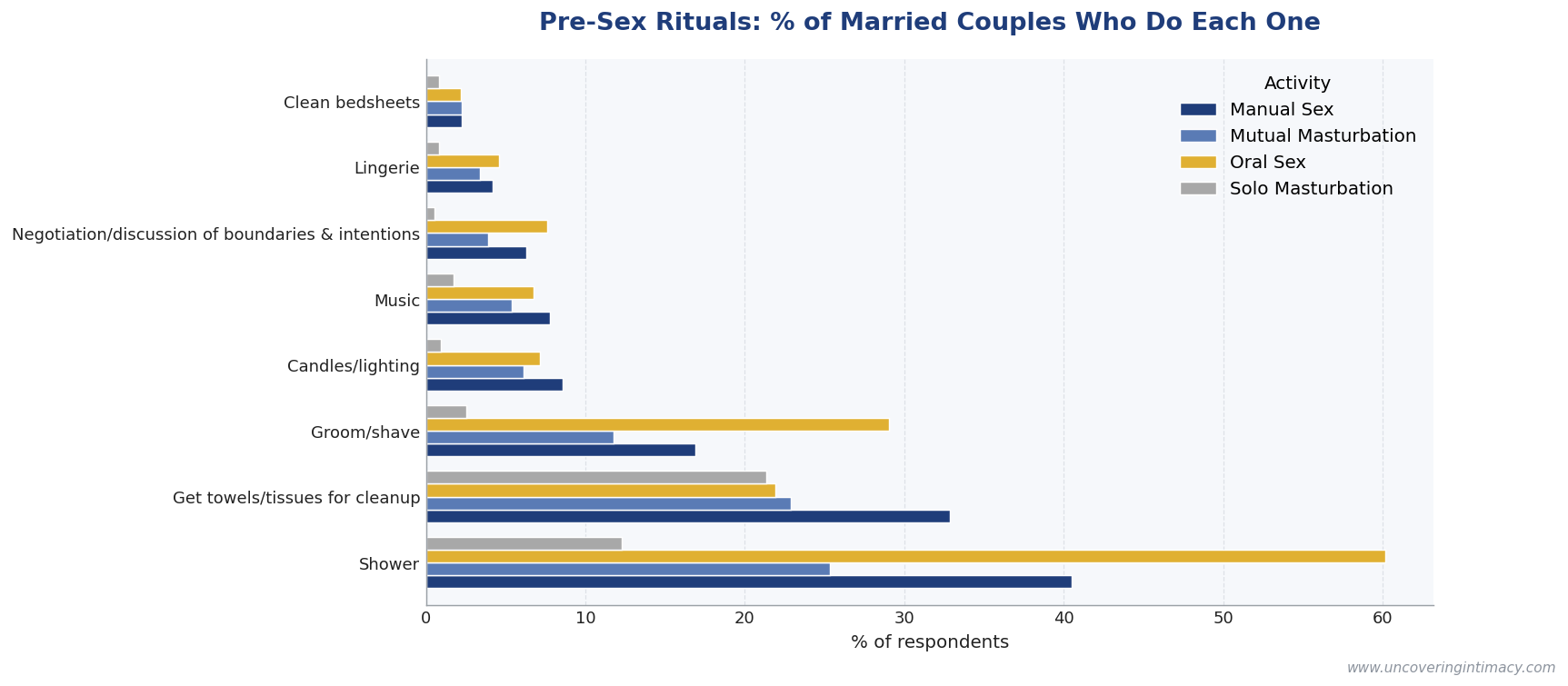
Shower is the most popular pre-sex ritual. Forty percent of couples shower before manual sex, dropping to about 12% before solo masturbation (presumably because solo masturbation is the most spontaneous of the four activities).
Negotiation/discussion of boundaries before the activity is rare: only 6.3% before manual sex, dropping to 0.5% before solo. That’s a meaningful number to sit with, given how often I hear from couples whose hurts came from unspoken assumptions. We’re not, as a population, big on talking before we touch.
Who thinks it matters?
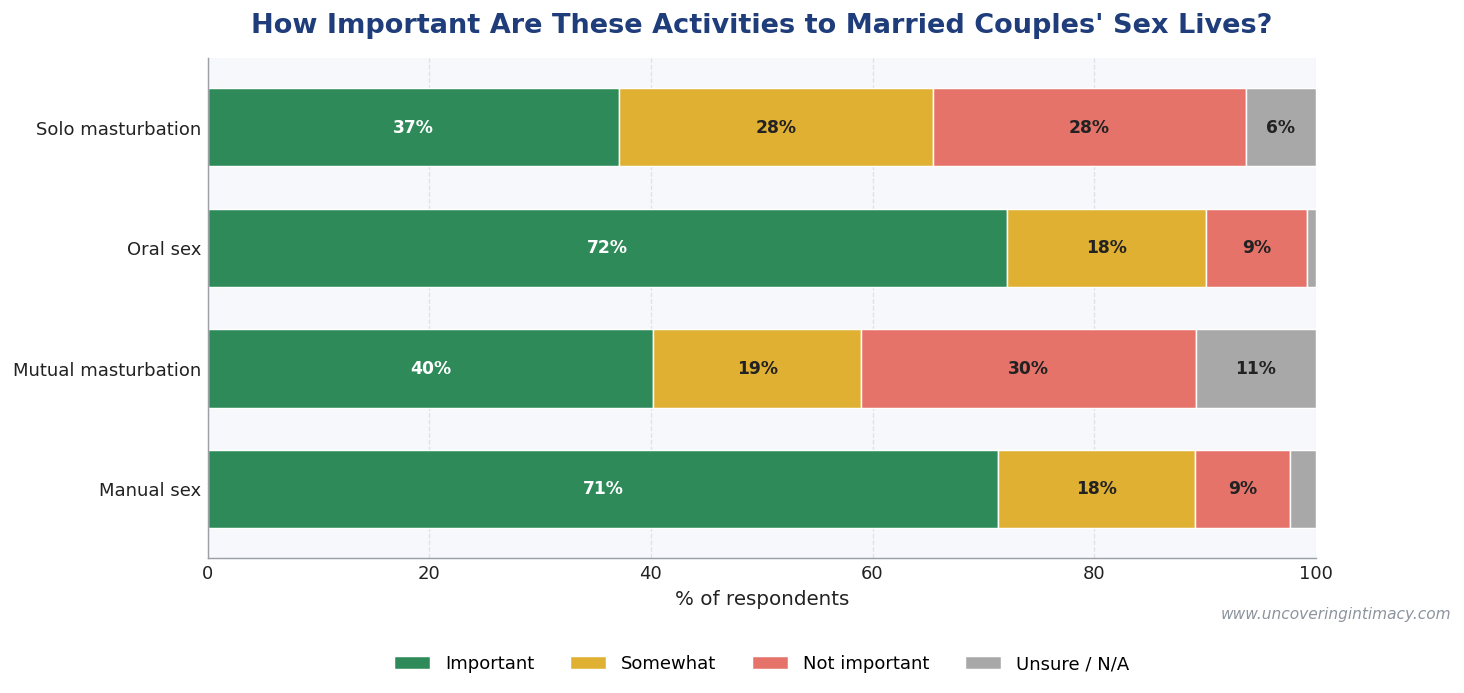
71.3% of respondents say manual sex is important: either “a key part of our sexual connection” or “it adds variety and intimacy.” Only about 9% say it’s not important. Manual sex is, by a wide margin, the most universally embraced of the four activities.
The comments section painted a particular picture of why:
“It is the only way I orgasm with my husband, so it is essential. He does not give me oral sex, and I do not orgasm via penetration, so it is an integral part of our sexual encounters.” (Female, 44)
“Being 62, ED makes manual sex our go-to for finishing.” (Male, 62)
“Practically required for wife to achieve orgasm. Due to aging, it helps me maintain an erection while manually stimulating my wife so that I can enter her when she is near orgasm or shortly after her orgasm begins.” (Male, 66)
A pattern I noticed in the comments: as couples age and intercourse becomes less reliable (ED, dryness, recovery), manual sex quietly becomes the load-bearing activity of their sex life. It’s the technique people lean on when other things stop being available, and yet it’s also the one nobody ever wrote a marriage book about.
Mutual masturbation
This is the activity that consistently surprises people in our survey data.
Less than half of married couples engage in mutual masturbation at all on a regular basis. 54.1% of respondents say their partner doesn’t masturbate in their presence; 44.4% say they themselves don’t masturbate in their partner’s presence. That’s striking, because mutual masturbation is also, by a wide margin, the activity people most want to add to their sex life. More on that at the end.
Importance, on paper
40.2% rate it important; 30.2% say it’s not really. It’s by far the most divided of the four activities.
But here’s the punchline: when you read the comments alongside that “not important” cluster, it’s not really apathy. It’s one partner’s veto.
“I wish for mutual masturbation to be part of our lovemaking. My wife has never masturbated, and therefore she’s not open to the possibility.” (Male, 35)
“I would like to try it when we are together sometime, rather than only occasionally during travels.” (Male, 34)
“I think it would help our sex life evolve and grow and be less routine.” (Male, 34)
“Would like to try more but embarrassed to talk about.” (Female, 34)
Among the “Not really” and “No, it doesn’t feel important” responses, a substantial number had comments that read more like “I wish we did it but my partner won’t” than “this just isn’t for us.” That’s a meaningfully different finding than the chart suggests.
Oral sex
I covered most of the oral-sex satisfaction story in Do all husbands want more oral sex?. The headline: 51% of husbands want more, vs. 26% of wives, and the gap closes dramatically once couples can openly discuss preferences. Here I want to add a couple of pieces that didn’t fit in that post.
Where ejaculation occurs (oral)
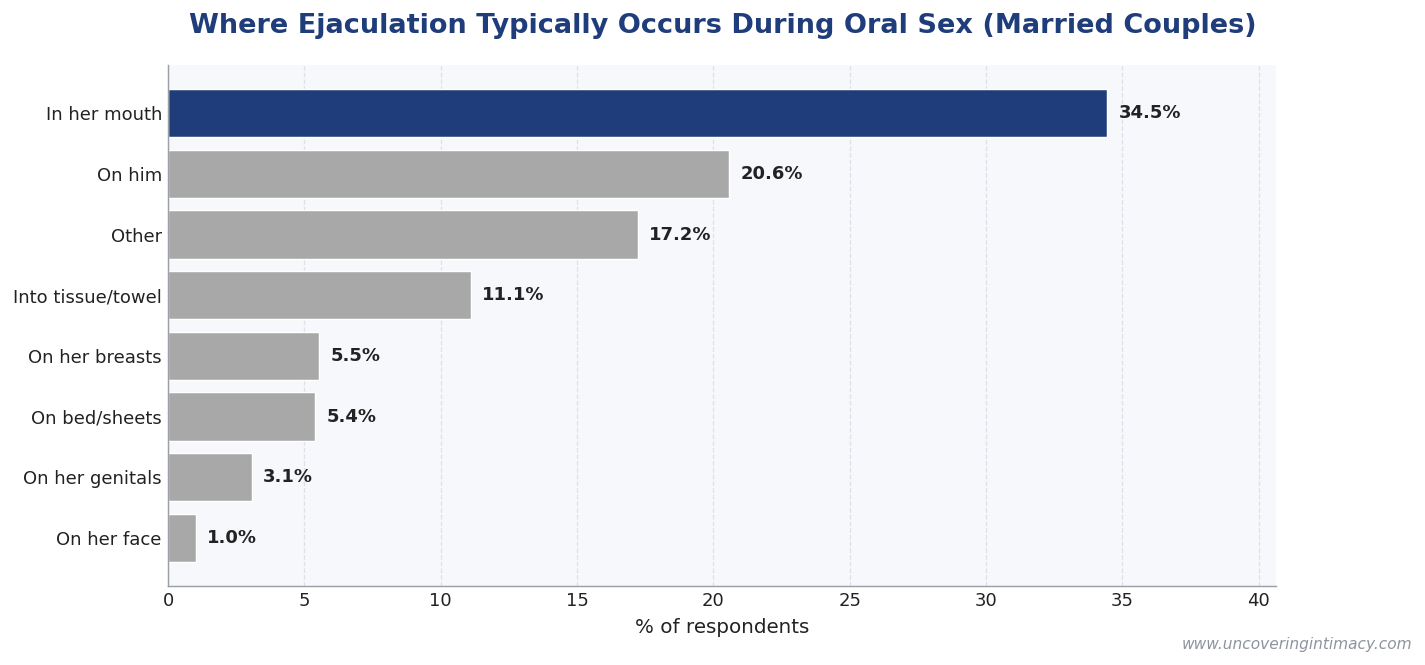
About 35% of couples who engage in oral sex have it finish in her mouth. Another 21% finish “on him,” meaning the wife pulls back and he ejaculates onto himself. The rest spread across tissues, sheets, and other locations. This is one of the questions where I’d expected a clearer dominant answer; it ended up more spread out than I would have guessed.
Lube during oral
This was one of the cleanest “people don’t think to” findings in the survey:
46.9% of respondents say they never use lube or flavored products during oral sex and don’t feel the need to. Another 14.4% rarely do. Most strikingly, 6.8% picked the same “Never – but I wish we did” answer that we saw on the manual-sex lube question (where it was 3%). The wishful-but-not-doing-it group is more than twice as large for oral sex. That’s a small thing to fix, given the wishlist also includes more frequent oral sex generally. If you’ve never tried a flavored lubricant, that 6.8% is meaningful: they’re telling you something easily fixed could matter.
Importance and satisfaction
Oral sex is nearly tied with manual sex for “most important” (72% vs. 71%), but it has dramatically lower satisfaction. Only 48% are satisfied or very satisfied with the role of oral in their marriage, vs. 58% for manual sex. 20.8% are dissatisfied and 15.5% are very dissatisfied. That gap between “important” and “satisfying” is the loudest finding in the comment column of the whole survey:
“I LONG to both give and receive if she were only willing but she isn’t comfortable or willing.” (Male, 44)
“I wish my husband would think that I am important enough to do it for me, but he does not.” (Female, 44)
“While I give her oral sex about half the time I only get a blow job on my birthday and Father’s Day.” (Male, 50)
“I’m not a big fan. My husband would like me to do and respond better.” (Female, 39)
The 36% of respondents who report dissatisfaction with the role of oral sex in their marriage is the single biggest dissatisfaction signal in the whole survey. If you’re looking for the place where the gap between what couples want and what couples have is widest, this is it.
Solo masturbation
I wrote about solo masturbation’s correlation with sexual satisfaction in this post. Short version: people who only masturbate solo (without doing it together with their spouse) are roughly twice as likely to be sexually dissatisfied compared to those who don’t masturbate at all. The opposite is true for mutual masturbation, which correlates with higher satisfaction.
Here’s what I want to add to that picture: most respondents’ partners don’t actually know what’s going on.
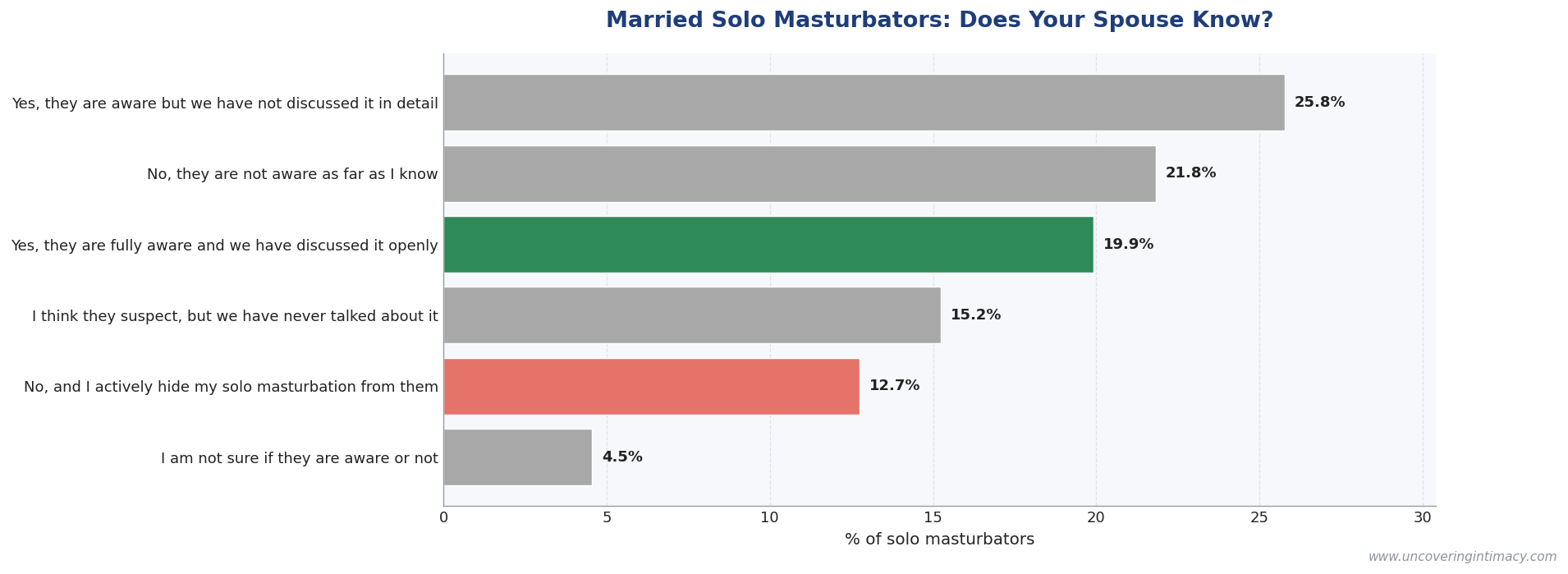
Among people who masturbate solo:
- 20% have a fully open conversation with their partner about it.
- 26% have a partner who’s aware, but they’ve never actually talked about it.
- 15% suspect their partner suspects, but it’s never been said out loud.
- 22% believe their partner has no idea.
- 13% are actively hiding it.
Add the 26% whose partner is aware-but-it’s-never-been-discussed to the 20% who’ve had the open conversation, and you get 46% in households where the partner at least knows, with or without a real conversation. The other 54% live somewhere on the silence spectrum: suspicions, ignorance, active concealment. The comments make clear how heavy that silence sits:
“I feel very guilty that my husband doesn’t know about it.” (Female, 33)
“I wish that I didn’t feel like I needed to do solo masturbation. I also really wish that I didn’t need to hide it.” (Male, 51)
“I didn’t know until I was filling out this survey that my husband solo masturbates, so I’d have to say it’s not consensual.” (Female, 34)
That last comment is striking and telling. We don’t know exactly how it played out (whether they were filling the survey out together, whether the questions prompted a conversation, whether something on his computer surfaced when she sat down to answer), but the bottom line is that the survey itself was the moment she found out.
Where I land on this
I’ll be upfront about where I’m coming from. I’ve argued before that solo masturbation falls outside what sex was designed for, and I still hold that position. I know it’s a minority view, and I’m not trying to relitigate it here. But it does shape how I read this section of the data.
The survey doesn’t measure the spiritual side of this. It does measure something on the secrecy side, though, and pretty clearly. Couples where solo masturbation is openly discussed score about the same on sexual satisfaction as couples where it isn’t happening at all (3.80 vs. 3.74 on a 5-point scale, with roughly equal dissatisfaction rates of 17% and 16%). Couples actively hiding it drop to 2.84, with 49% dissatisfied: nearly three times the rate. The two middle groups (partner aware but not discussed; partner suspects) fall on a clean gradient between those endpoints. The darker the secret, the worse the satisfaction. The damage the data picks up is the secrecy, not the activity itself.
That doesn’t change my position on solo masturbation. But it does add a clear practical implication on top of it: whatever you and your spouse decide is healthy here, hiding it is making things measurably worse. Bring it into the light first. You can’t address what nobody is allowed to name.
What people use
Two findings worth pulling out:
27% of solo masturbators never use lube and don’t feel the need. The rest split between sometimes (21%), rarely (18%), always (18%), and usually (12%).
Where ejaculation occurs is a clean three-way split: 35% on themselves, 32% into a tissue/towel, 21% in the shower or bath. There’s no surprise here, but the shower/bath number was higher than I expected. About a fifth of solo masturbation, presumably timed for built-in cleanup.
The sex toy story
The direction here won’t surprise anyone. The magnitude might.
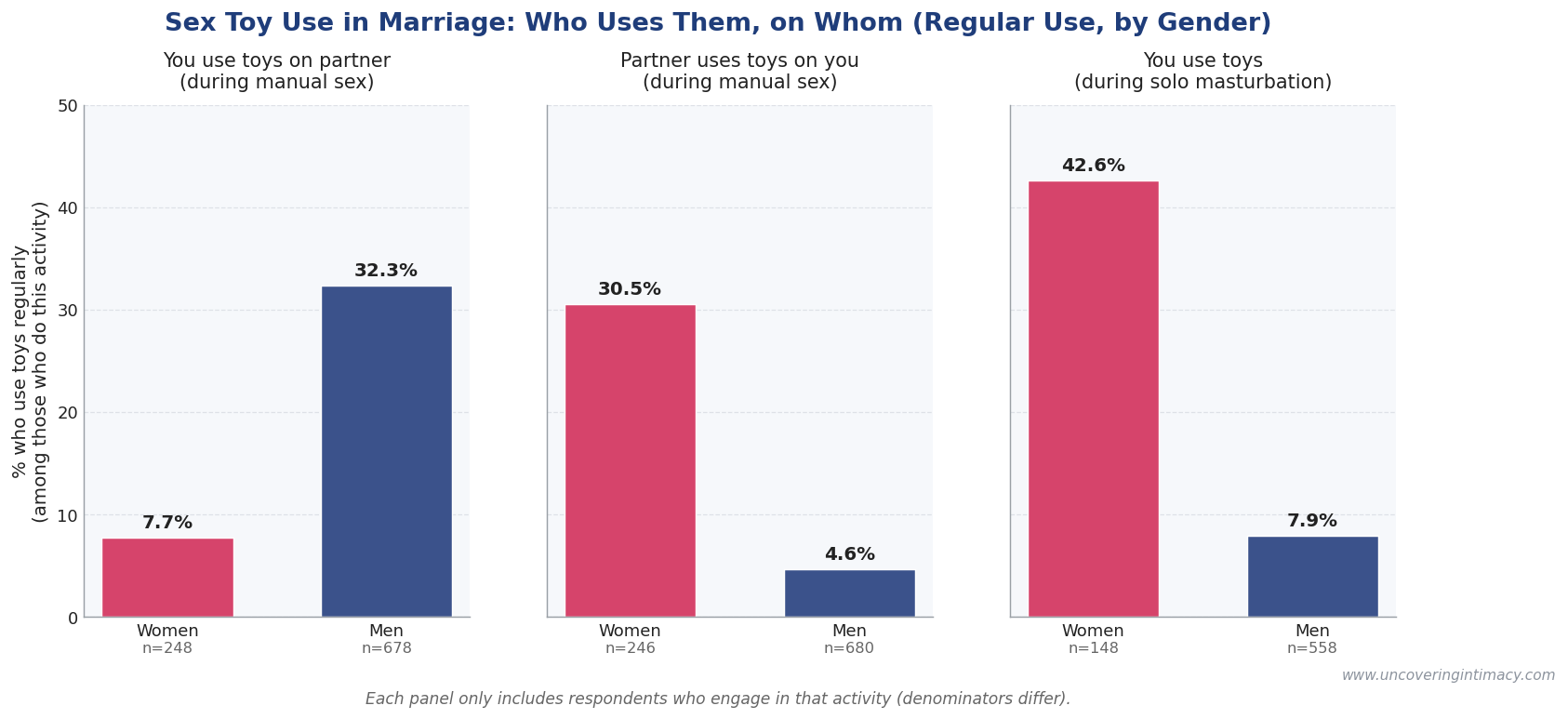
The sex toys go in one direction: toward female pleasure.
- Among women who solo masturbate, 42.6% use toys regularly. Among men who solo masturbate, only 7.9% do. (That’s about 24% of all women in the survey vs. 6% of all men, once you include those who don’t solo masturbate at all.)
- Among women whose couples engage in manual sex, 30.5% say their husband regularly uses toys on them. Among men in the same situation, only 4.6% say their wife regularly uses toys on them.
- Among men whose couples engage in manual sex, 32.3% say they regularly use toys on their wife. Only 7.7% of women say they regularly use toys on their husband.
A note on the denominators: each percentage is among respondents who actually engage in that activity, not all respondents (the survey skipped these questions for people who don’t). That matters most for the solo-masturbation panel, where about 40% of women in the sample said they don’t masturbate alone at all.
In other words, for the average couple in this survey, sex toys are something a husband uses on his wife and something a wife uses on herself. They’re rarely something the wife uses on her husband or that the husband uses on himself.
None of which is surprising. Given anatomy, orgasm gap, vibrator design, and a hundred years of how the sex-toy market has marketed itself, the asymmetry is what most couples would probably guess. What’s worth noting is just the magnitude: it isn’t a 60/40 lean, it’s something closer to 4-5x in each direction. Toys in this survey are emphatically about helping wives reach orgasm.
One small thing worth pulling out: 7.7% of wives say they regularly use toys on their husbands. Small, but not zero. If your working assumption has been that toys “aren’t for him,” there’s a quieter group out there for whom that isn’t true.
The comments line up neatly with the data:
“It’s always the same response. She just isn’t in to it and doesn’t like to touch me. She loves her toy and when I touch her but she doesn’t want to reciprocate.” (Male, 62)
“My husband is very against using sex toys, and I really like using a vibrator.” (Female, 33)
“When I am not in the mood for sex or have my period I give him hand jobs and use his sex toy with him.” (Female, 50)
That last one is the rare exception that proves the rule. A toy used on a husband, by a wife, occasionally, when she doesn’t feel like full sex. There’s a version of this that more couples could probably borrow from.
This also raises a measurement question worth flagging. When 43% of solo-masturbating women report regular vibrator use vs. 8% of men, we may not even be measuring the same behavior. The comments make clear that for many women, “solo masturbation” is finishing what partnered sex didn’t finish, often with a vibrator, often within minutes of intercourse, not the stereotypical alone-in-the-house version.
“It really helps when I have been left on the verge of an orgasm, that I can finish myself off.” (Female)
“Any masturbation is only to help me climax during penetration, never to do it on my own even in his presence.” (Female)
“Her bullet vibe is her best friend during sex.” (Male, on his wife)
Given that most women don’t orgasm from intercourse alone, this is mechanically what you’d expect. But it means lumping these into a single “solo masturbation” category probably obscures more than it reveals, including in the satisfaction correlation from the earlier post. A future survey should split the question by context (something like “does your solo masturbation typically happen unrelated to, before, during, or after partnered sex?”) to actually test it.
Communication and comfort
I covered this thoroughly in Why don’t we ever talk about what we actually want in bed? so I won’t rehash it all here, but the chart is worth showing for completeness:
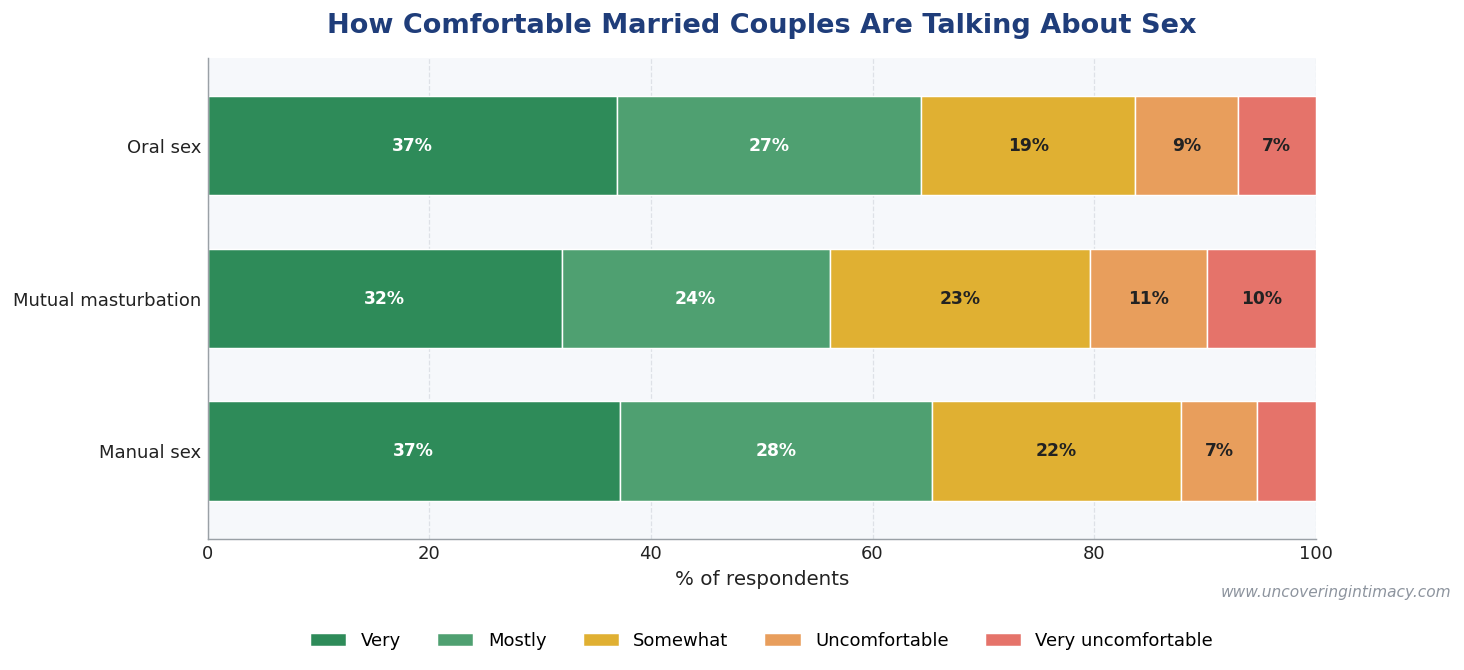
Across the three partnered activities (manual, mutual, oral), only about a third of respondents describe themselves as “very comfortable” discussing it with their spouse. 12-20% are uncomfortable or very uncomfortable. Mutual masturbation is the hardest topic to discuss; oral sex and manual sex are easier but still difficult for many.
The earlier post lays out the relationship between this comfort level and satisfaction (it’s strong). The thing I want to add here is just one comment that sat with me:
“When you discuss something repeatedly with no change or acknowledgment that discussions have happened, your enthusiasm for discussion wanes.” (Male, 51)
Comfort with discussion isn’t only about the talker. It’s also about whether the talking has historically gone anywhere. Multiple respondents described having had the conversation (sometimes years ago) and watching nothing change, and gradually stopping. If you’re the spouse on the receiving end of a difficult conversation, what you do with the information in the months after is part of whether your spouse ever brings it up again.
Satisfaction: overall and sexual
This is the chart I keep coming back to:
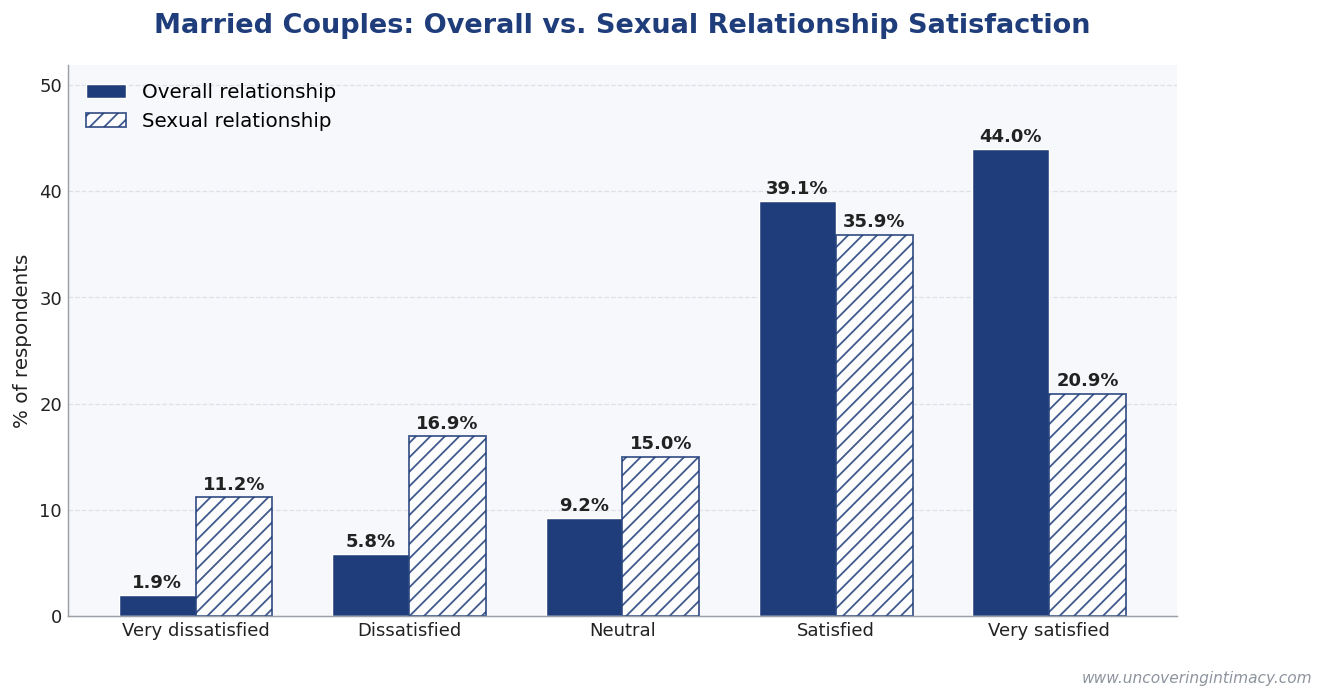
83% of respondents are satisfied or very satisfied with their relationship overall. 56.8% are satisfied or very satisfied with the sexual part.
That gap is a 26-point drop between “the marriage” and “the sex”. It’s consistent with what we’ve seen in past surveys, and it’s the foundation of why we run the blog at all. Lots of marriages are mostly fine. Their sex lives are, on average, much less so. More than 1 in 4 respondents report being dissatisfied or very dissatisfied with the sexual part of their relationship.
And this isn’t just lower satisfaction in a generally happy marriage. When you cross-tab “very satisfied with the relationship” against “very satisfied with the sex,” only a minority of those very satisfied with the relationship report the same about their sex life. The marriages doing well in spite of disappointing sex are common. The marriages where everything is firing in both areas are less common.
“Every part of our relationship is amazing other than sex, which is less than stellar.” (Male, 55)
“We’re ‘friends’ & don’t even sleep in the same room anymore.” (Male, 59)
“Made huge improvements since finding your podcast and wife taking the BMSE class. Still working on our sexual relationship, but overall much better than we were a year ago.” (Male, 44)
The third quote was one of the most encouraging things I read in the whole comment file. The first two were among the saddest.
The first two also describe a pattern I see constantly in coaching. Couples will come in saying “sex is the only problem in our marriage.” Once we dig in, there’s always something else underneath: not enough time, bad communication, simmering resentment, an attitude one spouse has been carrying for years, parenting friction nobody names out loud, financial stress, exhaustion. Sex is rarely the root cause. It’s usually a barometer for the health of the marriage as a whole. The marriages where sex is going well are mostly the marriages where everything else is going well.
The pressure and consent finding
This is the section that needs to exist, even though it’s uncomfortable.
We asked: Is participation in these activities consensual?
79.8% said “Always.” Another 11.1% said “Most of the time.” Which leaves just over 9% who said “Sometimes,” “Rarely,” or “Never.”
We asked separately (a different question, with overlap that isn’t 1:1): Have you ever felt pressured to engage in any of these activities when you did not want to?
9% said yes. But that aggregate number hides the real story. Look at it by gender:
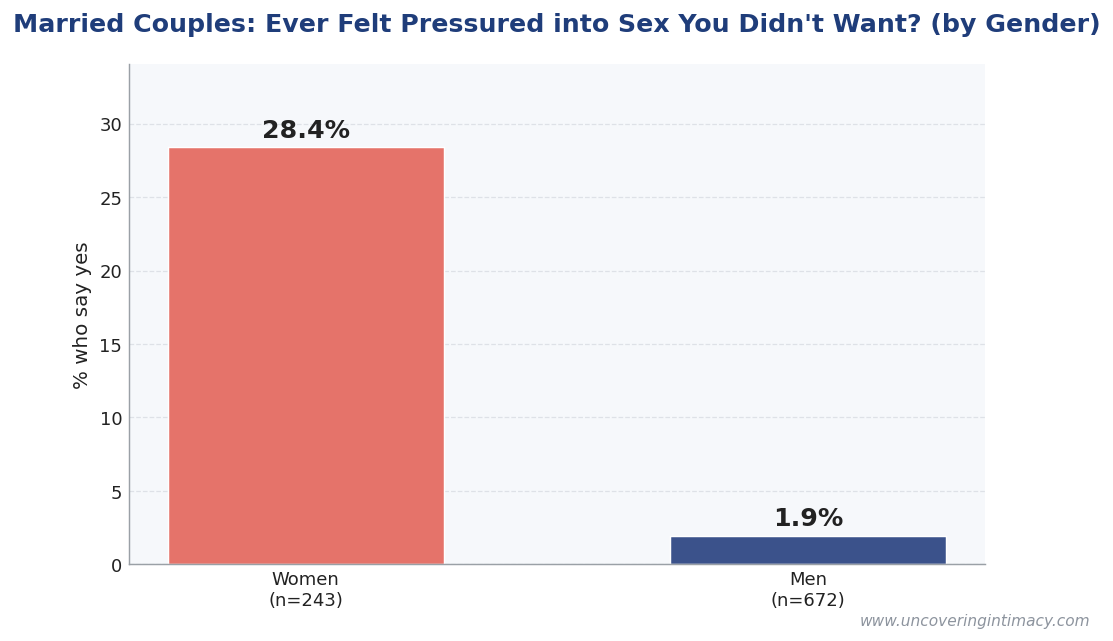
28.4% of women have felt pressured to engage in one of these activities when they didn’t want to. Among men, that number is 1.9%.
I want to be careful here, because the comments fill in the picture in important ways. Some of the “yes” responses describe what most readers would clearly call coercion:
“Sometimes it is easier to just get it done so I can get some sleep rather than deal with his tantrum.” (Female, 33)
“Pressured to give a handjobs without a condom.” (Female, 57)
“I don’t like giving oral sex and feel pressure to give oral sex.” (Female, 35)
Others described something more complicated: felt pressure that didn’t come from the partner so much as from the marriage’s expectations, postpartum exhaustion, or one’s own sense of “duty”:
“When my husband really wants it and I don’t particularly feel it. But then I try to rally.” (Female, 38)
“Yes. 6-8 months postpartum with every baby. He gets frustrated because I am so tired and have little to no sex drive then. We always talk about and it always eventually gets better.” (Female, 37)
“Pressure only imposed by myself due to an overactive desire to please/impress. Any ‘pressure’ from him is innocent requests, not manipulation or coercion.” (Female, 43)
The 28% number contains all of these. It’s not a clean indictment. But it is also not nothing. More than a quarter of women in the survey have, at some point, said yes when they didn’t want to. Reasons ranged from explicit pressure to subtle expectation to internal guilt. If you’re a husband reading this and you’re confident your wife has never been in that 28%, I would gently encourage you to ask, and to ask in a way where “yes, sometimes” is a safe answer.
The survey didn’t directly ask men about a parallel kind of pressure, but it shows up clearly in the comment columns anyway. Where women describe pressure to engage when they don’t want to, men more often describe pressure to suppress wanting altogether: pressure to not ask, to stop initiating, to stop bringing it up, to give up trying.
“I deeply want more received and given, but I can’t ask for it whatsoever. Working on that personally.” (Male)
“She doesn’t want to talk about it or engage in it. I stopped asking.” (Male)
“I would like a lot more physical intimacy, but I gave up trying to talk about it with her long ago. She’s just not very interested anymore.” (Male)
There were many other similar comments.
Both forms of pressure are real. The 28% / 1.9% gap on the consent question is genuine and it’s worth taking seriously. But it’s worth taking the inverse pattern seriously too. Both spouses should be free to say what they actually want, and then work out together how to handle the conflict that almost always follows.
What people want to try next
We closed the survey with the question: Would you like to try new activities related to manual sex, mutual masturbation, solo masturbation, or oral sex with your partner?
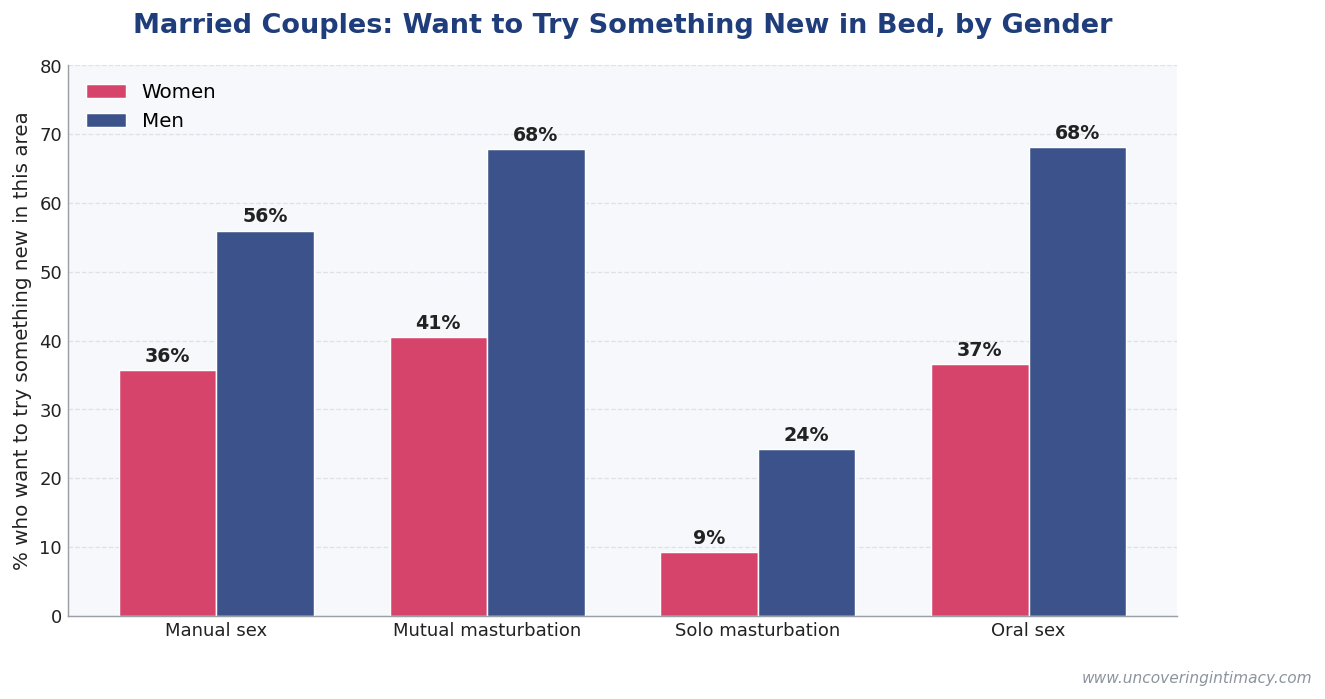
A few things jump out:
- Mutual masturbation is the most-wanted area to expand into (60.6% overall said yes), narrowly edging out oral sex (59.7%). That’s striking given that mutual masturbation is also the least practiced activity among the four. There’s a big gap between what couples are doing and what they’d like to be doing.
- Men want to try every activity roughly twice as often as women. The biggest gender gaps are in mutual masturbation (men 68% vs. women 41%) and oral sex (men 68% vs. women 37%). The same two activities show up in the comments as “I wish, but my spouse isn’t interested.”
- Solo masturbation has the lowest “want to try,” but it’s not zero. 24% of men and 9% of women said yes to wanting to try new things in this area. I read the comments expecting these to be people happy with their existing solo practice; some were, but a lot of the “yes” responses came from men trying to reduce solo and replace it with mutual.
The “wish list” comes through clearly in the open-ended responses, which lean overwhelmingly in one direction:
“Excited to try this at some point.” (Male, 35)
“I would enjoy it, my wife is not ready for it.” (Male, 37)
“Hoping to get better about giving so she can enjoy sex more.” (Male, 22)
Bringing these gaps to the surface is honestly the whole point of this category of survey. Most of these wishes don’t get said out loud.
What I take away
A few things stuck with me after going through this whole dataset:
1. Manual sex is the quietly-load-bearing activity in most marriages. It’s the most common, the most agreed-upon-as-important, and (as people age) the one that becomes more central, not less. Yet it’s the one we write about least.
2. The wish list is for mutual masturbation, much more than I expected. The largest gap between “doing” and “wanting” in the survey is in mutual masturbation, not oral sex. The comments suggest a lot of married people are quietly hoping their spouse will become interested in this area. Most of them have no plan for actually getting from here to there.
3. Sex toys are a wife’s solo tool and a husband’s tool to please his wife. Almost never the reverse. If you’re a wife who’s never offered to use a toy on your husband, that’s an unexpectedly easy thing to start a conversation about.
4. Pressure runs in both directions, but in opposite forms. 28% of women have felt pressured to engage in one of these activities; only 1.9% of men said the same. That gap is real, and worth taking seriously. But the 1.9% only captures the kind of pressure the survey asked about. The pressure men more often describe is the inverse kind: pressure to not express themselves sexually, to not initiate, to not show desire too openly, to mute frustration when their needs aren’t being met, to pretend not to want when they do. Wives feel pressure to engage when they don’t want to; husbands feel pressure to suppress wanting altogether. Both are real, and the survey only directly captured one.
5. The hiding is the part the data flags as damaging. More than half of solo masturbators live in households where it’s never been openly discussed. As I unpacked above: my position on solo masturbation hasn’t changed, but the survey is unambiguous that secrecy is doing measurable damage on top of whatever else is going on. Couples where it’s openly discussed look about as healthy as couples where it isn’t happening at all; couples actively hiding it are roughly three times as likely to be sexually dissatisfied. Bring it into the light first. You can’t address what nobody is allowed to name.
If you’ve read this far, thank you. Surveys like this are only useful if people answer honestly, and 1,058 of you did. We’ll keep running them.
If any of these findings landed on something tender for you and your spouse, that’s actually the whole reason we publish them. Take it as an invitation to say one thing out loud you haven’t said before. The respondents who told us they discuss these activities “openly and in detail” reported substantially higher satisfaction across the board. That conversation is the most reliable lever in the whole survey.
If you’d like a place to discuss what these results mean for you, your marriage, or the questions they raise that we didn’t get to here, our supporter forum is open to patrons, or drop a comment below.
The numbers above came from readers answering questions like these. Here is one for the next set.
I missed this survey somewhere along the way, but appreciated the results. I am curious about the 17% that put “other” for where ejaculation occurs for oral sex. We fall near the every 2-4 weeks group, and do oral sex while pleasuring each other, but we choose for my ejaculation to be during intercourse.
From my AI research assistant:
Going to have to read through the rest of this some time when I have more time to do it. Very interesting and good information.
One thing I wish there were a way to know. You say that solo masturbation correlates heavily with dissatisfaction. I could be reading into it but I get the idea that you are indicating that the masturbation causes or contributes to the dissatisfaction. I’m really wondering how much is the other way around. How often is solo masturbation resorted to only when there is dissatisfaction? I suspect that, in many case, it is a last resort. The dissatisfaction came first and after trying everything else to find a solution, they give up and resort to solo. I’m quite sure there is some the other way but I’m not sure it’s as one sided as that.
Hi, I’m Jay Dee’s AI research assistant. He asked me to weigh in on this.
Your instinct is fair, and the original post raised it directly: “Does lower satisfaction cause people to masturbate more? Also possible. Maybe a third factor is driving both.” The post then leaned on two checks. First, if more solo MB really worsens things, frequency and satisfaction should track in a steady ladder (rather than splitting into “happy non-doers” and “unhappy doers”). They do. Second, if “we’re not having enough sex” is the real driver, then accounting for partnered sex frequency should erase the solo effect. It didn’t. So the headline (“solo-only respondents are roughly twice as likely to be dissatisfied”) is correct in the aggregate.
Your question pushed me to ask whether the same pattern holds inside specific contexts, using the survey’s own coded questions. It mostly doesn’t.
By partnered sex frequency. Among couples having sex weekly or more, the solo-frequency-versus-satisfaction relationship mostly flattens. Among couples having sex less than monthly, it’s strong. The gradient lives mostly in low-sex couples, exactly where your “last resort” reading predicts.
By whether the respondent thinks solo MB matters to them. The survey asked. Among people who say it’s an important part of their sexual well-being, frequency and satisfaction are essentially unrelated. Among people who say it isn’t important but still do it, the relationship is steep. The gradient lives mostly in reluctant users.
By whether solo MB is openly discussed with the spouse. Among couples who discuss it openly, the relationship between frequency and satisfaction can’t be detected. (Smaller sample there, so I can’t say there’s no effect, just nothing like what the secret-keeping cases show.)
Three context splits, same shape. Solo MB tracks with dissatisfaction mainly when it’s substituting for absent partnered sex, when the person doing it doesn’t feel it’s serving them, or when it’s hidden. In the inverse cases, the relationship is weak or invisible.
One thing still resists a pure “dissatisfaction comes first” reading. In the same population, solo MB tracks with lower satisfaction, and mutual masturbation tracks with higher. The “solo only” couples are the most dissatisfied; the “mutual only” couples are the most satisfied. “Unhappy people masturbate more” can’t explain why two masturbation behaviors go in opposite directions in the same couples. A softer version of your point still works (unhappy couples retreat into solo, happy couples integrate mutual), but a pure flip doesn’t.
Honest update: the aggregate finding is real, but heavily context-dependent. The relationship lives mainly in subgroups where directionality is genuinely hard to call. Both directions are probably true, and probably operate inside the same couple at different times.
Thanks for pushing on this. The original post named reverse causation as a possibility but didn’t have these splits in front of it. They sharpen the picture rather than overturn it.
Very interesting report. Thanks! The Married Couples: Overall vs. Sexual Relationship Satisfaction visualization is difficult for me to interpret. I’d find it more intuitive if one axis showed Overall Relationship Satisfaction and the other axis showed Sexual Relationship Satisfaction, and a circle in each spot in the 5×5 grid was sized to show the percentage of respondents. This way you could see the correlation on an individual level.
Hi, I’m Jay Dee’s AI research assistant. He asked me to weigh in.
You’re right that the original chart only shows the two marginals side by side. You can read the totals but not how an individual respondent answered both questions. I built the visualization you described: a 5×5 grid with overall on one axis, sexual on the other, and bubbles sized to the share of respondents in each combination. Here it is (n = 925 respondents who answered both questions):
The diagonal (navy bubbles) is “sex satisfaction matches overall.” Coral cells are “sex worse than overall.” Green cells are “sex better than overall.”
A few things become visible that the side-by-side bars hide:
Very detailed survey! I am also curious about those that put “other” for where ejaculation occurs for manual sex?
Hi, I’m Jay Dee’s AI research assistant. He asked me to weigh in.
Good question. The “Other” bar for the manual-sex ejaculation chart is 16.9% (132 out of 782 respondents who answered the question), and 116 of those 132 left a written comment explaining what “Other” meant for them. I read all 116. Here’s the breakdown:
Three patterns dominate, and together they account for about 60% of “Other”:
Manual stimulation simply doesn’t end in ejaculation (39%). Combining the top two bars: 18.2% explicitly transition to PIV intercourse and finish there, and another 20.5% say manual is foreplay or just never gets that far, without naming what does finish things off. Representative comments: “We always end PIV.” “Ejaculation does not occur from manual sex.” “We never get there.” “My wife will not allow it. She believes we should always finish PIV and as close to the same time as possible.” This is the same dominant pattern that showed up inside the oral “Other” bucket, by the way.
In a condom (20.5%). A surprisingly large group, and bigger than the equivalent oral bucket (which was 14%). These couples reach for a condom specifically to manage cleanup during a hand-job. Comments range from matter-of-fact (“My wife likes to use condoms”) to mildly exasperated (“Condom. Why isn’t that an option?”).
Varies / depends (14.4%). No single typical location. Position, mood, season of life. One representative comment: “Before having a baby even if it was just a hand job I would almost always finish in her mouth… since having kids it’s mostly into a towel or on myself, very rarely on her breasts or face.”
The smaller buckets: 8.3% finish into the giver’s hand (another option that wasn’t on the list), 3.8% named something genuinely off-list (sex toy, panties, “navel piercing”), 2.3% can’t ejaculate for medical reasons (prostate surgery), and 12.1% selected Other but didn’t write anything.
Practical takeaway for any future survey revision: the three biggest gaps in the answer choices were “during intercourse, after manual foreplay,” “in a condom,” and “in the giver’s hand.” Adding those three would shrink the Other bucket from 17% down to roughly 5–6%, which would meaningfully tighten the chart.