Nude beaches, explicit movies, lifestyle resorts: where’s the line for a Christian couple?
Podcast: Play in new window | Download | Embed
Subscribe to the Podcast: Apple Podcasts | Spotify | Amazon Music | Android | iHeartRadio | Podchaser | Email | TuneIn | Deezer | RSS | More
A reader wrote in a few weeks ago with a question. She has been married over twenty years, she says their sex life is better than it has ever been, they’re both devout and involved at church, and her husband keeps introducing things into their sex life that she isn’t sure about.
She asked two questions. Are these things okay? And how am I supposed to decide? I’ll answer both, because the second one will still matter long after this particular list is behind her.
Here is her question as she wrote it, shared with her permission and with identifying details changed to protect her privacy:
I ran across your podcast ministry and have been very grateful and I’m thankful. My husband and I have been married for 20+ years. Thankfully our love making has gotten more exciting than ever before as we continue to learn and grow together. We both really enjoy sex. The problem is that my husband wants to do things that I’m just not sure if it is ok. I have tried all of these things and do end up enjoying them and feel that is what has made sex more exciting, but part of me really wonders if it is honoring God. The following is a list of questionable things.
1) Going to a nude beach (neither my husband or I look at others lustfully, we just really enjoy sunbathing in the nude and it is exciting being naked together somewhere other than our bedroom).
2) listening to sexy music that says words like “fuck, pussy, bitch, etc” definitely X rated graphic songs. But we use them in the context of making love.
3) watching sexy movies together that involve sex scenes showing full naked bodies. Again not in a lustful way but in a way that we enjoy as a couple and heightens our intimacy.
4) This next one my husband planned without my knowledge and just happened a few weeks ago. I was super hurt at first because we didn’t talk about it but we ended up having a lot of fun. We went to a “clothing optional” resort. We were naked a lot of the time and infront of people, or wore very sexy clothing (even lingerie type to the club at night) This was a new experience and as the week went on we warmed up to it. Again, neither of us were lustful, it only enhanced our excitement for each other. At this resort you could also have sex publicly. We had made some friends and ended up both having sex with our own partner next to each other. Many people at the resort were swingers. This couple and us were not ok with that. I did kiss the girl and touch her boobs but not in a lustful/attractive way but rather as part of the sensuality to enhance the love making with my husband (sounds weird and hard to explain. I know homosexuality is wrong and don’t want to cross that line but this was more of us being friendly type thing. Not sexual towards each other)
All of these activities have been recent starting with the nude beach about 5 years ago. Obviously things have intensified, since the resort was another level. My husband and I are both devout Christians and involved at church. My husband is always the one pushing all of these things (no he does not look at pornography, I’ve asked often and believe him). I’m the one always hesitant. He talks me into it. He also justifies it all saying we are not sinning because we aren’t looking lustfully or having sex with other people. He’s talking about booking a cruise and inviting this couple we met to come with us.
I’d love to hear what your thoughts are about these activities if they are wrong or how to make that decision and scripture to back it up.

The short answers
You asked for my thoughts on each one, so here they are.
The nude beach. If what you enjoy is the sun and the freedom, that’s one conversation. But you said it’s exciting being naked together somewhere other than your bedroom, and if part of that excitement is being seen, or the chance of being seen, then other people have become part of your sex life. That’s using them, even if you never look back. I wouldn’t put myself there. I’ll admit this is the item on your list where sincere Christians land in different places, which is one reason I care more about how you decide than about public nudity in general.
The explicit music. Honestly, I’m less sure here. I don’t think the words themselves are the main issue; the attitude behind them matters more. Crude is one thing. Lyrics built on contempt for the other person are another, and I’d steer clear of those. My practical concern is that what you get used to in private can creep into how you talk elsewhere. Of the four, this concerns me least, partly because nobody else is being brought into your bed. Still, be careful.
The explicit movies. When you say watching naked bodies on screen heightens your intimacy, other people’s bodies are doing some of the work in your sex life. If you’re watching to get excited, I don’t know how to call that anything other than lust, however much you love each other while it’s happening.
The resort. I believe this crossed a line, and it’s the one I’m most concerned about. Not mainly because of the nudity, but because of what happened there: sex in front of another couple, and your kissing and touching another woman as part of it. I’ll come back to that.
“We weren’t lusting” is the wrong test
Every step has been justified the same way: it isn’t sin, because we aren’t lusting and we aren’t having sex with anyone else.
The trouble is how narrow that definition is. You’ve now actively involved other people into your sex life – whether or not you had “sex” with them. I’d argue the kissing another woman and touching her breasts constitutes as part of your sexual activity – you used it as a foreplay. This is clearly sexual contact outside your marriage.
That’s my real problem with the “not lusting” argument. It doesn’t actually draw a line; it moves the line wherever you subjectively feel you want it to be to justify your actions.
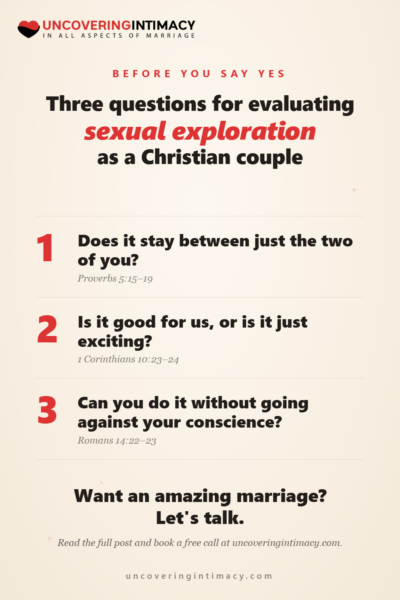
How to decide: three questions
You asked how to make the decision and for scripture to back it up, and that’s the question I most want to help with, because I won’t be there next time and there will always be a next thing to say yes or no to.
I’ve written before about the basic test for what Christians can do in the bedroom: one man and one woman, within marriage, and both consensual and non-harmful between the two of you. Those still hold, and the resort strains them. Another woman became part of your sex life, which steps outside “one man and one woman.” And it was a trip you didn’t get a say in, which at the very least puts pressure on “consensual.”
So, here are three questions to help flesh out that framework with Bible verses, as requested:
1. Does it stay between the two of you?
Sex was designed as a closed circle. Two become one flesh.
“Drink water from your own cistern, flowing water from your own well. Should your springs be scattered abroad, streams of water in the streets? Let them be for yourself alone, and not for strangers with you. Let your fountain be blessed, and rejoice in the wife of your youth, a lovely deer, a graceful doe. Let her breasts fill you at all times with delight; be intoxicated always in her love.” (Proverbs 5:15-19, ESV)
That passage isn’t only a list of don’ts. It calls a husband to faithfulness and to delight in his own wife, and it presents that as something good, not something grudging. But notice verse 17: “for yourself alone, and not for strangers with you.” Not “don’t have sex with strangers.” Don’t share it with them.
Paul makes the same point from the other side:
“For this is the will of God, your sanctification: that you abstain from sexual immorality; that each one of you know how to control his own body in holiness and honor, not in the passion of lust like the Gentiles who do not know God; that no one transgress and wrong his brother in this matter.” (1 Thessalonians 4:3-6, ESV)
Sexual holiness, for Paul, includes not wronging other people with your sexuality. Another couple, another wife, a room of onlookers: those are other people. And even if they consent and want to engage in immoral behaviours, like watching someone else have sex, you shouldn’t help them in that.
2. Is it good for us, or is it just exciting?
“‘All things are lawful,’ but not all things are helpful. ‘All things are lawful,’ but not all things build up. Let no one seek his own good, but the good of his neighbor.” (1 Corinthians 10:23-24, ESV)
“All things are lawful” was a slogan the Corinthians were using to justify themselves, and Paul answers it rather than endorsing it. Even for things that aren’t already ruled out, he says the test isn’t only “is this allowed?” but “does it build up?” And the person you’re supposed to be looking out for isn’t yourself. It’s the other person. Not your own thrill. Your spouse’s good.
3. Can you do it without going against your conscience?
“The faith that you have, keep between yourself and God. Blessed is the one who has no reason to pass judgment on himself for what he approves. But whoever has doubts is condemned if he eats, because the eating is not from faith. For whatever does not proceed from faith is sin.” (Romans 14:22-23, ESV)
Paul was writing about food and holy days, but the principle carries. “Condemned” there means in the wrong in that act, not sent to hell for having a question. His point is that if you go ahead with something while your conscience is objecting, you’ve done wrong even if the thing itself were neutral, because you had to override your conscience to get there. A conscience isn’t infallible. It can be too tender or too dull. But it’s not something to talk yourself past, and it’s not something someone else gets to talk you past either.
You wrote a long, careful email to a stranger asking whether this honours God. That tells me your conscience has something to say. It deserves to be heard.
Where this road goes
Look at the direction of your list. It started with a nude beach about five years ago, and by your own description things have intensified since. Explicit music, explicit films, a resort where you had sex beside another couple, making out with another woman, and now a cruise with that same couple.
Each step made the next one feel smaller. That’s the pattern I watch for, because what felt like a big step last year becomes the baseline this year, and the next thing has to be bigger to feel the same. Your husband’s rule says the line is intercourse with someone else. But each step has moved you closer to that line, not further from it, and a cruise with the couple you were already intimate beside (and arguably with) is a lot closer.
You’ve already had sex in the presence of other people, I would be shocked if you don’t progress to soft-swapping next (manual/oral sex – basically anything but intercourse with each other’s spouses), and I highly doubt that in a highly sexually charged situation, that you won’t shift your boundary further and it will move to “No sex with other people unless we’ve both present”, and then “unless we talk about it first”, and then “unless you tell me about it later”, and then “unless we’ve vetted the people”. This is how the progression often goes in these situations.
The part I’m most worried about
What stood out most in your email is that you are being pushed further and further, and you just keep going along with it.
Your husband planned that resort trip without your knowledge, and you were hurt that you hadn’t talked about it. You describe yourself as always the hesitant one, and him as always the one who talks you into it, with the same argument each time.
This is the pattern, and the pattern will likely continue until one day the marriage is destroyed because your husband is chasing a sexual high, and you don’t have boundaries in place to stop it.
Of the couples I’ve worked with who went down this particular road, only a handful came out the other side with their marriage intact. Most who believed they’d be the exception weren’t.
What I’d do
Don’t book the cruise. Not “let’s set some rules first.” Just don’t.
You don’t need to win a theological argument to say no. “No, I don’t want to do that” is a complete sentence. If you want something firmer: “No, I’m not doing that again. But I do want to work on us.” You don’t have to re-argue it every time he raises it. Saying no to being persuaded isn’t the same as refusing to talk.
Then you have to have a talk together about where this is heading, because you clearly are wrestling with it and uncomfortable with it. The choice is up to you – but follow your convictions and do things intentionally, don’t just be led into something that one day you might regret.

If you’re the one pushing
Some readers will see themselves in the husband here. A few men in our forum honestly did.
If your spouse only agrees after you’ve persuaded them, stop. Make room for an answer they can give without pressure, and accept a no as readily as a yes. And if your case for the next step is always “it’s not technically sin,” ask yourself whether you’re building your marriage or arguing for a loophole.
Now, this is very different from a spouse that’s just generally uncomfortable with trying new things sexually and then realizing they like it after the fact. I’m not saying never be open to being persuaded to trying new things – but if it’s a moral conviction, that’s not something you should be persuaded to set aside. If you want to do a study together with the purpose of finding the truth (not winning the argument), then by all means, go ahead and do that. But if the words “it’s not technically a sin” ever comes out of your mouth, then your heart is not in the right place.
Our goal as Christians should be to flee sexual immorality – not walk up to the line, look at God and say, “I’m not touching it” like a 5-year-old does.
Your hesitation isn’t the problem
You’ve been the hesitant one, and you’ve been talked past it again and again. It would be easy to start treating that hesitation as a flaw, as being uptight, as the thing to get over.
It isn’t. It’s worth listening to, and you’re free to stop and take time with it before anything else happens.
Want the framework on one page? I wrote up the three questions my wife and I actually use when something new comes up, in What’s actually off-limits in the marriage bed? It’s free, and it will still be useful the next time someone suggests something new.
If this one hit close to home, you might also want to read Do spouses have the right to specific sexual acts?, Is it okay for a Christian couple to ‘expand’ their sexual circle? and Can Christians have threesomes?
I don’t think going to a nude beach or watching a movie with erotic scenes is a problem on its own. Most Christians have a very distorted view of what constitutes “lust”. Long story short it’s a form of coveting, not merely seeing someone naked and enjoying what you see. If the questioner or her husband started trying to make concrete plans to seduce people then that’s a different story. The bigger issue is being pushed into something you aren’t comfortable with.
As for using vulgar language or listening to sexually explicit music, also no problem. Time, place, and context matters.
In the bedroom and the heat of passion, how else are you going to refer to certain body parts and acts? Your other choices are to use cutesy euphemisms or use medical terms. Neither option is very “sexy”. You’ll sound like a child or a medical textbook.
The swingers’ resort is a whole other can of worms. If the questioner isn’t comfortable with it then she shouldn’t let her husband pressure her into going. The husband definitely crossed a line by booking a trip there without her knowledge.
I agree it’s a form of coveting – you have to want.
So, if you see someone who is beautiful – that’s not a problem to notice. However, when you decide you want to see someone who is beautiful – there’s the problem – you want to see them because of their beauty.
Now, if you’re watching a movie and a scene comes up – I would say that’s different than going to look for movies with steamy scenes – because your intention is there – you are seeking it out. You want (covet).
“You have heard that it was said, ‘You shall not commit adultery.’ But I say to you that everyone who looks at a woman with lustful intent has already committed adultery with her in his heart.” – Matthew 5:27-28
I’m curious about your stand on the swingers’ resort – is your only contention that she’s not comfortable? If she was comfortable, then you’d be okay with it?
Matthew 5:27-28 is a reference back to Exodus 20:17. It’s rather obvious when you read both verses in Greek (in the Septuagint for the case of the Exodus verse). Christ isn’t inventing the concept of ThoughtCrime here.
Paul also affirms this in Romans 7:7: “for I had not known lust, except the law had said, Thou shalt not covet”.
Same Greek word in all 3 verses. There is something a lot deeper intended by the word “coveting” than merely viewing artwork or films with nudity or even going to a nude beach. The common misunderstanding of that one verse in Matthew has created a lot of false guilt and religious neurosis.
Some couples claim that swinging or other forms of Ethical Nonmonogamy have been beneficial for them. Others say different. The common statement I’ve seen from people who have had positive experiences is that you have to have an extremely strong relationship before you even think of doing it.
If her deceived her into attending a swingers’ resort and is pushing her into things she isn’t comfortable with , then that’s not a sign of a healthy relationship. That’s the most pressing issue, no?
Yes, it’s obvious that it’s a callback to the 10 commandments. I don’t think anyone disputes that, nor would anyone be surprised by that – you don’t need the Septuagint to figure that out. I’m not sure why you brought it in, but I’ll bite.
Yes, it’s the same word (epithymeō) in all three verses, and Jesus is pointing straight back at the tenth commandment. But I’d say that makes my point. Of the ten, it’s the one commandment about the heart rather than an act. If coveting only counted once you acted on it, it would just repeat “you shall not commit adultery” and “you shall not steal.” It doesn’t. It goes after the wanting itself.
And Matthew 5:28 is careful about that: the man looks “pros to epithymēsai,” for the purpose of desiring, and the adultery happens “en tē kardia autou,” in his heart. Romans 7:7 lands the same way. Paul isn’t saying the law caught his actions. He’s saying the command exposed the desire already living inside him.
It’s also the same move Jesus makes a few verses earlier with murder: you’ve heard “do not murder,” but anyone who is angry with his brother is already liable. Six times in that chapter it’s “you have heard… but I say to you,” and every time he takes the command from the hands to the heart. That isn’t thoughtcrime. Nobody is being prosecuted. It’s what Scripture has always said: God looks at the heart (1 Samuel 16:7), and adultery and coveting start there before they ever reach the hands (Mark 7:21-23).
You’re right that a bad reading of Matthew 5 has piled false guilt on a lot of people, especially young men. Noticing that someone is beautiful isn’t lust. Choosing to look in order to desire is.
On the most pressing issue, I’d disagree. She asked whether these things are moral, so that’s the question I answered. Being deceived into that trip is obviously wrong. Nobody needs to ask whether that’s okay, and the post touches on it.
As for swinging, I’ve written about it before (https://www.uncoveringintimacy.com/can-christian-couples-swing/) and my answer hasn’t changed: sex with someone other than your spouse is adultery, however strong the marriage. Two become one flesh, not four.
Wow, you answered this email well! So much honest truth. Thank you for being a voice of reason and hopefully, helping this couple out of the mire they’re in.
Thank you!