6 reasons sex can be harder to talk about than to have
Podcast: Play in new window | Download | Embed
Subscribe to the Podcast: Apple Podcasts | Spotify | Amazon Music | Android | iHeartRadio | Podchaser | Email | TuneIn | Deezer | RSS | More
A few weeks ago I spoke to a group in Kansas and offered to answer any questions they had. A lot of them emailed theirs in. I got to many of them during the talk, but not all, so I promised to answer the rest afterwards. This was one of them:
Why do husbands and wives often struggle to talk about sex, even though they’re comfortable having it?
It’s sort of weird, isn’t it? Even weirder: I have an easier time talking about sex in front of a room full of strangers than I do talking about it with my wife. Don’t get me wrong, we still do talk about sex, and fairly often, but it’s definitely more uncomfortable.
I also notice that when I’m excited to share something I learned about sex (some data correlation I found, something new about hormones, a new thought I had on the theology of sex), that’s easier than talking about my own experience of sex.
And it’s not just me. In our “Talking about sex with your spouse” survey, 919 people told us how often they have sex and how often they talk about it. About 71% said they have sex at least once a week. Only 39% said they talk about sex at least once a week. And 27% said they almost never talk about it, or never have had a conversation about sex.
So, today we’re going to explore six reasons I think that talking about sex can be harder than having sex, and then what you can do about it.
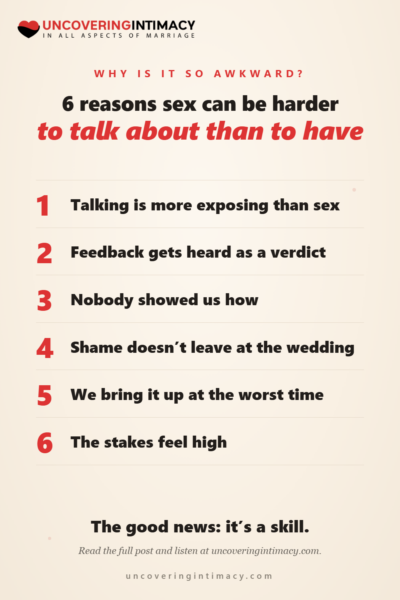
1. Talking about sex is more exposing than having sex
I think the big reason is that it’s vulnerable. More vulnerable than having sex, actually.
Sex is vulnerable, but it’s not always fully vulnerable. It’s a lot of body, and some of your mind. When you talk about it, though, you’re opening up something even more intimate: who you are, and what you think, feel and believe about an intimate topic.
In bed, actions can stand in for words. Things can stay a little vague. You can shift, nudge, make a noise, and hope your spouse picks up on it. If they don’t, nothing was really said, so nothing was really turned down.
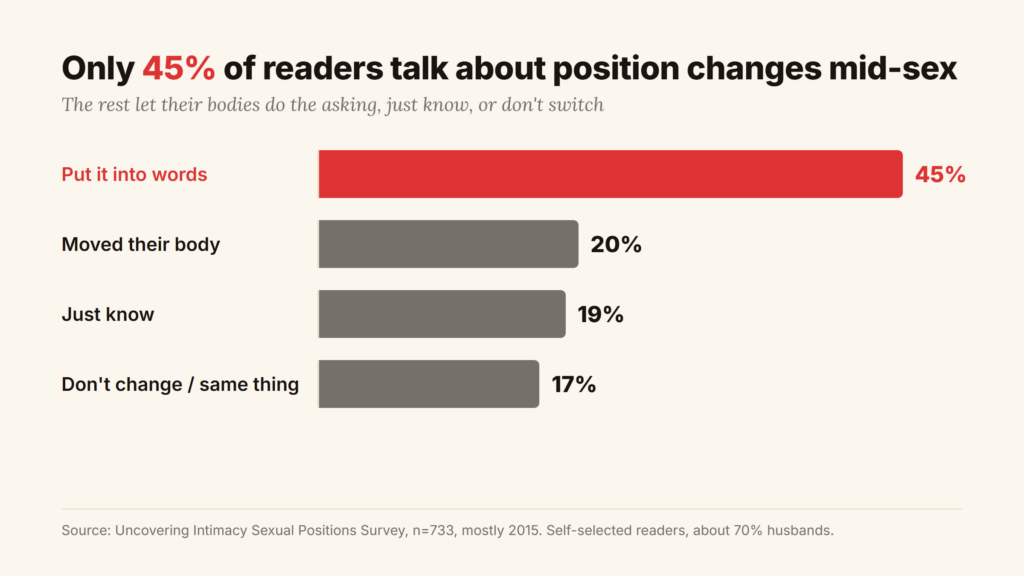
In our sexual positions survey, only about 45% of the 733 people we asked said they talk about position changes during sex.
Saying “I’d like more of this” or “that doesn’t work for me” takes vulnerability. Now there’s a clear request on the table, and your spouse could potentially say no to it.
That is scary, because we’re afraid what we share won’t be accepted, and by extension, that we won’t feel accepted. In other words, the risk is greater, and so we’re more scared.
Genesis 2:25 describes the first marriage like this: “And the man and his wife were both naked and were not ashamed.” I don’t think that was only about bodies. Being known all the way through, mind included, without shame, is part of what God designed marriage for. Most of us find the physical half of that easier than the rest.
I think this is one of the reasons hookup culture exists now, because once you remove the societal shame, sex is easy compared to a relationship. It’s not as fulfilling, but we don’t talk about that, do we?
2. Feedback gets heard as a verdict
Even when you do get the words out, they often aren’t heard the way you meant them.
“Could we try it a little differently?” is a pretty mild sentence. But to the person hearing it, it might sound like “you’re bad at this” or “you’re doing it wrong”, particularly if they have rejection sensitive dysphoria (RSD). Sex is tied up with how we see ourselves as husbands and wives, so a small suggestion can feel like a grade on your whole performance.
Neither spouse wants to hurt the other, so both stay quiet, and the thing that could have been fixed in one conversation gets put up with for years, sometimes decades.
3. Nobody showed us how
We often don’t have a good vocabulary or framework to talk about what’s going on. We just have a lot of feelings that we’re not amazing at articulating, because we haven’t been shown how.
Most Christians grew up with one of two messages about sex: silence, or “don’t.” Our parents didn’t talk about it in front of us. Church, if it said anything, taught us what not to do before marriage, not how to talk with our spouse after it. So we tend not to have good models of what talking about sex in a healthy way looks like.
That tends to leave a lot of us with a vocabulary that includes a lot of “you know” and “down there” and “that thing we do” instead of clear communication.
So, even if we get up the courage to have the conversation, we often fumble through it awkwardly. And when it goes awkwardly once, it’s easy to decide not to try again.
4. Shame doesn’t leave at the wedding
A lot of us spent years hearing that sex is dangerous, dirty, sinful, or something along the same lines. Some of that was meant to protect us, and some of it was just fear. Either way, it doesn’t vanish when you say “I do.”
What tends to happen is that doing it becomes allowed, but wanting it out loud still feels wrong. You can have sex with your spouse and feel fine about it, then feel your face go hot when you try to say what you actually enjoy. The act got permission. Your desire didn’t.
If that’s you, it’s worth separating shame from plain embarrassment, because they need different responses. I wrote more about that in the post Shame vs Embarrassment.
And I’m doing a talk about shame and how to deal with it biblically at the end of November, so if you’re interested in that, click here.

5. We bring it up at the worst possible time
When do most couples talk about sex? In bed. Mid-act. Or right after one of you said no and the other one is hurt.
Those are the moments when everyone feels most raw. You’re physically exposed, emotions are already up, and whatever gets said is going to be heard through that. It’s almost never over coffee on a weekend, when you’re removed from the in-the-moment pressure.
Then, because the conversation went badly, we conclude that talking about sex goes badly. It wasn’t the topic. It was the timing. (I dig into this more in When Is the Best Time to Talk About Sex With Your Spouse?)
6. The stakes feel high
Here’s the subconscious risk assessment most people do: if this conversation goes badly, it could make sex itself worse. Maybe they’ll get self-conscious. Maybe they’ll pull back. Maybe it will be weird between us for a week, or a month, or a year, or forever.
Measured against that, silence feels like the safe choice. And in the short term, it is. But silence has a cost too; it just costs you slowly over time. The things that don’t work keep not working, the things you’d love never get asked for, and over time you both start to assume this is just how it is.
The good news: it’s a skill
Now, the good news is that talking about sex is a skill. And like any skill, the more you work on it, the easier it gets.
One of the most amazing things about marriage is that you get a lifetime of practice (hopefully). Nobody expects you to be good at it in the first year.
How to build the skill
Here’s where I’d start.
Talk about it outside the bedroom
Pick a neutral time: a walk, a drive, coffee on a Saturday morning. Nobody is naked, nobody just got turned down, and nobody is half asleep. You’ll both hear each other better, and if it gets uncomfortable, you’re not stuck in the place where you’ll have sex next.
Walks and drives work well because you’re facing the same direction, not each other, so it feels less vulnerable.
Start with what’s working
Open with something you genuinely like. “I really liked it when you…” is easy to hear, and it tells your spouse the conversation is safe before anything harder comes up. It also gives them information. A lot of people have no idea what their spouse enjoys most, because nobody ever said it.
Use a structure
You don’t have to come up with the words from scratch. Questions and prompts do a lot of the heavy lifting. Take turns answering one or two of these:
- What’s one thing we do that you don’t want us to stop doing?
- Is there anything you’ve wondered about trying, but never brought up?
- When do you feel most wanted by me?
- What helps you get in the mood, and what kills it?
- Is there anything I do that you’re not crazy about, but haven’t wanted to say?
Or check out our 37 Questions for spouses to ask each other about sex or our conversation starters deck.
A structure takes the pressure off. You’re answering a question, not launching a complaint. People tend to especially like questions that come from a PDF or deck, because then you can say, “it’s not my fault, Jay wrote it!” when your spouse gives you a weird look for asking.
I get blamed for a lot of stuff, with full permission.

Say “I’d love…” instead of “you never…”
“You never touch me like that anymore” is a verdict. “I’d love it if you touched me like that more” is an invitation. Same desire, very different conversation. Lead with what you want, not with what you feel they’re failing at.
And when you’re on the receiving end, try to remember that your spouse is taking a risk telling you. Thank them for it, even if it stings a bit.
Start small
Your first conversation doesn’t need to be the big one. Try this as a low-stakes starter: sometime this week, outside the bedroom, each of you tells the other one thing you enjoy about your sex life. That’s it. No requests, no fixing. Just practice saying sex-related sentences out loud to each other and finding out that nothing bad happens.
If something bad does happen and it falls off the rails, book a discovery call. I can help you get through it, reframe it and make it productive.
Then do it again next week, and maybe add one of the questions above.
Or, listen to old podcast episodes, or read our old anonymous questions posts to each other. It will give you practice talking about sex without it having to be about you. Then, talk about how you’d answer each question, because you certainly don’t have to agree with me on everything.
If you want more on getting past the awkwardness of saying what you want, read Why Don’t We Ever Talk About What We Actually Want in Bed?
Let your spouse hear your voice
In Song of Solomon 2:14, the husband says to his bride: “let me see your face, let me hear your voice, for your voice is sweet, and your face is lovely.”
I like that he wants both. Not just her body, not just her presence, but her voice. I 100% agree with him on that one. Your spouse likely wants to hear your voice too, even when it’s awkward, maybe especially then.
It’s going to feel clumsy at first. That’s fine. You’ve got a lifetime to practice.