Why Do I Feel So Rejected by My Spouse?
Podcast: Play in new window | Download | Embed
Subscribe to the Podcast: Apple Podcasts | Spotify | Amazon Music | Android | iHeartRadio | Podchaser | Email | TuneIn | Deezer | RSS | More
At our last Couple’s Night, I mentioned something called Rejection Sensitive Dysphoria (actually, I think I tend to call it Rejection Sensitivity Dysphoria, even though that’s not the right name) almost in passing. I didn’t dwell on it, but afterward one of the guys reached out. He’d never heard the term before, and it had struck a chord, because he recognized himself in it right away.
“I struggle with rejection,” he told me, “even when I haven’t actually been rejected.” He said he could come up with all sorts of reasons and explanations for why that might be, but at the end of the day, as he put it, “it’s just the way I’m woven.”
If you’ve ever felt that, this post is for you. Because there’s a name for what he was describing, and learning that name is the first real step toward it loosening its grip.
First, what Rejection Sensitive Dysphoria actually is
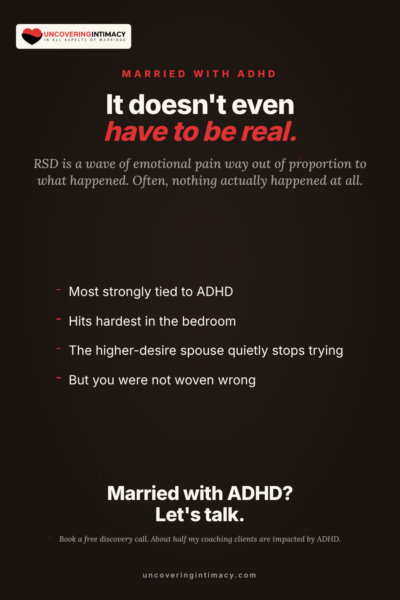
The word “dysphoria” comes from a Greek root meaning “hard to bear,” and that’s exactly the right description. Rejection Sensitive Dysphoria (RSD for short) isn’t ordinary disappointment when someone turns you down. It’s a wave of emotional pain so intense it feels almost physical, it arrives in an instant, and it lands way out of proportion to whatever actually happened.
The term was named and popularized by a psychiatrist named Dr. William Dodson, who noticed that a huge number of his patients shared this same hidden experience. They could handle a lot in life, but the moment they sensed disapproval or rejection, something in them collapsed or flared up, fast and hard, with no dimmer switch.
The strangest part: the rejection doesn’t have to be real
With RSD, the trigger doesn’t have to be an actual rejection. Your brain can react to rejection that was only perceived: a curt text, a certain look, your spouse seeming distracted at dinner. Or it can react to rejection that’s merely anticipated, bracing for a “no” before you’ve even asked the question. So you end up hurt, defensive, or withdrawn over something that, in reality, never happened. Your spouse is left baffled, because from where they’re standing, they didn’t do anything.
It’s most strongly tied to ADHD. The leading theory is that the ADHD brain regulates emotion differently, so feelings come in at full volume. Add to that the fact that many people with this wiring have spent years collecting “you’re too much” and “you’re not enough” messages, and the nervous system learns to expect the next blow and flinch before it comes.
As well, people with ADHD tend to play a lot of “what if” games in their head, playing out scenario after scenario of what could potentially happen in any given situation, and they tend to skew negatively in a lot of cases.
How it plays out in a marriage
This is where it gets important for the two of you, because marriage is the most rejection-loaded relationship most of us will ever have. You’ve staked everything on this person accepting you, which means they also have the most power to make you feel accepted, but they also have the most power to make you feel rejected as well. That’s the tradeoff.
A few ways RSD shows up between spouses:
- A neutral comment (“did you move my keys?”) lands as an accusation.
- A delayed reply to a text feels like cold withdrawal.
- A piece of feedback, however gentle, feels like “you’re a failure,” not “here’s one thing.”
- You replay a tiny moment for hours, certain your spouse is pulling away.
And then there’s the bedroom, where I see this does the most quiet damage. When you reach for your spouse and hear “not tonight,” a healthy nervous system files it as bad timing. An RSD nervous system files it as “I am unwanted, I am undesirable, I was a fool to even try.” That’s not a small difference. Over time, the higher-desire spouse with RSD often just stops initiating altogether, because the pain of a possible “no” outweighs the hope of a “yes.” The marriage slowly goes quiet, and the lower-desire spouse usually has no idea why. They never said no to you. They said no to one moment.
This can happen on the lower desire spouse’s side as well, where even repeated initiation can feel like a rejection in a way. Because they feel like you’re initiating again and again because it’s never enough. That you’re never good enough, you’ve never satisfied them, you just want more and more and more because they aren’t fulfilling their needs.
Or, as the higher drive spouse wants to explore and try new things, the message they get is, “you’re not enough as you are, I need something else in order to want to be with you” instead of the reality that they want to explore all these things together with you as an adventuring partner.
So is there a fix?
There’s no off switch, and I’d be lying if I told you there was. But yes, there is real help, and you’ve already taken the biggest step just by having a name for it. Here’s what actually moves the needle:
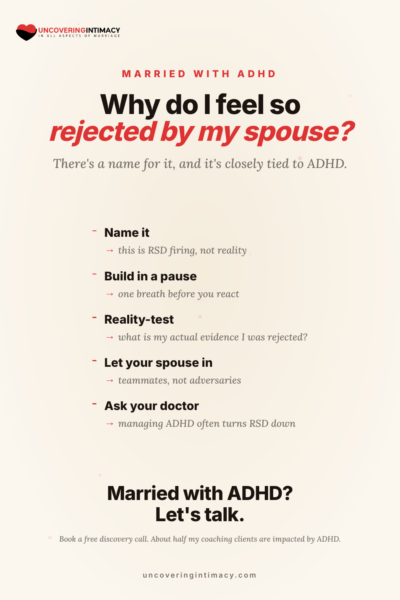
Name it in the moment. When the wave hits, train yourself to think, “this is RSD firing.” That simple label puts a gap between the feeling, which is 100% real, and the story it’s telling you, which is often false. The feeling can be completely real and the conclusion still be wrong.
Build in a pause. Because RSD is fast, almost all the damage happens in the reaction. One deliberate breath before you respond, especially with your spouse, prevents most of the wreckage.
Reality-test the story. Ask yourself, “What’s the actual evidence I’ve been rejected here?” Most of the time, there isn’t much. And when you genuinely can’t tell, ask your spouse directly instead of assuming.
Let your spouse in on it. This is the big one, and it’s the gift of being married. When your husband or wife understands that a short answer or a tired “not tonight” can land on you as full rejection, you stop being adversaries and become teammates spotting the same pattern. Their reassurance starts to do real work, and you stop interpreting their humanity as a verdict on your worth. As well, they can call out RSD moments for you when they see you spiraling.
Medication is an option. Managing the ADHD often turns the RSD volume way down. There are even a couple of medications used specifically for this. That’s a conversation for your doctor, but you can ask about Alpha-2 agonists and monoamine oxidase inhibitors as well as the usual ADHD medications (methylphenidate and amphetamines, which most people recognize as Ritalin, Concerta, Adderall, etc.).
Now, I should also note that RSD is often mistaken for depression or anxiety. So a lot of people land on an SSRI like Prozac, Zoloft, Lexapro and all those. For RSD, those usually don’t do much, which is part of why people feel like nothing has worked. Not that they don’t do much for depression and anxiety, but they tend to do nothing for the RSD itself. If you’re struggling with RSD and it’s being mistaken for anxiety and depression, or if you have anxiety and depression and are being treated for it but the RSD lingers, it doesn’t mean the meds aren’t working, it’s because it’s a completely separate symptom that just often gets kind of lumped in, but it doesn’t tend to get helped with SSRIs.
So if you’re trying these meds and it doesn’t feel like it’s working, it may be that you’re trying to tackle the wrong thing. And it got misdiagnosed. Or you have both, which is often very common in people with ADHD.
You’re not woven wrong
For You formed my inward parts; You covered me in my mother’s womb. I will praise You, for I am fearfully and wonderfully made;
Psalm 139:13 (NKJV)
People with ADHD, and particularly RSD, can often feel like they’re broken, like they were made wrong, and that can sometimes make them feel like God just didn’t care that much about them, or they wouldn’t have been made this way. The Bible tells us the opposite story, that God made us the way we are, on purpose.
Now, that becomes a very complex topic, trying to balance between God’s sovereignty and a broken, fallen world. And how do we decide: was this God’s will, or was God’s will somehow circumvented by sin, and we’re then not what God wanted, but instead just a distortion, a mutation, something that wasn’t wanted?
My personal belief is that this was all in God’s plan, that He knew the world would be broken. He set the plan of salvation in place before sin ever entered the universe (Revelation 13:8, 2 Timothy 1:9, Ephesians 1:4, Titus 1:2). And if that’s the case, then God knew what was going to happen. He knew sin was going to corrupt the world, He knew we were going to be born the way that we are. That you are going to be born with RSD, and you are going to suffer and struggle with it for your whole life. And He still looked at all this and went, “No, this is the way it needs to be. This is deliberately chosen for you to have the life that you have.”
He thought that was worthwhile to accomplish His end goal of being with you in heaven. And so if this is what you have to go through in order to get there, then know that God loves you and that He created you this way for a purpose. And His purpose is that He wants to be with you forever (John 14:2-3, 1 Thessalonians 4:17, Revelation 21:3).
All you have to do is decide you want to be with Him (Luke 23:42-43, Romans 10:9, 13, John 3:16, Revelation 3:20, 22:17).
Does it make it all go away? Absolutely not. Does it make it easier to live with? Maybe a little bit, I don’t know, you’ll have to tell me, please share in the comments below. But I hope that brings someone some comfort.
Now, if you or your spouse are struggling with ADHD, if you are having trouble trying to figure out how to work with ADHD in your marriage and you want to talk to somebody, you can book a free discovery call and we can talk about it. I have experience with this in my own marriage, as well as helping many others in theirs, in fact about half of my coaching clients are impacted by ADHD in their relationships. It’s a pretty common struggle, and you don’t have to do it alone.