Why does my husband have a lower sex drive than me?
Podcast: Play in new window | Download | Embed
Subscribe to the Podcast: Apple Podcasts | Spotify | Amazon Music | Android | iHeartRadio | Podchaser | Email | TuneIn | Deezer | RSS | More
I had someone email me this lately:
My question relates to the language used when discussing low-desire husbands. It seems like the universal tendency among Christians discussing this topic is to allow for the situation where the husband has the lower desire, and no identifiable problems need addressing. We know that moral, physical, and psychological issues can lead to the husband having the lower desire, and we know that porn use is high among men. But how large is the set of men who don’t have those issues and still have a lower drive than their wife? Are the data strong enough to cast suspicion on any man who claims to have the lower desire without having one of those issues? Can we legitimately suspect that such a man is just trying to cover up a porn habit? On a more positive note, even if the husband legitimately has a lower desire that isn’t due to a moral, physical, or psychological problem, he should nonetheless take the lead and initiate frequently enough to satisfy her desires… In short, it seems there should never be a situation where the husband has the lower desire without having some problem that needs addressing. Maybe I’m missing something?
So, there are two questions here: the first is – how common is it for men to have lower desire than their spouse and not be dealing with some other issue. The second is, if they do have the lower drive than their wife, should they still be leading in the bedroom?
The first one I’ve answered plenty of times. I’ve generally said that a quarter to a third of marriages have the wife as the higher-drive spouse, which comes out of the research on desire discrepancy and lines up with what I anecdotally see in my inbox and coaching clients.
However, thanks to the recent work in cataloguing all of our data, I can now scan all of our survey data over the years pretty easily. It’s pretty awesome.
So, here’s what I found:
How common is it for the husband to be the lower-drive spouse?
Three separate surveys asked some version of “who has the higher drive,” and they were run years apart on different topics.
| Survey | Marriages where the wife is the higher-drive spouse |
|---|---|
| Going to Bed Naked (n=1,157) | 22.7% |
| What Happens When One Spouse Wants Sex And The Other Doesn’t (n=1,595) | 21.0% |
| Period Sex Survey (n=606) | 14.2% |
These are weighted by gender, since men are overrepresented among our respondents at roughly two to one.
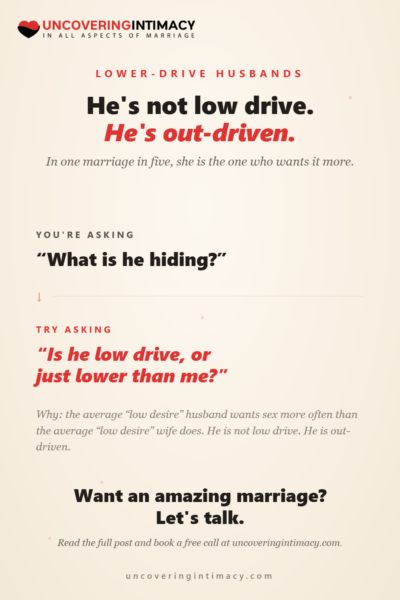
So: about one marriage in five.
How these numbers were calculated (my AI research assistant’s notes for those who like math and statistics – if you don’t, just skip this section)
A note on this box: the analysis behind this article was run by my AI research assistant, and what follows is its own write-up of how it did the work. I have left it in its voice rather than rewriting it in mine, because I want you to see exactly what was done rather than my summary of it. So the “I” below is the assistant, and “our” means the two of us.
Each respondent describes one marriage, so you might expect me to just count respondents. That gives 17.0%, 14.1% and 12.0%. I don’t trust those numbers, and here is why.
About two-thirds of the people who answer our surveys are men, and men and women give wildly different answers to this question:
| Survey | Wives: “I’m the higher-drive one” | Husbands: “she’s the higher-drive one” |
|---|---|---|
| Going to Bed Naked (n=1,157) | 39.8% | 5.5% |
| One Spouse Wants Sex (n=1,595) | 38.5% | 3.6% |
| Period Sex (n=606) | 26.7% | 1.7% |
Pool a sample that is two-thirds men and the answer drifts toward whatever the men said, especially in a self-selecting group. That is a fact about our audience, not about marriage. So I weighted by gender: every marriage contains exactly one husband and one wife, so the two groups count equally regardless of who happened to fill in the survey. That is the 22.7% / 21.0% / 14.2% in the article.
There is a further reason to trust the correction: the selection problems run in opposite directions and partly cancel. Higher-drive wives are overrepresented among the women who read a Christian sex blog, which pushes the left column up. Higher-drive husbands are overrepresented among the men, which pushes the right column down. Balancing them splits the difference rather than compounding it.
Is it just the word “drive”? No. I re-ran the whole thing on how often each spouse said they wanted sex, in times per week, rather than the adjective they picked off a list. That gives 38.9% and 3.5%, weighting to 21.2%. Same answer.
The “couples with a gap” figure. Same weighting, then wife-higher as a share of wife-higher plus husband-higher, leaving the evenly-matched couples out of the denominator. That gives 18.6%, 23.3% and 28.2%. Note that you have to apply the weighting first and take the share afterwards. Averaging the two genders’ ratios instead gives answers one to two points too high, because the two groups have different numbers of matched couples in them.
On the Australian number. Its full derivation is in its own box further down. The short version is that it is modelled rather than measured, and it was published independently rather than peer-reviewed. I went looking for a peer-reviewed study that measured both spouses and reported which one was higher. I could not find one, and that hole in the literature is worth noticing on its own.
What none of this fixes. Our respondents chose to answer a survey on a Christian sex blog. They are not a random sample of marriages and we would not present them as one. One in five is the most defensible number we can get out of our data, not a census.
That’s across all marriages, including the ones where both spouses want about the same amount. Set aside the evenly-matched couples and the wife is the higher-drive spouse in 19% to 28% of the rest.
So: about one marriage in five overall, and about one in four once you set the evenly-matched couples aside.
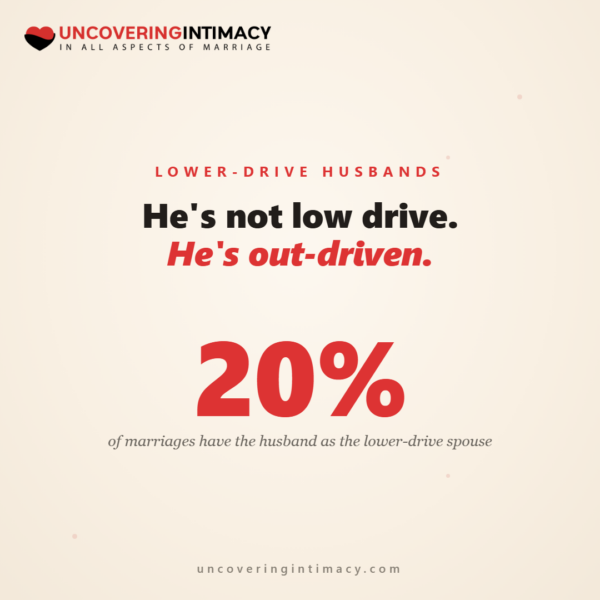
of marriages have the husband as the lower-drive spouse
It’s closer to one in four once evenly-matched couples are set aside. Weighted from 3,358 responses across three Uncovering Intimacy surveys.
I did find one other piece of research though that agreed with the 1/3rd figure: An analysis of the Second Australian Study of Health and Relationships puts the wife as the higher-desire spouse in 26% to 31% of couples with a large gap, meaning one spouse wanting sex more than twice as often as the other. Which is, near enough, a quarter to a third.
So, depending on what exactly you’re asking – it’s anywhere from 20% to 31% of couples. 1/5th to 1/3rd.
Where the Australian 26% to 31% actually comes from (my AI research assistant’s notes)
A note on this box: as with the one above, this is my AI research assistant’s own write-up, left in its voice rather than rewritten in mine. The “I” below is the assistant, and “our” means the two of us.
Short version: no researcher measured a group of couples and found that the wife wanted more sex in 31% of them. The number is the output of a simulation. Here is the whole chain, because I would rather you judge it than take my word for it.
1. What was actually measured. The Second Australian Study of Health and Relationships (Badcock et al., Sexual Health, 2014) surveyed a representative sample of 20,094 Australians aged 16 to 69. Three-quarters were in a regular heterosexual relationship. It asked them how often they actually had sex and how often they would ideally like to. The answers: an ideal average of 3.9 times a week for men and 2.9 for women, against an actual average of 1.36.
Notice what is missing. ASHR2 surveyed individuals. It did not survey husbands and wives as pairs, so it cannot tell you what is happening inside any particular marriage. It gives you two separate piles of answers, one from men and one from women.
2. What was calculated from it. Colin Mathers took those two piles and asked what would happen if you paired them up. He sorted each sex into percentiles of desired frequency and then modelled three ways couples might form:
- Maximum compatibility: every man pairs with the woman at his own percentile. This is the best case, the least possible mismatch.
- Random pairing: sex drive plays no part in who marries whom. He drew 10,000 simulated couples at random.
- Halfway between the two, which he treats as the realistic case, since in life there is probably some correlation between partners’ drives but not a perfect one.
3. The number itself. Under random pairing, using a twofold gap as the threshold for a real mismatch:
55% of couples are in a relationship with greater than twofold desire discrepancy. In 69% [of] these couples, the man is the higher desire partner, and in the other 31% the woman is the higher desire partner.
That 31% is the top of the range, because random pairing is the most extreme assumption. The other scenarios give slightly lower figures: 30% under the realistic halfway case at a twofold threshold, and 26% if you set the bar at a fourfold gap instead. Mathers’ own summary of the whole exercise is that the man is the higher-desire partner in 70% to 74% of couples, which leaves the woman at 26% to 30%.
4. What I would and wouldn’t claim from it. This is a model, and its answer depends on an assumption nobody has measured: how strongly people’s sex drives correlate with their partner’s. Change that assumption and the number moves. What makes it worth citing anyway is that it starts from genuinely representative data on 20,094 people, which is better than anything we have, and that it lands in the same place our own surveys do by a completely different route. Our mismatched couples run 19% to 28%. The simulation says 26% to 31%. Two methods with entirely different weaknesses, pointing at roughly the same answer, is about as much confidence as this topic currently allows.
Now, that’s just lower-desire than their wife.
A man can have a perfectly ordinary sex drive and still be the lower one in his marriage.
If you want to track objectively low desire, then there’s another study. Lori Brotto found low sexual desire in men running 14% to 17% in the American NHSLS data, and 17.1% in the British NATSAL survey, where lack of interest in sex was the single most commonly reported sexual problem among men.
This agrees with yet another study from Frank, Anderson and Rubinstein who surveyed 100 couples they described as “normal,” meaning not a clinical sample, not people who had gone looking for help – in fact, 80% of them said they were in a happy marriage. In that study, 16% of the husbands reported a lack of interest in sex.
In short, this is not a rare pathology confined to broken marriages. This is about 1 in 6 men.
Why lower drive men seem like a myth
Because they don’t want to be seen.
Ask wives and husbands the same question and you get two different worlds. In our Going to Bed Naked survey, 39.8% of the wives said they were the higher-drive spouse. Only 5.5% of the husbands said their wife was. The desire-gap survey: 38.5% of wives, 3.6% of husbands. Our Period Sex survey said 26.7% and 1.7%.
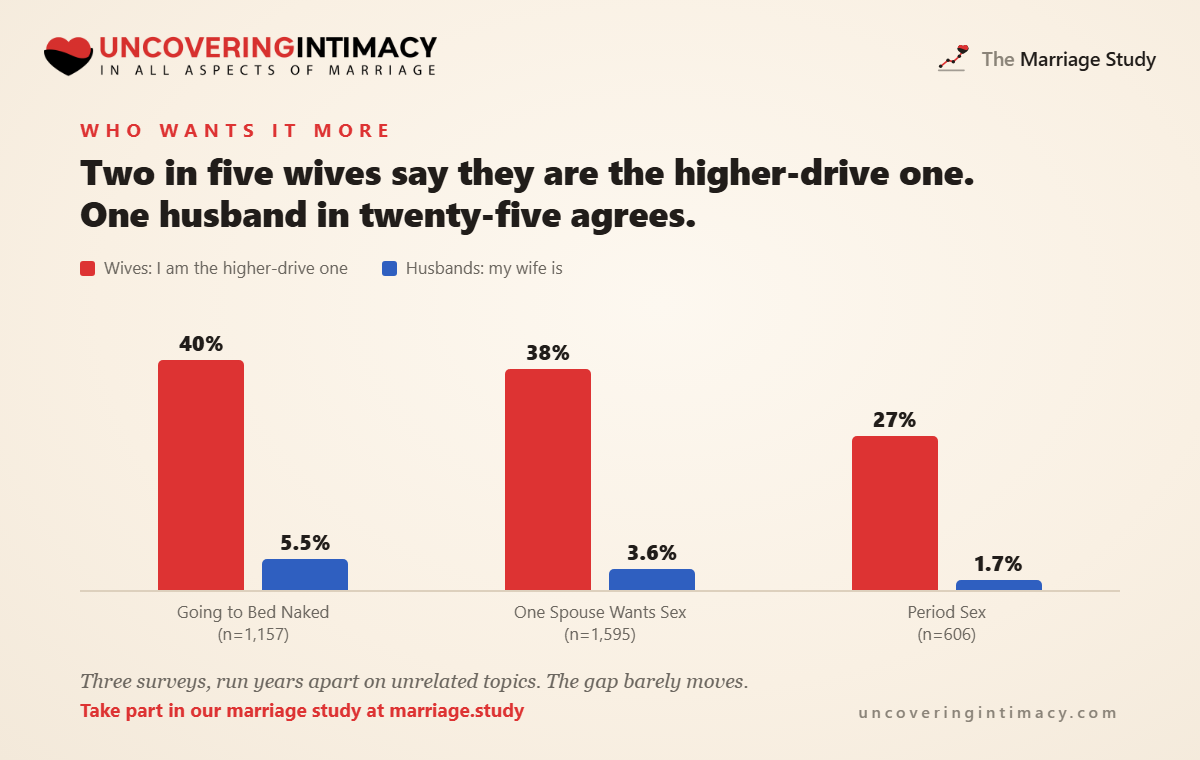
Two in five wives say they’re the higher-drive one. One husband in twenty-five agrees.
Low-drive husbands are close to silent in our data. They are less likely to volunteer data, write me an email about it, or participate in the forums.
So the entire visible record of this situation comes from their higher-drive wives. Which means when you and I are reading about low-desire husbands, we are almost always reading a wife’s account of a man who doesn’t want to talk about it. He is almost always being described in absentia, which is definitely not the best way to get a handle on him.
Which is why I went looking for him properly, in the one survey that asked the question directly. Eleven hundred and fourteen husbands rated both their own drive and their wife’s. Forty said she was the higher one. Of those forty, fourteen wrote anything at all in the comment boxes.
Fourteen men, in the survey I built specifically to study this exact problem. That’s the closest thing I have to an archive of low-drive husbands describing themselves in their own words.
One man, married twenty-eight years, rates his own drive as “barely there” and would be content with sex a couple of times a year. His wife wants it weekly. His desire is not just lower, it’s significantly lower, and objectively low.
“Lower desire” is a comparison, not a diagnosis
Another of those fourteen men, married eighteen years, put this entire section into one sentence:
“I am a twice a week kind of guy, my wife is higher than that, so that makes me the lower drive spouse.”
He wants sex twice a week. He said his wife wants it four times. That is what “low drive” means in his house.
I pulled every couple in the desire-gap survey where the wife is the higher-drive spouse, and looked at what the husband actually wants, in terms of frequency.
The median low-drive husband in that group wants sex about once a week. Sixty-eight percent want it at least weekly. Forty-eight percent want it twice a week or more. When you restrict it to the men who answered for themselves rather than being described by their wives, it goes up: median twice a week, and 88% want sex at least weekly.
Now compare that to the low-drive wives. The median low-drive wife sits right on the line between weekly and once every two weeks. Only half want it weekly. Twenty-seven percent want it twice a week or more.
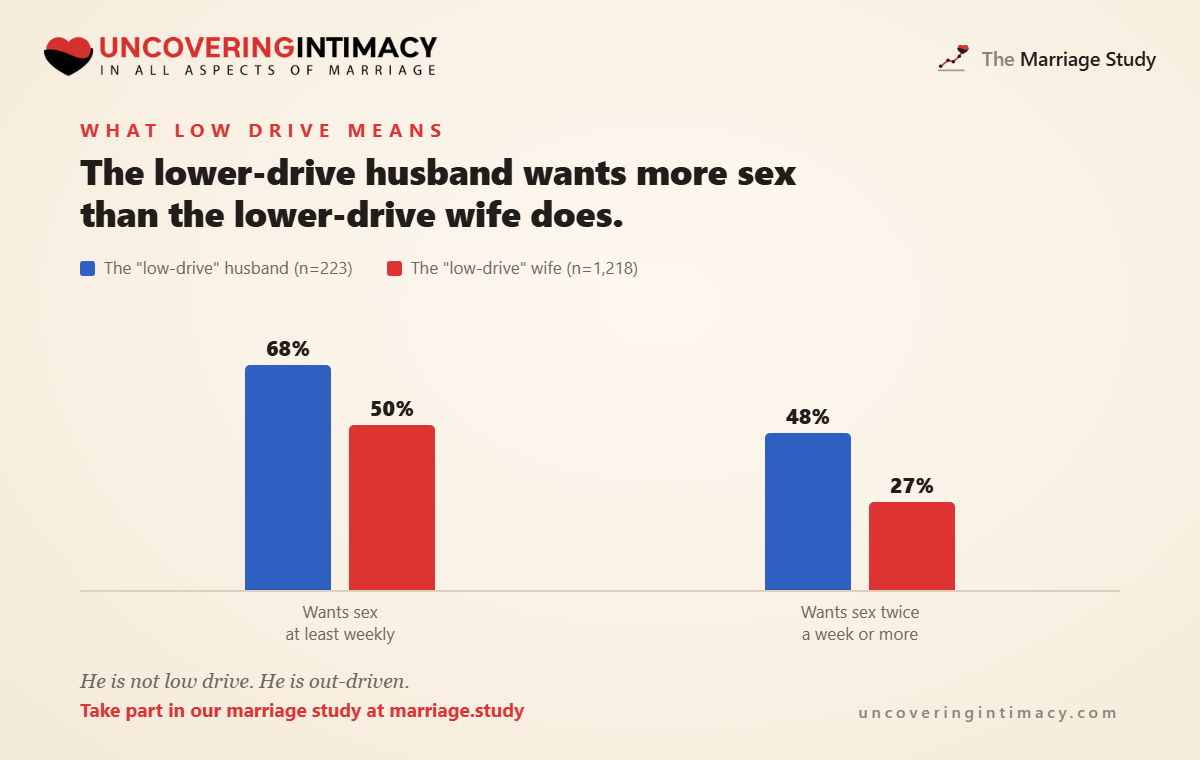
The average “low desire” husband wants more sex than the average “low desire” wife does. He is not low-drive, he’s just out-driven by his wife. His wife, in these couples, wants sex a median of four times a week, which is exactly what the higher-drive husbands in our data want. High-drive wives are every bit as high-drive as high-drive men.
And yet 71% of these husbands were rated by their spouse as “somewhat low,” “low,” “barely there,” or “non-existent.” A man who wants sex twice a week gets labelled as having a low sex drive, because the label is calibrated against the person he married rather than against any baseline.
If you go looking for a hidden pathology to explain why a man only wants sex once or twice a week, you are going to have a hard time finding one, because there isn’t a pathology. There’s a gap. Which is roughly what I argued years ago in Sex drive differences aren’t the problem, except now I have the numbers for it.
Is he hiding a porn habit?
Let’s take the porn hypothesis.
The strongest evidence for it: Carvalheira, Træen and Štulhofer studied 596 coupled heterosexual men with decreased sexual desire and found that 67% of them masturbated at least once a week, and of those, 70% used porn at least weekly. So yes, a solo sexual outlet is common among low-desire men.
Here’s the problem with turning that into a presumption of guilt.
In our Home Sex Videos survey, out of 360 men, exactly six said they had never seen or used porn. Ninety-eight percent had some history with it, and 53% reported currently using it, actively trying to quit, or having been addicted at some point. In the How Long Does Sex Last survey, 733 of 907 men, 81%, said they masturbate without their spouse’s knowledge at least occasionally.
Those men are overwhelmingly the higher-drive spouse.
If porn history is nearly universal among husbands generally, then finding it in a low-desire husband tells you approximately nothing about why his desire is low. A test that comes back positive for almost everyone is not a test. You would be “discovering” porn use in the low-drive husbands at very nearly the rate you’d discover it in the high-drive ones, and then treating it as the explanation in one case and background noise in the other.
What actually causes it instead
When I read through those responses looking for what wives do describe, the same handful of things come up over and over.
Exhaustion, constantly. Shift work, long hours, small children, a large family, a schedule with nothing left in it. Erectile dysfunction and the withdrawal that follows it, which is enormous and underrated: 45% of men with low sexual interest in Brotto’s review also had erectile difficulties. Once sex starts feeling like a task he might fail at, many men stop wanting to try. Another of the fourteen wrote about high blood pressure, diabetes and the ED that came with them, and then added this:
“I suspect I would have a higher drive if I was ‘fully functional’. Also, I have not learned what pleases my wife, which makes me less likely to initiate.”
Again – a task he’s not sure he can complete satisfactorily. Men like to win, if we think we’re going to lose, many of us would rather not play. Reframing sex so that it doesn’t require an erection or an orgasm is crucial to this for those who struggle with either of those.
Another often mentioned issue was depression, which is nearly as large a factor. In the research Brotto reviews, 55% of men with low desire had a history of major depression against 32% of controls, and in 88% of those cases the desire complaint started at the same time as the depression or just after.
Shame, specifically the Christian flavour, can also play a huge role – for both men and women. If you still hold on to a belief that sex is sinful, dirty, or otherwise less than holy – that’s going to negatively impact your desire.
Note that most of these are problems worth addressing. ED, depression, shame and exhaustion all deserve attention. So the instinct that something should be looked into is often right. It’s the specific assumption, that something is a concealed moral failure, that isn’t supported.
Where the question is right
Now, the second half: that he should be taking the lead and initiating anyway. There are actually two questions buried in there, and they have different answers depending on which spouse you’re talking to.
Should the lower-drive spouse be initiating? Yes. Absolutely, and I’ve argued it before in Why lower-drive spouses should initiate sex.
The theology is not complicated:
1 Corinthians 7:3-4 – The husband should give to his wife her conjugal rights, and likewise the wife to her husband. For the wife does not have authority over her own body, but the husband does. Likewise the husband does not have authority over his own body, but the wife does.
Paul writes that symmetrically on purpose. A husband’s obligation to his wife’s sexual needs does not evaporate because he happens to be the one who wants it less just as a wife’s obligation to her husband’s needs doesn’t disappear because she wants sex less. Nowhere does the Bible support a drop to the lowest common denominator.
Behaviourally, this holds up. In Brotto’s review, 60% of men reported having engaged in sexual activity without sexual desire, meaning acting first and letting desire catch up is already a normal male experience, not a novel demand – this is just responsive desire, which we talk about often. Waiting to feel like it is a strategy that mostly produces less sex and less desire over time.
Should the higher-drive spouse be expecting it? No. And this is where I start to disagree with the way the question is formed.
There’s a difference between “the lower-drive spouse should initiate more than they currently do” and “the lower-drive spouse should be leading this.” The first is good advice. The second is handing responsibility for your marriage’s sex life to the person who wants it least, and then being disappointed when they don’t run with it.
I wrote recently about what leadership actually looks like in a marriage, and the short version is that leaders absorb burdens rather than distribute them. Freedom flows down, responsibility flows up. Then, answering a husband whose wife wouldn’t go beyond the basics, I put the rule more specifically: the amount you need to lead or carry a part of your relationship is directly proportional to the relative strength of your desire for that part.
Apply that here and it gets uncomfortable for the higher-drive spouse, because the desire gap is mostly your burden. You’re the one it costs. You’re the one lying awake about it. You care more, which by that rule is precisely what makes it yours to carry: the planning, the initiating, the setting up of conditions where this can actually happen.
Expecting your lower-drive spouse to lead on this is unfair, and more to the point – it doesn’t work. You will be waiting a long time, you will get progressively more frustrated, and every week they don’t initiate will feel like fresh evidence that they don’t care. Meanwhile they’re mostly just not thinking about it, because that’s what having a lower drive means.
I’m the higher-drive spouse in my marriage. My wife’s desire is almost entirely responsive, which in practice means she is essentially never in the mood ahead of time. We had a conversation about it years ago, and what it came down to was her saying that it’s basically up to me to lead it – how can she be expected to when I’m the one with the motivation? Instead, she would follow where I led.
And I think that’s the way it should work – the one with the desire should lead in that area, the one without should follow. Regardless of whether it’s the husband or the wife. The alternative in those 20% of marriages where the wife is the higher drive spouse is that the husband leads something he’s less interested in, or maybe not at all – and that never works out well.
For those who believe in egalitarian marriages, this shouldn’t be a problem at all. However, for those who subscribe to a complementarian approach, this can seem like a conflict.
I do think men should lead their household, and the relationship is a part of that, and sex is a part of that relationship. You don’t get to be 100% hands off. It’s just that in the day to day and week to week operations of the marriage – the wife might be pushing this part of the marriage forward.
But I think husbands should still be standing back from time to time and assessing everything, and if you see that a part of the marriage is lacking – then that’s something that needs to be addressed – whether it’s your favourite part to tackle or not.
You can hand that department over to your wife, but that doesn’t mean you get to be free of all responsibility – it’s still your responsibility.
Either way, if you are the husband who is following his wife in this area, here are some basic ground rules:
You have to be willing. Not aroused on command, nobody can promise that, but willing to be moved, which is a different thing and a real one. That’s the difference between desire and willingness, and it’s most of what separates a workable version of this arrangement from a miserable one. Showing up unwilling is not following her lead.
If you have to say no, owe her something for it. I’d rather you didn’t, most of the time, and I’ve written about how to turn your spouse down without doing damage. But if there’s a genuinely good reason, then “no” is only half an answer. The other half is when it will be a yes. Name a time, mean it, and then be the one who comes to her at that time. A no with no follow-up is how a rain check turns into a pattern.
Don’t be an anchor. If she’s driving this part of your marriage forward, she is going to try to move it somewhere. New things, more often, different rhythms. You can have opinions about that. What you can’t do is put her in charge and then quietly veto everything she steers toward, because that isn’t delegation, it’s a leash. Handing her this role means handing her genuine authority in it.
And if that sits badly with you, there’s an honest way out: lead it yourself. Take it back and carry it properly, with all the planning and initiating and noticing that involves. That’s a completely legitimate choice – she’d probably be happier with that, but then you actually have to do it. What isn’t legitimate is the third option most couples actually land on, where nobody has it, both of you are waiting on the other, and the whole thing quietly runs down.
Either way, headship doesn’t evaporate. If you have delegated this and, later on, it has quietly slid, that’s still yours to notice and yours to pick back up and figure out why, and then push for a fix. Delegating a responsibility and quietly dropping it look identical from the outside for quite a while. The difference only shows up later, when something has drifted and you find out whether anyone was still watching.
The part that doesn’t resolve
Plenty of higher-drive wives don’t actually want the logistics solved. Being the one who plans it, brings it up and sets the evening up is not what they were hoping for, even when it works. What they wanted was to be pursued. To be wanted.
I end up explaining this on calls more often than almost anything else, and I usually get there through fiction. Pick up any romance novel. Watch any romantic comedy. There’s a structure underneath all of them that never varies: someone turns up, generally some improbable combination of a pirate and a billionaire, and he decides. He sweeps her off her feet so completely that she doesn’t get a vote in it. She gets the entire thing without ever once having been the person who said out loud that she wanted it.
That, or it’s fate, or hormones or something else – something that takes away her agency. Most wives do not want to be in charge of sex. All the movies geared towards wives, the ones they like, take it away from them. And they do this, because that’s what they watch. There are no Disney princesses who save the prince. There are no males locked in towers. When they try to make a strong, independent female lead, the movie does terribly.
The only book I’ve seen be as popular in churches as the Bible is 50 Shades of Grey – I think half the women in North American churches read them.
Now, it’s a terrible example – I’m definitely not suggesting reading it, but that’s the fantasy. Most of the wives I talk to were taught, their whole lives, that saying it out loud is the one thing a decent woman doesn’t do. You don’t undo that with a conversation about scheduling.
That is a completely understandable thing to want. It is also a want that can’t be met by assignment. Suppose you tell him, clearly and fairly, that you need him to come after you more, to initiate assertively, maybe even aggressively. Suppose he hears it and does it. You now have exactly what you asked for and it still isn’t what you wanted, because he’s doing it because you asked. The pursuit you wanted was the kind that arrives unplanned and unexpected, and the moment you had to request it, that version stopped being available.
Which brings me to this comment from the survey:
“I hate the feeling of having sex because he is just trying to fill my tank instead of because he wants to. It has made me feel like I’m doing something wrong.”
The feeling is real and I hear it constantly. But look at what’s actually being turned down. Here is a man having sex with his wife when he doesn’t especially feel like it, because she wants it and he loves her. That is a self-sacrificial act. And it’s being marked down for not being a selfish one.
That’s the bit I think we have upside down, and not only in marriage. We’ve somehow decided that a person acting on their own appetite is the loving one, and a person choosing you against their own inclination is the lesser one. It’s backwards. Appetite is the cheap version. Anyone can pursue you when they already want to.
Christians in particular should be able to see through this, because the love we hold up as the pattern is Christ, who was explicit about not wanting what was in front of him:
Luke 22:42 – Father, if you are willing, remove this cup from me. Nevertheless, not my will, but yours, be done.
Christ didn’t want to die for you – He did it because He loved you and you needed it. If that upsets you – well, then you have some work to do.
If “he didn’t feel like it” disqualified an act from counting as love, that prayer would be an embarrassment instead of the centre of the faith. The not-wanting is exactly what made it cost something. It’s what shows us that it wasn’t easy for Him to do this for us.
So there’s homework for the higher-drive spouse too. When your husband comes to you having chosen you over his own inclination, that is the more expensive gift, not the cheaper one. Learning to receive it that way is real work. But the alternative is a standard your marriage cannot meet, because you are asking to be desired involuntarily and on schedule, and there’s nobody who can supply that.
If you’re the lower-drive spouse, initiate more than you feel like, and do it toward your spouse rather than at them. If you’re the higher-drive spouse, stop treating “they should want to” as your strategy, because it won’t make you happy.
So, to answer the question
No, I don’t think porn is the largest reason men have a lower drive than their wife. It is far too common among husbands generally to tell you anything when you find it in one of them, and where it does turn up in these marriages, it has usually already been found and confessed and fought over rather than hidden.
No, I don’t think the lower-drive husband should be solely responsible for his wife’s sexual satisfaction. I think the one with the higher drive should lead it, and the lower-drive one should then actually follow that lead.
And the distinction the question is missing is between “low drive” and “lower drive than his wife”. Those aren’t the same condition. Lower drive than his wife is a conflict to be worked through, not a fault to be found, and it’s the situation in roughly one marriage in five. Low drive in absolute terms is much rarer, and yes, it’s often attached to something solvable: ED, depression, exhaustion, shame, some theology he absorbed as a kid and never went back to examine. All of that is worth chasing down. You just still have the conflict underneath it either way. Hopefully this post gave you a bit of a framework for how to do that.
So, can you legitimately suspect a man who says he’s the one who wants it less?
No, I don’t think so. Also, that’s not going to solve any problems, and it’s certainly not going to encourage them to speak up and try to solve the conflict the gap is causing in their marriage. It’s more likely to shut him down.