Why Does My Wife Refuse Intimacy Beyond the Basics?
Podcast: Play in new window | Download | Embed
Subscribe to the Podcast: Apple Podcasts | Spotify | Amazon Music | Android | iHeartRadio | Podchaser | Email | TuneIn | Deezer | RSS | More
I had this question come in through the Anonymous Question page.

Hello and thank you for taking my question.
Married 17 years with two amazing girls. I love my wife and have been with her since 20 years old, (now 42). My wife and I have sex around twice a week and I am always the initiator. I have been asking for years if we could work on foreplay. She never flirts, sends texts, or anything to initiate sex with me.
Furthermore, she refuses to let me finger her or give her oral sex (which I would really like to experience). She also refuses to give me oral sex or try any new toys, although she can orgasm with a vibrator and that is the only way she is able to orgasm.
I ask to try new things but always get a “I like what we do already” or get an emoji with eyes rolling. She then says, “I guess I’ll just never be good enough for you” or “is this all you ever think about.”
I feel like I am always the one putting in any effort and the sex I am given is to shut me up or to check a box as a wifely duty. Sex or anything sex related is always on her terms, what she wants, and how she wants it. It is not a deal breaker that we cannot enjoy these things together but I would love to have these opportunities as her husband.
Even more, I would like to have a good reason of why she refuses. She just says she does not want that or it doesn’t feel good or its gross or maybe some other time. I even ask her to do little things like come to bed without panties or send a flirty text, which never happens. She would allow me to do these things when we dated so I am unsure of where it got in her mind to never do them again.
I am her only sexual partner and she is my second. She has never had any sexual trauma (that I am aware of) or past issues that would hold her back from exploring other types of enjoyment. We are both clean people that take good care of ourselves.
I guess as a husband in a loving marriage where we have a great family and everything is pretty darn good, I just do not understand. I feel like I have been plenty patient over the years asking for this but nothing ever seems to change. Thank you
Alright. I’ve said this in bits and pieces over the years, but I’m not sure I’ve ever articulated the whole thing in one place before. Let’s see if I can manage it this time.
Who ends up leading the sexual relationship
The amount you need to lead or carry a part of your relationship is directly proportional to the relative strength of your desire for that part of the relationship compared to your spouse’s.
If you both have relatively high drives, you’ll find more of an even split. A lot of people experience this early on, while there’s plenty of NRE (new relationship energy), otherwise known as infatuation. This can be problematic, because later on when it shifts, it can feel like a bait-and-switch for the now higher-drive spouse.
When one of you is relatively very high and the other is relatively very low, or their drive is close to non-existent, then the higher-drive spouse is going to be initiating and leading the sexual part of the relationship nearly 100% of the time.
That can understandably also create conflict and some negative feelings, because it feels icky to be the one initiating all the time. It can make you feel like a pest. Like you’re forcing your spouse to have sex with you. Like you’re an imposition, like they don’t actually want to be with you. And it gets compounded by dismissive or condescending gestures, like eye-rolling, even in emoji form.
That said, this setup is perfectly okay if two things are true: you both understand that this is your dynamic, and the lower-drive spouse recognizes that sex is an important part of the marriage even if they don’t personally feel a drive for it.
This is the arrangement my wife and I have. She has little to no drive, and that’s okay. I understand she’s never going to be the one to initiate, so I don’t ask her whether she wants to have sex, because if I’m asking her to come up with the desire herself, the answer is always going to be no. But that doesn’t mean she doesn’t enjoy sex once I lead it. I’ve had to get over the fact that she probably isn’t going to initiate regularly, and that when she does, it comes out of love for me rather than out of her own desire.
Now, honestly, that took a while to get over. Once I did, things got much better. Once I understood that leading is my role, and she was okay with it being my role, it stopped being a problem. But notice what that depends on: she doesn’t turn me down, she doesn’t roll her eyes at me, she doesn’t get frustrated that I want her.
And there’s one more piece: You have to get good at sex, so that the lower-drive spouse genuinely enjoys it once they’re there, even if they never intrinsically look forward to it. Because if you’re initiating something she’s not going to enjoy … well, then you’re lucky she’s willing to put up with that twice a week for your benefit.
Now, in your case, she won’t let you lead – you have the responsibility of leading (initiating), but not the authority, and those need to go together.
She doesn’t want you to try anything, explore anything, or do anything to her. That’s a real struggle, because how are you supposed to find out what makes it good for her if you’re not allowed to explore at all?
So that’s the thing I’d bring to her. Not a request for a specific act. Something more like: I want to make sex better for both of us, and to do that we need some way to explore that isn’t too uncomfortable for you, and we need to be able to talk about it afterward so we can work out what does and doesn’t work.
She told you why. Four times.
And here’s what worries me most in your letter: you don’t know why she doesn’t want to do these things.
However, she told you. Four times.
You wrote it down yourself:
“She just says she does not want that or it doesn’t feel good or it’s gross or maybe some other time.”
Those are four different answers, and I think you’ve been hearing them as one refusal. I don’t think they are. I think they’re different problems wearing the same coat, and each one needs something different from you.
“It’s gross” is a moral word, not a sanitary one
Let’s take “it’s gross,” because I think that’s the loudest word in your whole letter.
Look at what you wrote a few lines later: “We are both clean people that take good care of ourselves.”
You heard “gross” and you defended your hygiene. I don’t think she was talking about hygiene at all. “Gross” is usually a moral word, not a sanitary one. It’s what people reach for when something feels wrong, not when something feels unclean, although there can be overlap there.
Now, I think there could be two things going on here.
The first is that women who engaged in sexual activities before marriage, even though they enjoyed it at the time, often retroactively bucket those acts as sexually immoral, because they’re attached to pre-marital sex. The activity gets tainted by the context.
The second is that your definition of gross changes when you’re aroused, because of how our brains work. When you were young and dating, it was both more exciting, and she likely had higher levels of testosterone, less stress, and fewer responsibilities, and those all tend to radically affect women’s arousal patterns (the dual control model covers the stress half of that). So, in short – she’s not turned on enough to be willing to do those things. Right now it’s too gross. If she was intoxicated with arousal, she wouldn’t care.
And this we see often in affairs – suddenly people will do things they previously considered off limits, gross, taboo, etc. because of the excitement and arousal of the affair, and that really hurts their spouse. Even more so when those get re-classified again as immoral acts because of the context when they repent and rebuild the marriage – often these acts remain off limits, which can really cause a lot of hurt and confusion.
And I think these two things together explain why we see that, for women in particular, the more they engage in premarital sexual activities, the less their sexual satisfaction is in their marriage. This is correlated to both manual sex and oral sex prior to marriage.
Now read your own letter again. You had sex before marriage, with each other. You’re her only partner. And the two things she won’t do now, manual and oral sex, are two of the things you were doing back then.
In our data, a couple who did manual, oral and vaginal sex before marriage ends up with the wife about 16% less sexually satisfied in her marriage.
That effect doesn’t show up in frequency. Only in satisfaction. Which is your marriage, exactly. Sex twice a week for seventeen years. Frequency is fine. She shows up. What’s missing is specific acts, and they happen to be the specific acts from the years you weren’t married yet. They also happen to be the acts that women tend to say they need to enjoy sex more.
Which also answers the thing you said you couldn’t understand:
“She would allow me to do these things when we dated so I am unsure of where it got in her mind to never do them again.”
The wedding did. Those acts got re-filed and the context shifted. They’re not “things my boyfriend and I did” anymore. They’re “what I did before I was married,” and she may well have spent the years since making peace with that by deciding it was shameful. Now you’re asking her to do the shameful thing on purpose, as a wife, as the mother of your two girls. That can be a hard bridge to cross for some wives.
And this pre-marital context doesn’t tend to affect men in the same way. I think that’s why you wrote “I just do not understand”. You are both remembering the same past, and you remember it as good, but there’s a fair chance she remembers it as what she did before she knew better, and every time you ask for it again, you’re asking her to go back there.
And she’s likely not consciously aware of this – she’s not intentionally stonewalling you. She’s answering you in the only word she’s got.
“It doesn’t feel good” might be a status report
I’d also flag one more possibility on “it doesn’t feel good,” because it might be the plainest one. You said she can only orgasm with a vibrator. We’ve had that conversation on the forum plenty of times, and it goes like this, from one husband:
“She used to orgasm with oral only in the beginning and it wasn’t often. Then over time we got a good vibrator and she always orgasms with it. But it has been almost impossible to orgasm otherwise.”
If that’s what’s happened to you two, then “it doesn’t feel good” isn’t guilt and isn’t a dodge. It’s a status report. And lying there while your husband works away at something that isn’t going anywhere, knowing he’s waiting on a result you can’t produce, isn’t pleasant. It’s awkward. Anyone would start avoiding it.
But you’re right that you don’t know. And that tells me you two aren’t having discussions about it, which means you can’t communicate about it productively. That’s the actual problem, because if you can’t talk about a problem in your marriage, you can’t solve a problem in your marriage.
This is true far more often than people expect. Most of the time, when someone tells me they have a problem with sex, the problem isn’t sex. The problem is that they can’t have a conversation about sex. It’s a communication issue, a trust issue, and an attitude issue, not a sex issue.
“I guess I’ll just never be good enough for you”
Mixed in with all of that is this line. And I want to spend a minute on it, because I don’t think it means what you think it means.
My wife used to say this too.
I also wrote a whole thread about this on our forum back in 2020, because it kept coming up in the Becoming More Sexually Engaged course discussions. Here’s what I wrote:
This is an extremely common feeling. My wife feels the same way often. We’ve had lots of discussions about it. On her side, she says she can’t wrap her head around how I can be content (which I am), and yet still want more.
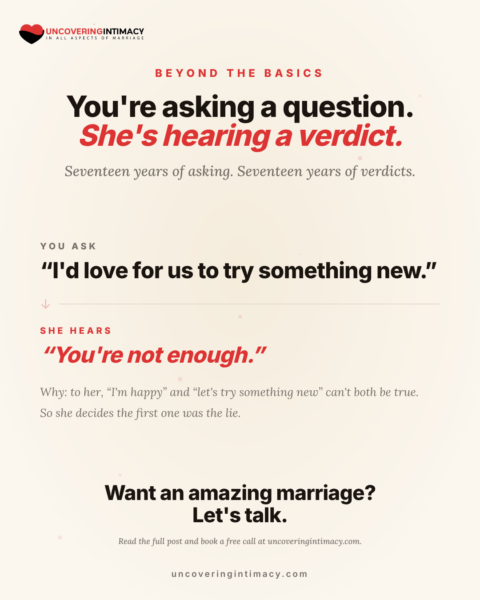
That’s the piece I’d hand you. She can’t make “I am happy with our sex life” and “I would like to try new things” fit in the same head at the same time. Now, I don’t know if you’re both content and curious, but that’s where a lot of husbands end up if the marriage is healthy.
To her, they’re a contradiction, and the only way to resolve a contradiction is to decide one of them is a lie. So she concludes the contentment is the lie. Which means every time you ask for something new, she isn’t hearing curiosity. She’s hearing a verdict: you are not enough, and I have been pretending.
You’ve been asking for seventeen years. She’s been hearing seventeen years of verdicts.
And underneath that there’s often something bigger, which is a fear of risking the mediocrity you already have for something that might be really good. Because what if things change? What if it’s harder? What if you have to have difficult conversations and you don’t handle them well? That’s usually not just a sex problem. It’s typically a whole-life problem.
That’s what I spend a lot of my time on with coaching clients. How do we have these hard conversations? How do we shift that attitude to “I want more than this”? And how do we make that shift feel possible, so it doesn’t feel so risky?
Because there’s a good chance your wife doesn’t want to talk about this, or explore it, because the last time she did, it wasn’t safe. That might mean she tried something and you pushed further than she was willing to go. It might mean she tried to share how she felt about something and you took it badly. Or it might be family-of-origin stuff, where she was taught a bad attitude about sex that’s carried forward into your marriage.
About that eye roll
Now let’s come back to the eye roll, because I’ve been hard on this one before and I want to be careful.
I’ve listed eye-rolling as one of the red flags that a marriage is drifting toward divorce, and I stand by that. It sends a very clear message: that his desire to connect is so unimportant to her that it gets the same treatment as a lame joke.
In your situation though, her eye rolling doesn’t seem to be dismissive, but rather full of self-doubt. Contempt doesn’t come with self-doubt. Your wife rolls her eyes, and she says “I guess I’ll just never be good enough for you.” Someone who genuinely thinks you’re beneath her doesn’t also lie awake worrying she’s failing you. They can’t both be sincere.
So read the eye roll through that context. It’s a shield, not a sneer.
That doesn’t make it harmless. It still lands on you exactly like contempt does, which is precisely why it’s on that red flag list, and it’s probably a good part of why this has been eating at you for seventeen years. But it changes what you do about it. You don’t confront contempt. You tell her what the gesture does, because there’s a very good chance she has no idea it’s doing it. Of everything in this post, that’s the easiest conversation to have, and it’s the one I’d have first.
That doesn’t mean it’s an easy conversation, it’s just easier than the other ones.
The sacred cows
Whatever the reason, if you can’t talk about it, you can’t fix it. That’s the real problem here. The rest is context, but this is the issue. Not the oral sex, not the toys. It’s that you can’t have a productive discussion about any of it.
And here’s the detail in your letter that proves it, the one I think you glossed right over:
“I even ask her to do little things like come to bed without panties or send a flirty text, which never happens.”
Stop and think about that. Why would anyone refuse to send a text?
It costs nothing. There’s no hygiene concern, no pain, no exposure, no theology. If her problem were oral sex specifically, or her body specifically, a flirty text would be free.
It isn’t free. And that tells you the fence isn’t around the acts at all. It’s around the topic. She’s not protecting oral sex. She’s protecting a whole territory, and everything that points at that territory, right down to a text message, gets refused on principle.
So you need to have an open conversation about the fact that you don’t feel allowed to have the conversation. That there are sacred cows in your marriage that you’re not allowed to touch. Not allowed to challenge, not allowed to question, not allowed to discuss or try to improve, because they’re simply off limits. That shouldn’t be a valid stance in a loving marriage.
A note for wives and other low-drive spouses
If you’re a wife or husband reading this and feeling defensive on her behalf, or on your own, I get it. So let me say a few things directly to you.
None of this is designed to tell you that you’re inadequate. It isn’t a scorecard, and it isn’t a list of things you’re supposed to be doing. If your spouse asks for something new, they are not filing a complaint about you. They’re doing the one thing the data says actually matters, which is being honest about what they want. The alternative version, the one where nothing is ever said and resentment quietly builds for a decade, is far worse, and I’ve watched it play out plenty of times.
And a wife on our forum said it better than I ever have:
“This concept is challenging for me… I think it’s because it feels like things may never be ‘enough’ for my husband. He will just always want more and more and different and different and edgy and edgy until there is no moral way for me to satisfy him.”
It’s not the “I feel inadequate to fulfil your request”, it’s “if I say yes to this, there will be another ask, and another, and it never stops, and eventually it ends somewhere I can’t go.” – that is the inadequacy they’re feeling – that potential future when they can’t go any further. And if that’s what you believe, then holding the line right where it is isn’t stubbornness. It’s the only rational move you’ve got. Any movement proves the line moves.
I’d offer two things.
First, from another wife in that same conversation, who felt exactly that and then went and found out:
“I totally felt that way myself when I decided to stop being a gatekeeper. I used to say ‘he’s just never satisfied!’ And that is sort of true, he wants sex, a lot. But, now that we have been having regular sex, and I have not been denying him (and even initiating and engaging) we’ve come to a rhythm (or are finding it still) and it is not increasing more and more, and it is not getting more and more edgy”
The escalation she was bracing for didn’t happen. It settled into a rhythm.
Second: if that fear is real for you, then say it out loud. Not “I like what we do already.” Say “I’m afraid this never stops.” That’s a sentence your spouse can actually respond to. They can tell you where the ceiling is. They can’t do that if the only thing they ever hear is no.
If you don’t share your fears, then they can’t comfort you about them.
Where that leaves you
You can’t force someone to grow. If she really doesn’t want to, if she genuinely wants to stay stuck here, then you’re stuck. There isn’t anything you can do about that. You took a vow to love her no matter what, and this is one of those “no matter whats.”
Sometimes the only option left is prayer, and I don’t mean to say that prayer is only a last resort, but rather that all of this should be covered in prayer, and sometimes there isn’t another step that you can take at the moment.
Now, if this conversation has become hostile in your marriage, then pray about it alone, because or else you risk your shared prayer time feeling like a manipulation tactic. If you’re praying with your spouse and saying something like, “God, please soften the heart of my wife who is depriving her spouse, against your word…” or something like that – it’s not going to go well. Don’t do that.
If the conversation is more open and feels like an impasse you both would like to move forward on, then pray about it together and ask God to show you a way forward.
Because if your wife is open to growing, open to changing, open to exploring with you, and you’re willing to do it in a way that’s comfortable for her (or at least not unduly uncomfortable, because all growth is a bit uncomfortable), then there’s a lot of room here. You’ve got seventeen good years, two kids, and a marriage you describe as “pretty darn good”. That’s not a small foundation. Most of what’s broken here is a conversation, and conversations can be learned.
If you want help with that specifically, book a discovery call. I can walk you both through the discussion, help you build better attitudes, better conversations, better communication, and teach you how to handle the conflict when it comes up. Then you can work together to make your marriage amazing for both of you.
Because I’m willing to bet there are things she wishes she could change in the marriage too, that also feel like sacred cows that can’t be touched.
For everyone else
How would you answer this question? I’d love to know what you think below, and maybe the original poster will come and read your thoughts if you have ideas I didn’t, either that support or contradict my stance. The floor is yours.