
SWM 157 – Why Sex Gets Derailed Right Before It Starts
Podcast: Play in new window | Download | Embed
Subscribe to the Podcast: Apple Podcasts | Spotify | Amazon Music | Android | iHeartRadio | Podchaser | Email | TuneIn | Deezer | RSS | More
From time to time I get questions from our anonymous Have A Question page. I received one a bit ago that I thought would be good to answer in its own post because this is a feeling that’s common to a lot of marriages. I’ve heard this same complaint, with very minor variations, from many husbands and some wives.
And like this person, if you don’t know what’s going on, it can lead to some bad assumptions. Maybe this has happened in your marriage. Here’s the question:
Am I going crazy or is my wife subtly sabotaging things?
I’ve often pointed out to my wife that there’s a clear distinction in how she approaches our plans based on whether it’s something she really wants or it wasn’t really her idea. I’ve seen her move mountains and leap over obstacles in some areas of our life together. But in others she’s a never ending fount of potential issues, problems and risks. They seem reliably separable into categories of what she really wants and what I possibly want more.
One area, I see this and is making me feel like I’m going crazy, is our sex life. If we’re going on a holiday and she wants to have a lot of sex, she will plan ahead, bring outfits, lube and be very vocal about it. It’s great, fantastic even. If it’s a regular day we’ve scheduled sex, she won’t exactly say no, but the likelihood of some kind of ailment popping up just on time is about 75%. Tiredness, tummy/digestive problems, a slight cough or cold; just enough to be a dampener.
I particularly enjoy going down on her, but upon approach she will just mention something wrong. (some version of “I haven’t washed up” or “I had an upset stomach earlier”). I like to make out, but after the first peck she’ll says something like “Not too much though, I was getting some sniffles yesterday”. Moreso in the past, she would physically behave like someone who would rather not be touched, as an almost knee jerk reaction to my affection. It’s just too much of a coincidence that when we’re getting intimate she will bring up some of the most off putting topics in a way that perfectly sabotages the mood for me. Sometimes it’ll just be something completely unrelated and left field.
We do talk a lot, so I don’t think it’s a case of just needing some time to offload. We spend an abnormal amount of time together, talk at multiple points during the day and usually a lot in the evenings too. I know she really likes to talk, and I’m willing to be a listening ear but help me out here!
I have raised this with her. She has previously denied it happens at all. She has admitted it now, when I’ve pointed it out in the moment. She has explained some particular situations. She has apologised. She rejects my rationale that it has anything to do with desire or attraction. All of this leaves me none the wiser as to how to move forward. She thinks it shouldn’t be a blocker but for me it is. It completely turns me off and leaves me feeling like a man she’s trying to distract herself from or manage, rather than a man she’s into. Is that the plight of being a husband? When women have affairs with some guy they desire, do they ever bring up weird unrelated issues right before they get intimate?
I know you can’t confirm if I’m imagining it, but is this something a lot of women do? Am I out of touch as a husband to expect that our only scheduled time to be intimate may not be the time to talk about an ingrown hair or pest control incident? Am I expecting too much of a choreographed encounter if I think we should both be at least trying to make it appealing?
The False Binary That Makes You Lose Either Way
Like I said, I’ve heard this time and time again, and you’ve done what most people do in the same situation – you’ve set this up as a binary choice when there are other options, including what is probably going on. And the way it’s framed, you can’t win. Either you’re going crazy, in which case you lose. Or your wife is being malicious, in which case you also lose. This is a bad way to frame things, particularly because neither are likely to be true.
I doubt you’re crazy. I also doubt your wife is malicious. Malicious spouses are actually pretty rare in my experience.
I did post your question in our supporters forum, and unsurprisingly both husbands and wives said this sounded very familiar. They experience it too. The husbands tended to resonate with the frustration. The wives tended to resonate with a sense of shame or guilt because they know they’ve exhibited the same behaviour, although I want to again point out that I’ve seen this dynamic with the roles reversed.
Why Common Patterns Point Away From Malice
Because it’s so common, that alone tells us something important – if it’s a very common experience that consistently shows up across so many marriages, then it’s likely not malicious. That’s far more consistent with an autonomic response of some sort, because even the spouses who felt embarrassed that they behave this way don’t know how to stop or, or why they’re doing it.
It doesn’t mean these wives (or husbands in some cases) are actively trying to sabotage their sex life. In fact, if they’re in my forum, they are at least sex-positive, and more likely actively trying to improve this part of their marriage.
And yet, what you’re describing is extremely common.
So if it isn’t madness, and it isn’t malice, what’s actually going on?
The Brain System You’re Running Into – The Insula
Almost everything you describe points to one specific brain system. It’s responsible for disgust-avoidance and disease-protection, centered primarily in a region of the brain called the insula.
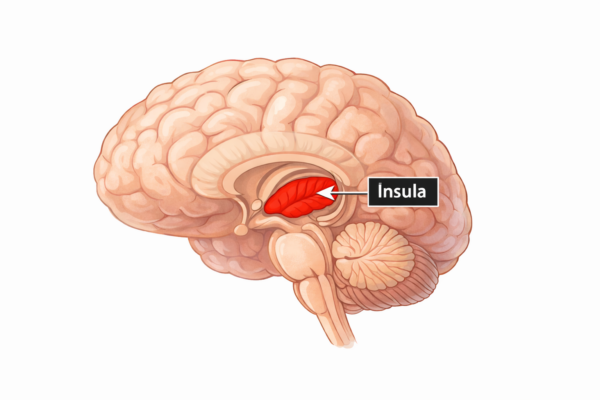
The insula is a cortical region deep within the brain heavily connected to the prefrontal cortex and the limbic system. Its job is survival. Not moral judgement, not relationship evaluation or health – survival of itself.
The insula monitors internal bodily states and external contamination risks. It tracks things like:
- Hygiene and cleanliness
- Smells and tastes
- Bodily fluids
- Signs of illness
- Internal sensations like nausea, fatigue, congestion or discomfort
When the insula detects anything that might increase the risk of infection or physical harm, it produces an aversive response. Not fear exactly, but a subtle signal that tells them to “avoid this” – whatever the thing that’s setting it off is. That signal can show up as thoughts, feelings, urges or verbalized concerns.
What Sexual Arousal Changes
Here’s the part that’s confusing you – sexual arousal changes insula activity.
When arousal increases:
- Dopamine-driven reward circuits ramp up
- Motivation and approach behaviour increase
- Prefrontal inhibition relaxes
- The insula’s disgust signaling is muted
This is not just a guess. Research shows that sexual arousal and disgust responses interact in the brain, and that arousal tends to dampen natural disgust reactions. The insula, which helps process both bodily feelings and disgust-related signals, is part of the broader network that changes its activity when sexual arousal increases. Here’s a study on that effect: Sexual arousal may decrease natural disgust response
This is why people willingly engage in behaviours during sex that would otherwise feel uncomfortable, unclean, or even disgusting outside of arousal. The system that normally says “this could make you sick” is temporarily dialed down.
Why Context Changes Everything
So now look at the pattern being described.
When intimacy begins before arousal is established, the insula’s aversion mechanism is still fully active. Its job is to scan for problems. When it finds one, it speaks up. It’s as if her brain has been asked, “Is there any health-related reason we shouldn’t have sex right now?” and off it goes, searching for anything that might qualify.
Things it might not have noticed earlier suddenly come to the foreground, because the system has been inadvertently prompted to look for them.
That’s why the objections are so reliably in the same category:
- I didn’t shower
- I had stomach issues earlier
- I might be getting sick
- I don’t feel clean
- Not too much, I had sniffles
Those are not random mood killers. They are exactly the kinds of things the insula is designed to notice when it is operating in its avoidance role.
Once arousal is already present, however, those same signals either never appear or don’t feel important enough to mention. That’s why the same woman can plan elaborate sexual encounters in one context and seem almost hyper-aware of bodily imperfections in another.
In one context, that internal question never gets asked. In the other, it does. Or if it is asked, the answer is so quiet it doesn’t register.
The difference is not attraction. The difference is mental context.
Is the insula doing its primary job of disgust-avoidance, or has it switched to its secondary role?
The Insula Doesn’t Shut Down – It Switches Jobs
For a long time, it was assumed that the insula shut down during sexual arousal. FMRI scans show that this isn’t true. The insula remains active. It just changes what it is doing.
Instead of scanning for risk, it is retasked to track things like:
- Bodily pleasure
- Arousal-related sensations
- Heart rate, warmth, genital sensations
- Emotional intensity
In short, it switches from “Should we avoid this?” to “What is happening in the body right now?”
That’s because the insula isn’t just a disgust-avoidance center. It’s a body-awareness hub.
So it doesn’t merely stop blocking arousal. It actually contributes to it by amplifying bodily sensation and emotional intensity.
This is why I am constantly telling husbands that they need to learn how to turn on their wife’s brain.
Mental arousal for women is critically important. If you’re trying to generate desire using only physical touch, you’re doing this on hard mode. The body is only one part of the system.
When the brain becomes aroused, dopamine signaling increases, particularly through the nucleus accumbens. At the same time, the prefrontal cortex begins to quiet.
The medial prefrontal cortex handles social self-evaluation and reputation management. This is where thoughts like “What would people think if they knew I did this?” or “Good girls don’t like sex” tend to live.
The dorsolateral prefrontal cortex handles long-term consequence monitoring. Much of the messaging many women received growing up about sex lives here. “Don’t have sex because bad things will happen.” Pregnancy. STDs. Loss of approval. Loss of God’s love. Even when those reasons are no longer relevant, those pathways can be very hard to override.
The anterior cingulate cortex manages conflict between desire and values. This is where the “It feels good, but it might be wrong” tension shows up. That system also quiets during arousal.
In short, when arousal increases, all the functions we tend to lump together as “inhibition” decrease. The brain shifts from scanning for risk and judgment to focusing on experience.
Why This Can Feel Like a Different Personality
The shift can be so dramatic that it almost feels like a different personality has emerged.
Some wives feel deeply unsettled by this afterward. When they “come down” from arousal and those inhibitory systems come back online, they struggle to reconcile how willing, enthusiastic, or adventurous they felt the night before. That discomfort can lead them to feel embarrassed, ashamed, or even scared.
In that state, it can feel easier to believe they were tricked, pressured, or coerced, rather than accept that their own brain simply operated differently in a different context.
So while they may have been eagerly asking for certain things the night before, the next morning they feel conflicted because all the judgment, risk assessment, and damage-control systems are back online.
If someone doesn’t understand that it’s possible to operate very differently in two mental states and still be the same person, that internal conflict becomes intolerable. And when internal conflict feels unbearable, we often push it outward and blame our spouse instead.
That feels easier.
But there is no need for that.
She wasn’t coerced. She wasn’t tricked. She simply had a different perspective in a different neurological context.
One system was temporarily downregulated while another was upregulated. That shift produces a very real change in responses, and those responses are often what we interpret as personality.
It’s still the same person – but in a different context.
Why This Feels So Targeted Towards You
From your side, this lands like an intentional sabotage because the timing is impeccable. As soon as you bring up sex, suddenly she doesn’t feel well when she’s never mentioned it before, or remembers she didn’t shower, or any of the other myriad reasons. The information appears precisely when it will have the strongest dampening effect on your desire.
But it’s because the insula is being prompted just then by your initiation. That’s what kicks off its system check to see if there’s any reason not to engage in sex, and if you start looking for reasons, you’re probably going to find them.
But from her side, it often feels like honesty or even responsibility. Her brain is saying “before this goes further, you should know…”
And again, the problem is that you’re trying to jump into sex without switching mental contexts for her first. You need to get that insula to switch into “arousal awareness” mode rather than a “why shouldn’t we do this” gatekeeping mode.
Why “Just Push Through” Backfires
This is why telling someone “just relax” or “get out of your head” almost never works.
Trying to override or make the insula switch gears with willpower usually increases anxiety, which further activates the insula while also increasing cortisol, which decreases dopamine – which is needed for arousal.
In short, telling her to “just relax” is going to do the opposite. That’s why these situations often spiral instead of resolve.
What This Means Practically
Now, knowing what’s going on in the brain can be helpful. It can help us understand our spouse better, recognize that this isn’t malicious behavior, but rather a good system that’s just getting in the way sometimes. That can help us give our spouses grace when we feel hurt, ignored or disconnected due to its hijacking of their libido.
But it also gives us clues about what approaches might work better.
If the problem is that the disgust-avoidance role is active before arousal has had a chance to switch its function, then the solution isn’t trying to willpower your way through it because this is a subconscious system, and they don’t like to be ignored or overridden.
Instead, you need to change the order of operations.
Scheduled Sex Isn’t the Problem. Cold Starts Are.
Scheduled sex gets blamed for a lot of things it didn’t actually cause. Scheduled sex can absolutely work. For many couples, it is the only way intimacy happens at all.
What doesn’t work is treating the scheduled time as the starting line instead of the finish line, or not giving enough time to ramp up.
If a couple has barely interacted all day, or communication has been purely logistical, then the scheduled time itself needs to include warm-up. You cannot expect arousal to switch on instantly just because the clock says it’s time.
That warm-up does not have to mean flirting all day or maintaining constant sexual energy (though when this is possible, that definitely helps, like when you’re on vacation). It simply means that desire usually needs a transition period. Time to connect. Time to shift gears. Time for arousal to arrive before physical intimacy is expected.
Sometimes that means she is intentionally doing things that she already knows help her move toward desire once the window opens. Other times it means he takes the lead during that scheduled time by slowing things down, reconnecting emotionally, and letting arousal build instead of rushing towards the outcome.
The point is not that intimacy needs to be manufactured all day long (though again, that definitely helps) – the point is that if sex is planned after a long gap in connection, the plan needs to include space for desire to switch gears in the insula and other parts of the brain.
Scheduled sex works best when it includes a runway, not when it assumes a cold start will somehow work this time.
As an example, we have a pretty standard Friday night ritual, and our brains like rituals. We each shower, so we feel clean – which already takes out a lot of that insula-monitored objections. We observe Sabbath, so we don’t work Friday evenings to Saturday evenings, which means there is nothing we’re expected to do, no jobs to complete, no work deadlines to worry about. We try to shut out the world on Sabbath, so we don’t watch TV, movies, etc. Instead, we pick a book that helps us focus on our marriage, and we use it as a starting point for deep conversations.
My wife reads while I listen and massage her. This helps the insula switch over, not only because it includes some non-sexual touch (that tends to get more sexual as it progresses), but also because we tend to talk about intimate subjects, which makes us feel connected, bonded and safe with each other.
Friday nights almost always end well because we’re intentional about manufacturing a context that works for us. You’re more than welcome to steal that routine if it works for you.
I hope that helps.
If you have a question you’d like to have answered, you can submit it on our anonymous Have A Question page.
Join Our Community!
Support this ministry and get exclusive access to our private forum, featuring additional resources, live discussions, and a supportive community of like-minded couples.
Learn More & Support Us