Most Marriage Conflicts Aren’t About Right and Wrong
Podcast: Play in new window | Download | Embed
Subscribe to the Podcast: Apple Podcasts | Spotify | Amazon Music | Android | iHeartRadio | Podchaser | Email | TuneIn | Deezer | RSS | More
One of the things that comes up a lot in my coaching calls looks like this: a couple describes their latest fight. Maybe it’s about how the dishwasher gets loaded, or what time the kids should be in bed, or whether you deal with a problem the moment it comes up or sleep on it first. The details change, but two things are always true: both of them are frustrated, and both of them are certain they’re right.
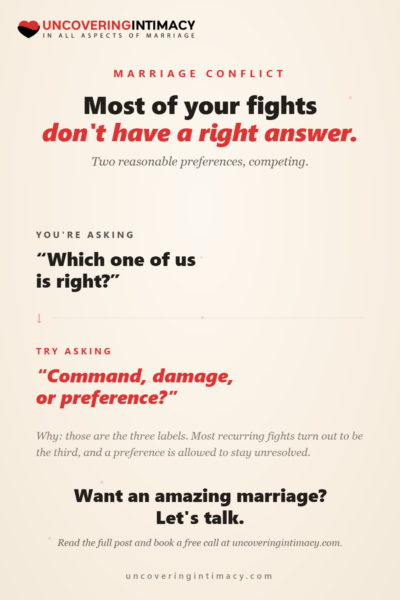
And I find myself explaining, again, a principle that is obvious when it’s stated, but doesn’t seem to be common for people to operate under: you don’t think alike. You never will. And that’s okay, because most of what you’re fighting about doesn’t have a right answer.
Two reasonable preferences, competing
I said this in passing in What does biblical leadership look like in a marriage?, and someone in our forum asked if I had a blog post about it. I didn’t, but it deserves its own post, and so here we are. Most marital conflict is not about right and wrong. It’s two reasonable preferences competing.
Think about the fights that actually recur in your marriage. How clean the house needs to be before company comes. Whether money left over at the end of the month gets saved or enjoyed. How much detail counts as “telling me about your day.” Whether a birthday is a big deal or just a Tuesday. What counts as initiating sex. Which love language gets used.
None of those have a morally correct answer. Scripture doesn’t specify a bedtime. There is no commandment about loading cutlery handle-up or handle-down. These are preferences, formed by your upbringing, your personality, your family culture and a thousand experiences your spouse wasn’t there for.
I mean, you could argue (and rightly so) that spoons placed handle-up will tend to stack together and then not get clean, but it’s still not a moral issue. Those who choose to do it the more ineffective way still aren’t sinning by doing so. They just get to rewash dishes when it comes out, and that’s the extent of their penance for the atrocity.
The trouble starts when we promote a preference to a moral issue. Once the fight becomes “right vs. wrong” in your head, everything changes. Compromise stops feeling like flexibility and starts feeling like losing, or worse, like condoning something wrong. Your spouse’s disagreement stops being a difference and starts being a character flaw. You’re no longer negotiating; you’re prosecuting.
Why we’re all so sure we’re right
Years ago, buried in a podcast episode about half a dozen other things, I talked about the concept of a “reality tunnel”. I had honestly forgotten about this term until one of my clients brought it up a few months ago because he was ripping through old podcast episodes.
Reality tunnels are the idea that each of us experiences the world through our own filter of beliefs, experiences and assumptions, and then quietly assumes everyone else is in the same tunnel.
Marriage makes this worse, not better. Your lives are so intertwined that of course you assume your spouse sees things the way you do. On top of that, we like being right, and one of the main ways we feel validated in being right is when people agree with us. So when your spouse sees things differently, doesn’t notice what you notice, doesn’t think what you think, it’s easier to get angry than to consider that your way might just be a way.
There’s a second layer to this, one I covered in the red flags episode: we see our own struggles, intentions and feelings far better than we see our spouse’s. You know the whole story behind your preference. You lived it. Their preference just looks like a wrong answer with no reasoning behind it, because you weren’t there for the reasoning.
So it isn’t that your wife thinks you can read her mind, and it isn’t that your husband thinks you’re being deliberately difficult. It’s that each of you quietly believes your way of thinking is the way, and everything else is a deviation from it.
The Bible already makes this distinction
Here’s what’s interesting: Scripture itself distinguishes between commands and preferences, and it does so in the middle of a church fight.
In Romans 14, the early church was divided over two separate arguments: what a believer was allowed to eat, and which days were holy. These weren’t trivial to the people involved. They felt like matters of faithfulness. And Paul, who was never shy about drawing hard lines when something was actually sin, refuses to draw one in either dispute. On the food question:
Romans 14:2-3 – One person believes he may eat anything, while the weak person eats only vegetables. Let not the one who eats despise the one who abstains, and let not the one who abstains pass judgment on the one who eats, for God has welcomed him.
And on the days question, the same answer:
Romans 14:5 – One person esteems one day as better than another, while another esteems all days alike. Each one should be fully convinced in his own mind.
He opens the chapter by telling them to welcome one another, “but not to quarrel over opinions” (Romans 14:1), and lands on the instruction I quoted in the leadership post:
Romans 14:19 – So then let us pursue what makes for peace and for mutual upbuilding.
If the church can hold differing convictions about things its members considered deeply spiritual, without dividing over them, then a husband and wife can survive differing preferences about what weekends look like, rest or activities.
Proverbs has something to say here too:
Proverbs 14:12 – There is a way that seems right to a man, but its end is the way to death.
That verse usually gets preached about sin, and fairly. But notice the mechanism it describes: seems right. Our internal sense of “obviously correct” is not a reliable instrument. Paul says the same thing more gently: don’t think of yourself more highly than you ought, but “think with sober judgment” (Romans 12:3). Sober judgment includes being able to say: this thing I feel strongly about is a preference, not a principle.
How to tell a preference from a principle
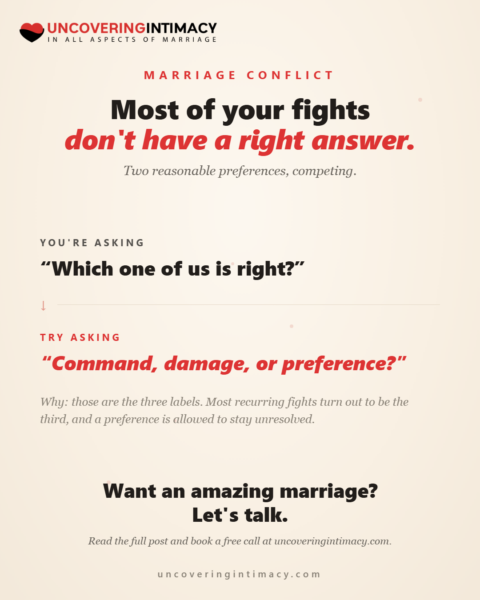
When you’re in the middle of it, everything feels like a principle. So here are three questions to ask about any recurring conflict:
- Is a biblical principle being violated? Not “would God probably agree with me,” but a principle you could actually name: honesty, faithfulness, stewardship, treating your spouse with love and respect. If you can’t say which principle is at stake without stretching, there probably isn’t one. Be honest here; most of our daily conflicts fail this test immediately.
- Does it cause real damage? Some things aren’t commanded either way but still matter: choices that harm your health, your finances, your children’s wellbeing. Real damage is measurable and would look like damage to a neutral observer. “I would be annoyed” is not damage. “I think my way is better parenting” is not damage.
- Or is it just not how you would do it? If it failed the first two tests, this is what’s left. It’s a preference. It’s allowed to stay unresolved, be traded, or be handed to whichever of you cares more.
One guardrail: abuse is never a preference-level issue, and sin doesn’t become acceptable because you both agreed to it. Agreement is not a moral sanitizer:
Acts 5:9 – How is it that you have agreed together to test the Spirit of the Lord?
Sapphira went along with her husband, and it did not protect her. I wrote more about that boundary in the leadership post, so I won’t repeat it all here. But nothing in this article is about tolerating harm. It’s about deflating the fights that were never about harm in the first place.
The corollary to that is: just because you feel hurt doesn’t mean you’ve been harmed. Hurt feelings are real, but they’re information, not a verdict. Some of what gets labelled a trigger these days is a strong preference being challenged. Real trauma exists, and I work with people carrying it. But “this bothers me” and “this is harming me” are different claims, and a marriage needs to be able to tell them apart.
What to do when it’s a preference
Get curious, not angry. When your spouse does something that seems “obviously” wrong to you, the assumption underneath your anger is usually that they had no good reason. In my experience they almost always had a reason, and that reason might be “I didn’t think it was that important”, because to them it wasn’t. But don’t assume they weren’t thinking. Ask what they’re seeing that you’re not. I tell coaching clients this constantly: assume your spouse loves you, and when their behavior seems to say otherwise, investigate before you convict.
Respond to what they said, not to your interpretation of it. A huge share of preference fights happen mostly inside your own head. Your spouse says something, you interpret it, and then you argue with the interpretation. Confirming what they actually meant before responding sounds almost too simple to matter, which is why I wrote up a four-step way to practice it.
Pick your battles. As I said in the resiliency episode, not everything is worth a fight, and fighting about everything fills a marriage with constant dispute. Some differences need discussing. Many just need room.
Let some differences stand. I know couples where one is vegetarian by conviction and the other isn’t, where one keeps Halloween at arm’s length and the other hands out candy, where one grows through group Bible study and the other grows best alone with a journal, and the marriage holds. In How to use conflict to create intimacy I made the case that conflict may not even be a result of sin, just of free will. Within the Godhead we see differing perspectives and distinct personalities, handled so well that the result is perfect unity. Difference is not the enemy of oneness. Handling difference badly is.

Unity is not uniformity
God’s design for marriage is that two become one flesh. Not one brain. If He had wanted you married to someone who thinks exactly like you, He could have arranged it, and you would have learned much less and grown much less and been far more confident in some opinions that deserved challenging.
The goal was never to think alike. The goal is to love someone who doesn’t think like you, without needing to fix that about them.
Try this: together, list your last three conflicts. Run each one through the three questions above and agree on a label: command, damage, or preference. Then talk about what changes if you both start treating the preferences like preferences. My guess is that the argument gets a lot smaller once neither of you has to be wrong for it to end.