
Why Don’t We Ever Talk About What We Actually Want in Bed?
Podcast: Play in new window | Download | Embed
Subscribe to the Podcast: Apple Podcasts | Spotify | Amazon Music | Android | iHeartRadio | Podchaser | Email | TuneIn | Deezer | RSS | More
You know the feeling. There’s something you wish were different about your sex life. Something you want more of, or less of, or just… different. And you haven’t said it. Maybe you’ve tried before and it didn’t go well. Maybe you’re not sure how to bring it up without it sounding like a complaint. Maybe you’ve just quietly decided that some things are better left unsaid.
Our survey data suggests that a lot of married couples are living in exactly that silence. And it’s costing them more than they probably realize.
The Pattern That Kept Showing Up
We surveyed over 1,000 married Christians about their sexual relationship, including manual sex, oral sex, and mutual masturbation. Across all three, the same pattern emerged without exception: couples who can talk openly about sex report dramatically higher satisfaction than those who can’t.
This isn’t a subtle trend. The gaps are large enough to be hard to ignore.
Among couples who are very comfortable discussing manual sex, average sexual satisfaction is 3.90 out of 5. Among those who are very uncomfortable discussing it, that drops to 1.78. That’s a 2.1-point gap on a 5-point scale.
The numbers are nearly identical for oral sex (gap of 1.79) and mutual masturbation (gap of 1.75).
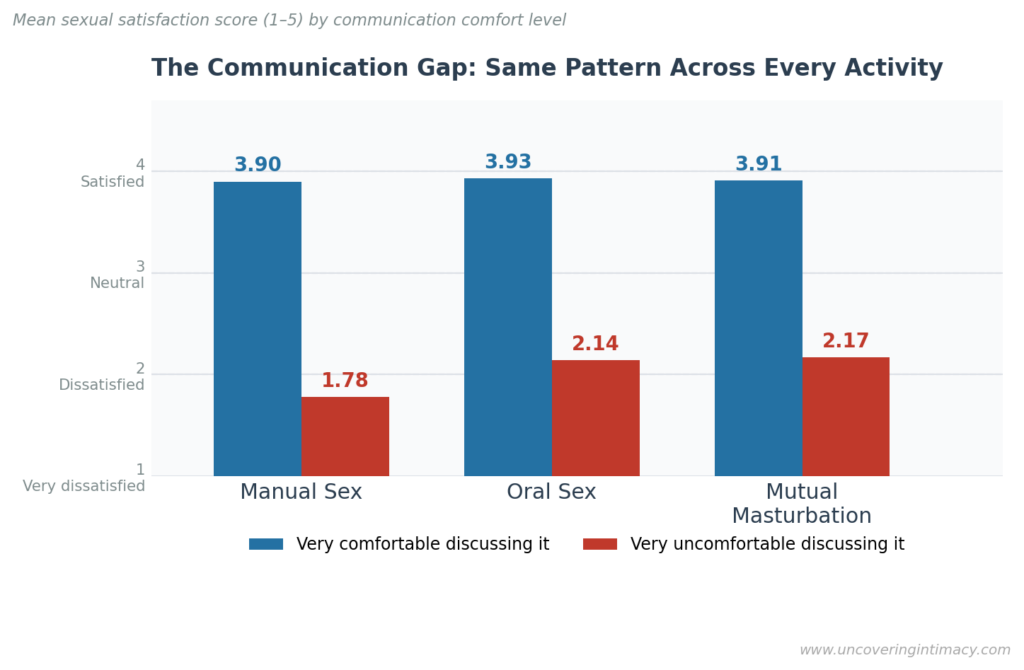
Three different activities. Three different questions. The same result every time.
It’s Not Just One Activity
What makes this finding particularly striking is how consistent it is. It would be easy to chalk up the oral sex findings (which we covered in a previous post) to something specific about that activity. Oral sex carries its own emotional weight for a lot of couples, so maybe the communication gap there is a special case.
But manual sex? Mutual masturbation? These are activities that couples often treat as lower-stakes, less loaded. And yet the communication pattern predicts satisfaction just as strongly across all of them.
The correlation between communication comfort and sexual satisfaction hovers around r=0.42 to r=0.43 across all three activities. That’s a strong, consistent relationship; not a fluke.
What this suggests is that the issue isn’t really about any specific sexual activity. It’s about whether the couple has built a marriage where talking about sex is possible at all.
Who Is Actually Talking?
Only about 37% of respondents describe themselves as very comfortable discussing manual sex with their spouse. For oral sex it’s 36%, and for mutual masturbation it drops to 32%.
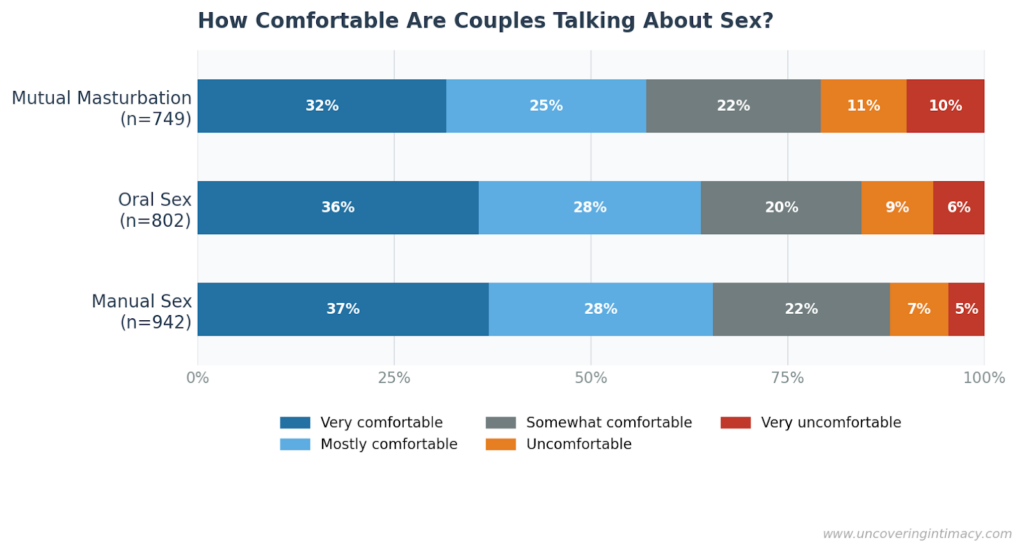
That means the majority of married couples in our sample are navigating their sex lives with some degree of hesitation, awkwardness, or outright avoidance when it comes to talking about what they want.
The “want to discuss but stuck” numbers tell their own story. For mutual masturbation alone, 10% of respondents said they want to discuss it but haven’t, and another 8% said they want to but don’t know how. That’s nearly 1 in 5 people sitting on something they’d like to say and haven’t.
Across all three activities, there are people who want this conversation and simply haven’t found a way into it.
What Openly Discussing It Actually Does
When couples do discuss their preferences openly and in detail, the difference is stark. For manual sex, those couples average 3.97 on overall sexual satisfaction. Those who want to have the conversation but don’t know how score 2.29. That’s nearly a 1.7-point gap, and it holds across oral sex and mutual masturbation too.
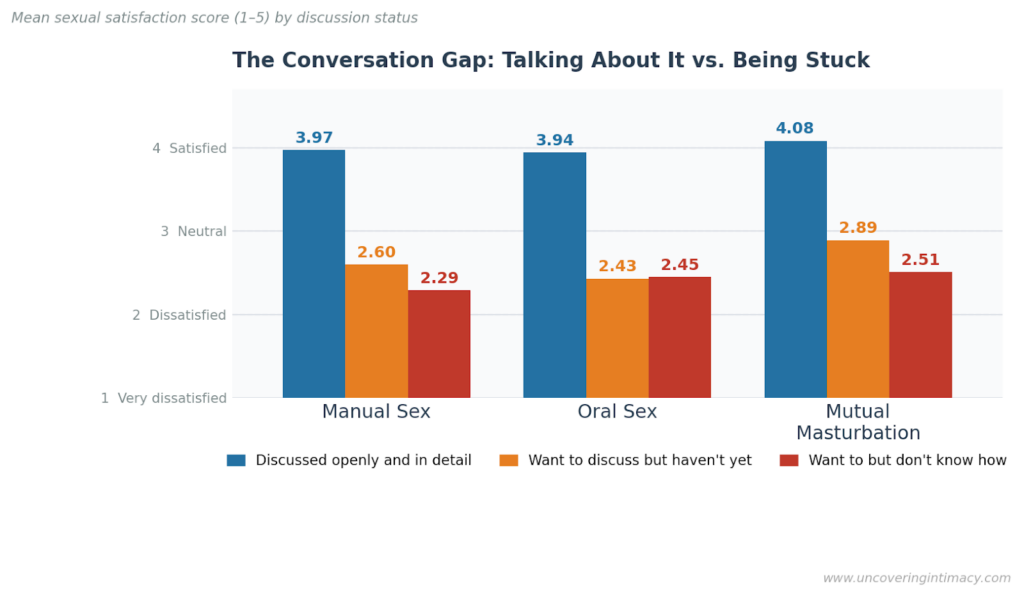
It’s worth being honest about what the data can and can’t tell us here. We can’t say with certainty which came first: whether open communication leads to better sex, or whether couples who are already happier find it easier to talk. The causation likely runs both directions. But the pattern is consistent enough, and the gaps large enough, that something real is going on.
One clue: the correlation holds even when controlling for how often couples have sex. So it’s not simply that more sexually active couples talk more and are also more satisfied. Communication seems to matter independently.
The Gender Picture
Men and women in our sample are fairly similar in their communication comfort levels, which is actually a little surprising. For manual sex, 36% of husbands describe themselves as very comfortable discussing it, compared to 40% of wives. The pattern holds for oral sex, though the gap narrows, and flips slightly for mutual masturbation where husbands edge ahead.
I also thought it was interesting that wives being more willing to discuss doesn’t mean they’re more willing to engage; it just means they’re more comfortable having the conversation. In my experience working with couples, men are often less likely to verbalize discontent with their sex life. They may bring it up with me, but they don’t see their wife as a safe person to raise it with, or they’ve given up raising it. Some will still bring it up, but far more won’t. Wives tend to be less worried that an honest conversation will damage the relationship. If a wife is unhappy with her sex life, she’s far more likely to let her husband know and push for change.
What that means in practice is that both spouses often end up in the same silence, but for different reasons. Husbands are sitting on something they want but haven’t asked for. Wives are more likely to be the ones who could open the door, but may not realize it’s closed.
Why the Silence Persists
If talking about sex is this strongly associated with satisfaction, why aren’t more couples doing it?
A few reasons show up repeatedly in the comments our respondents left:
Couples who haven’t had the conversation yet often don’t know how to start without it feeling like a criticism. Saying “I wish we did more of X” can easily land as “you’re not doing enough,” even when that’s not the intent at all.
Some couples had an early attempt that went badly; one spouse felt judged or pressured, and the subject quietly got closed. Years can pass without it being reopened.
And for some people, the silence has simply calcified into an assumption: this is just not a conversation our marriage has. The longer it goes unspoken, the more weight it accumulates, and the harder it becomes to raise.
A Note on “We Don’t Need to Talk About It”
One group worth mentioning: about 5-7% of respondents said they haven’t discussed preferences because they don’t think it’s necessary. Their satisfaction scores are actually reasonably good, around 3.4 to 3.7 on sexual satisfaction, well above the struggling groups.
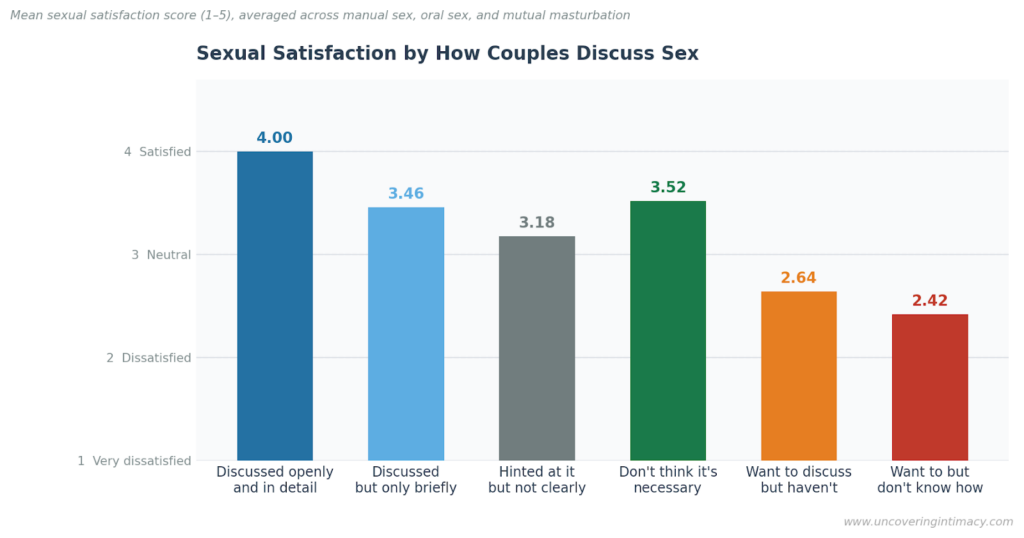
So there are couples who are doing fine without explicit conversation. Some couples develop a kind of wordless attunement over years of marriage that works for them. The data isn’t saying every couple needs to have a formal sit-down about their sex life.
What it is saying is that for couples who are dissatisfied, the absence of open communication is almost always part of the picture. And for couples who are stuck and want to change something, the conversation is usually the place to start.
So, if you’re dissatisfied; if there’s something you’ve been sitting on, something you want more of or less of or just different; the silence is almost certainly part of the problem. And the conversation, as awkward as it might feel to start, is almost certainly part of the solution.
If you’re not sure how to open that door, start small. You don’t have to tackle everything at once. Pick one thing, one honest sentence, and see what happens when you say it out loud to your spouse.
That’s it for today. If this episode resonated with you, and if you want to dig deeper into building that kind of openness in your marriage, head over to UncoveringIntimacy.com. There’s a lot there to help you get started.
Join Our Community!
Support this ministry and get exclusive access to our private forum, featuring additional resources, live discussions, and a supportive community of like-minded couples.
Learn More & Support Us