
You know the cycle. Something happens, a tone of voice, a forgotten commitment, a moment that stings, and suddenly you’re both defending your corners instead of actually connecting. You talk at each other. You wait for your turn to explain yourself – maybe you don’t do very well at waiting. Maybe you interrupt and talk over each other a lot. As a result, after the “conversation” ends, you both feel more alone than before.
What if there was a simple framework that could break that cycle? Not a magic fix, but a real, learnable skill that draws you toward each other instead of apart?
It’s called the Mirror Game. It’s easy to explain and simple to implement – the hard part is remembering to do it.
Why Most Conflict Goes Sideways
Here’s what usually happens when one of you is hurting: the hurt person leads with their pain, the other person gets defensive because they, in turn, feel hurt, and the conversation becomes a competition to be understood rather than a genuine effort to understand.
The counterintuitive truth? The person who’s hurting needs to go first, not to be understood, but to understand. Here’s why.
When you lead with curiosity toward your spouse before asking them to hear your pain, something remarkable happens: they stop defending and start opening. That creates the safety for them to actually receive what you’re feeling.
This is the Mirror Game. And it works in four steps.
Step 1: Ask For Their Perspective
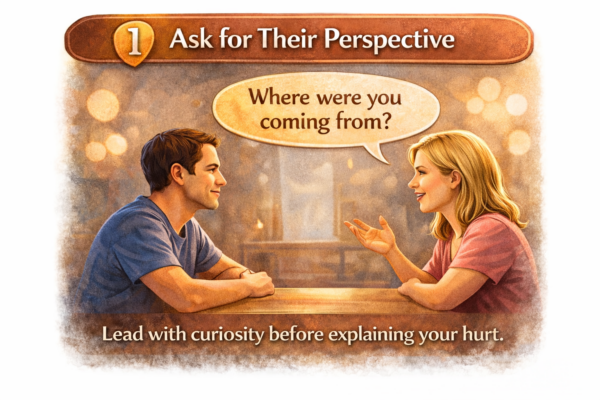
Before unloading everything you’re feeling, pause and acknowledge that you might not have the full picture. In fact, you definitely don’t, because you’re not a mindreader – no one is.
This is easy to do – just follow this pattern:
When [blank] happened, I felt [scared / frustrated / hurt / shut out]. But I might be missing something. Where were you coming from?
This doesn’t abandon your perspective or pretend your feelings aren’t real, but it signals to your spouse that you’re coming with curiosity, not accusation. That you’re assuming they love you and if you feel hurt, that it’s because you don’t understand something, and you’re not going to assign motive – you’d rather hear it from them. This is the “Assume Love” part of our Marriage Mastery Foundations.
That single shift can change the entire trajectory of a conversation.
Of course, you can only do this if you’ve first taken a moment to regulate yourself, to get out of a fight/flight/free/fawn response and into genuine openness.
He who has knowledge spares his words, and a man of understanding is of a calm spirit. – Proverbs 17:27
Step 2: Reflect Back What You Heard
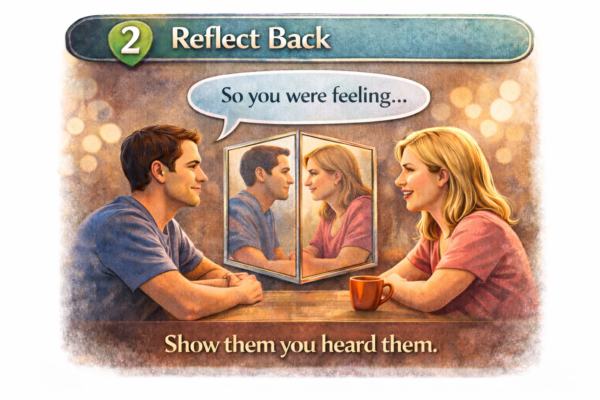
Once your spouse shares their perspective, repeat it back to them in your own words before moving on.
This step is more powerful than it sounds. Your spouse doesn’t just need to be understood, they need to feel understood. There’s a difference. When you repeat back what you heard them say, in your own words, something shifts in them. Their nervous system settles. Their walls come down.
It might feel awkward at first. Do it anyway. You’re not just validating their experience, you’re proving that you actually showed up to listen. You’re choosing to be loving and curious despite being hurt.
Step 3: Ask For Them To Do The Same
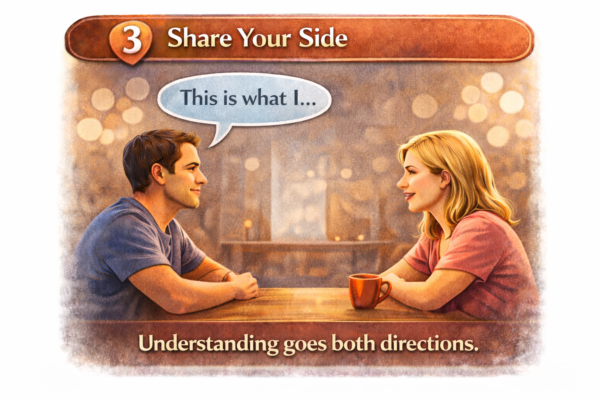
Here’s where many well-meaning spouses drop the ball, especially the peacekeepers and the conflict-avoiders.
After your spouse shares, it’s tempting to say “Okay, I get it, we’re good” and move on. Resist that urge. Because when you do that, you’re unintentionally sending a message: your feelings are the only ones that matter here and then you miss out on half the benefit.
Instead, ask to share your experience too. You can say:
“That’s not quite how I experienced it. Can I share where I was coming from?”
This isn’t escalating the conflict, it’s offering the other perspective that they’re missing. True resolution isn’t one person giving in. It’s two people actually seeing each other and then deciding how to move forward together.
In marriage, we’re called to a mutual kind of love.
submitting to one another in the fear of God. – Ephesians 5:21 NKJV
That means both partners’ inner worlds matter. Your feelings matter. Don’t quietly erase them in the name of keeping the peace.
Step 4: Be Seen and Confirm It
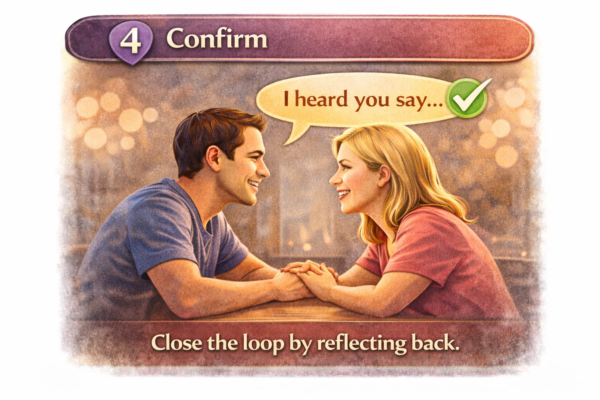
Now share your perspective. Be honest and specific. And when you’re done, close the loop:
I’m not sure I was making sense. Do you mind telling me what you heard me say?
Ask your spouse to reflect your words back to you, just as you did for them. This isn’t a test, it’s a gift. It gives them the chance to show you they were really there with you. And more often than not, something surprising happens: in the act of reflecting back what they heard, they discover something new in themselves too. A little more empathy. A deeper connection. A moment of Oh, I didn’t realize that’s how it felt for you.
That’s the mirror working.
This framework won’t solve every conflict overnight
In fact, it doesn’t solve conflicts itself. What it does is expose the conflict from both sides – it shines a light onto it so that you can see more clearly the entire picture.
And yes, sometimes a spouse won’t engage. They won’t reflect. They won’t ask to see you. That’s a harder conversation about boundaries and patterns, and it deserves its own post.
But for the everyday friction of marriage, the misunderstandings, the hurt feelings, the moments where you’re talking past each other, the Mirror Game is a practical, grace-filled way to pursue the kind of deep knowing that marriage is meant to hold.
After all, isn’t that what we’re after? Not just peaceful coexistence, but the holy gift of being truly known by the person who chose you?
Join Our Community!
Support this ministry and get exclusive access to our private forum, featuring additional resources, live discussions, and a supportive community of like-minded couples.
Learn More & Support Us