Category Archives: Marriage


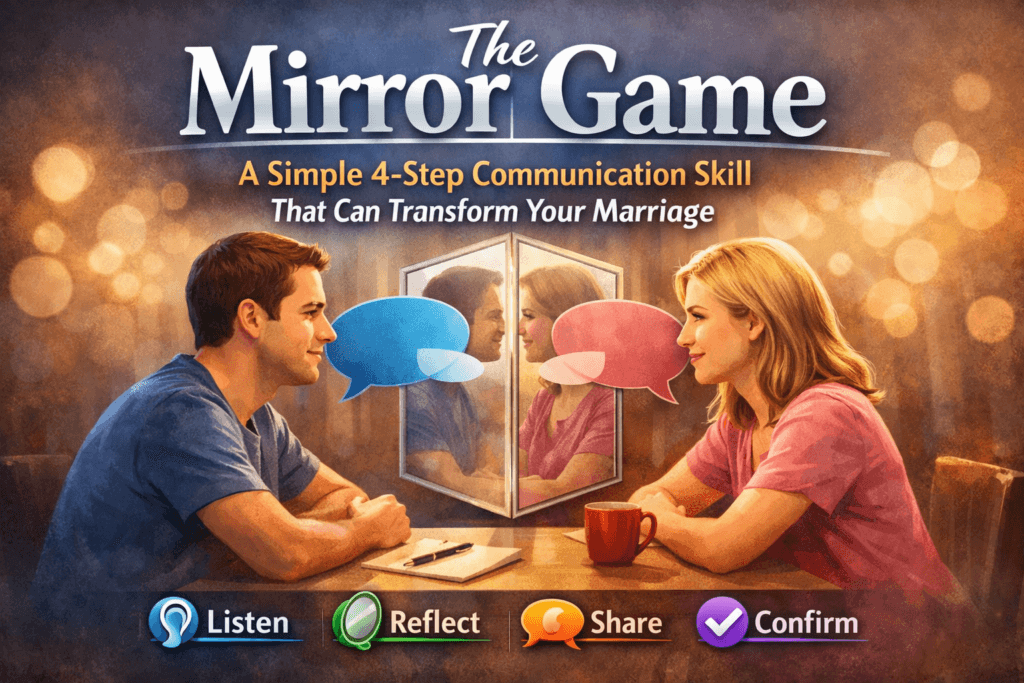
The Mirror Game – A Simple 4-Step Communication Skill That Can Transform Your Marriage

You know the cycle. Something happens, a tone of voice, a forgotten commitment, a moment that stings, and suddenly you’re both defending your corners instead of actually connecting. You talk at each other. You wait for your turn to explain yourself – maybe you don’t do very well at waiting.  Maybe you interrupt and talk over each other a lot. As a result, after the “conversation” ends, you both feel more alone than before.

What if there was a simple framework that could break that cycle? Not a magic fix, but a real, learnable skill that draws you toward each other instead of apart?

It’s called the Mirror Game.  It’s easy to explain and simple to implement – the hard part is remembering to do it.

Are you actually upset about what happened, or just hungry, angry, lonely or tired?

Often the fights we have as couples aren’t about what we think they are.  Because while we think we’re fighting about respect, sex, tone, in-laws, money, kids or anything else under the sun, often the real issue is far less dramatic.

Sometimes it’s just physiology.  Before a disagreement turns into an argument (or whenever you “wake up” enough to think “how did this become a fight?!”), there’s a simple checklist worth running first:

HALT.

Hungry
Angry
Lonely
Tired

SWM 150 – Control, sex and marriage

Last month, I watched a great video by Gary Thomas and his wife Lisa on how a controlling spirit can harm a marriage. It got me thinking: In Christian circles, we often struggle to define the difference between healthy leadership and damaging control—both in marriage and in our relationship with God.

Why is it that surrendering to God is seen as good, but demanding control from a spouse is harmful? The key, I believe, is consent and love. When surrender is freely given and motivated by love, it can bring freedom and joy. But when control is forced, it leads to resentment and broken trust.

In this post, I’m sharing some personal stories and lessons we’ve learned about navigating these tricky dynamics in marriage.

SWM 148 – 14 red flags your marriage is drifting towards divorce, affairs or lifelong unhappiness

Have you noticed how quickly disagreements turn into demonization these days? Whether it’s politics, religion, or even marriage, we’ve gotten stuck in a cycle of contempt—where the ‘other side’ isn’t just wrong, they’re evil. And it’s destroying relationships.

I see this in my marriage coaching practice all the time: spouses who’ve spent years labeling each other as selfish, cruel, or hopeless. They roll their eyes, assign malicious motives, and show up just to prove their partner is the problem. Once that mindset takes root, digging out takes months—sometimes years.

But there’s hope. When couples catch it early—before contempt hardens into habit—change can happen fast. Today, I’m sharing 14 warning signs that you’re heading down this dangerous path. Some might surprise you (like sarcasm or ‘harmless’ nicknames), but the last one? It’s the red flag you can’t ignore. Let’s dive in.

SWM 146 – Legalistic vs Loving Approach to Marriage – Shifting from Rules to Relationship

In my work as a marriage coach, I often see couples transition from one type of marriage to another. There’s no clear line between these states, no set of rules that definitively places someone in one category or the other. Yet, by observing how they handle conflict, express themselves, and interact in small ways, you can often tell which state their marriage is in.

A big part of my job as a coach is helping people shift from one type of marriage to another as most issues in marriage are resolved by doing so.

SWM 139 – Why won’t my spouse do x – I would do it for them

Recently, I’ve noticed a question popping up all over the place. It’s come up in our supporter forum, coaching sessions, emails, comments in our latest survey, and more. This question points to a fundamental tension in many marriages – at the root of it is a self-centric desire. The desire for our spouse to serve our own needs and expectations. Whether it’s about sex or more subtle emotional needs, this recurring question often revolves around a common theme: a wish for partners to be more like ourselves.
For men, this question frequently focuses on sexual matters. Some men wonder why their spouses don’t engage in sex as often as they would like or why they don’t fulfill certain specific desires. On the other hand, when women voice similar concerns, the issues are often more nuanced. Many women express frustration with their partner’s inability to intuitively understand their needs without explicit communication.
And, of course, in some marriages, those dynamics are reversed.
Both scenarios boil down to a deeper, more universal issue: the tendency to project our own needs and expectations onto our spouses, often without fully considering their unique perspectives and experiences.
In this post, we’ll delve into why this tendency is problematic and how understanding our partner’s individual differences can relieve this frustration.

SWM 137 – Why we don’t spank our children

Last week, Gary Thomas posted an article on his substack on the topic of discipline vs. punishment—not taking a stance but rather offering it up as a controversial conversation starter. Reading it made me curious about something—does your view of hell change your parenting approach? After all, if God is our example, and you believe that hell is eternal punishment, does that then lend to a more heavy-handed approach to parenting versus someone who believes that hell is an act of mercy?

I posted that question in our forum, and it then led to a discussion on using physical punishment on children.  I spent a fair bit of time in the last week or two writing on that thread, and so I thought I’d repurpose it here for those who might be curious about how we raised our children.

We, Christina and I, don’t believe hell is eternal torture.  We don’t believe such a view is in keeping with the Bible.  We grew up in a denomination that taught it was, and it was one of the reasons we left because the doctrine couldn’t stand up to either biblical scrutiny or logic as we saw it.  If you want to know why and/or argue that stance, I fully welcome you to read the post What happens when you die?  That’s not the point of this post.

The point of this post is to share why we don’t spank our children, and now that my children are growing up into adults, what the outcome of such a choice has been.

SWM 135 – It’s good to try new things

Most kids, when growing up, enter a picky stage at some point.  Some when they’re toddlers, some when they’re young children, some when they become teenagers.  When our 3rd or 4th kid entered this phase, everyone knew the response when they didn’t want to eat something new that we’d made.  “It’s good to try new things.”  They didn’t have to eat it all but had to try it—a decent try, not a touch to the tongue followed by an exaggerated exclamation of disgust.

Teaching children to at least give something new a fair shot, I think, has applications later on in life as well. I often talk to husbands and wives whose spouses simply will not try anything new in the bedroom. One will bring up an idea, and it’s immediately shot down by the “picky” spouse—the one who is perfectly happy with the flavour of vanilla every night.

Today, I want to talk about why I think it’s good to try new things – not only when it comes to food, but also in the bedroom – or outside of the bedroom, depending on how much privacy you have.  We’re going to talk about the interplay between dopamine, controlled risk-taking, adventure and trust in marriages as it pertains to sex and more.

SWM 133 – Loving your spouse where they are

I often give beginner homework to my coaching clients. A few of them will likely read this and think, “He was talking about me.” You’re not wrong, but you’re also not alone. 

I give it out frequently because it helps combat some fundamental problems I see in many marriages: resentment, unmet expectations, and continued disappointment. Whatever caused the resentment doesn’t matter. If you want to improve the marriage, you must get rid of that attitude first. Resentment leads to contempt, and once you hit that point, the marriage is on life support, and it becomes challenging to resurrect.

Some come to coaching and realize that they have this issue.  They recognize that resentment is an attitude, and attitudes can be changed.  They know they can fix it; they just don’t know how or need some support, some accountability, or encouragement to keep up the hard work of changing that mindset.

And it is hard work. Reversing that mindset takes time, effort, and consistently following the plan we co-create. There are ups and downs, backslides, and sidetracks. But if they put in the work, then it does happen. Then the fun begins because now we can make some real progress.

Others come to coaching convinced their spouse is the issue and work hard to rationalize and justify their attitude toward them.  They want me to change their spouse so that they can be happy.  Sometimes, they have one foot out the door already, and this is the last-ditch effort to “save the marriage,” by which they mean that if I don’t fix their spouse, they will divorce them.

Whatever type they are, they get the same homework. It’s not only the first step to reversing the mindset but also a test to see if they’re coachable.

SWM 131 – Tips to fight more effectively

Last week, I shared a list of ideas our Couple’s Night group had that helped build a resilient marriage. At the end of the call, we still had some time and started discussing fighting more effectively. Again, the group came up with some excellent ideas I want to share today.

Because fights will happen, I might even say they should happen.  When I come across a couple that doesn’t fight in any way – that’s a red flag.  It means one or both don’t feel safe in the marriage.  They aren’t able to express their views and opinions. 

Because if you put two people together for long enough, they will eventually find something to disagree about.

Ideally, a fight won’t involve yelling, screaming, hitting, throwing, or anything else like that, but it’s okay to quarrel.

So, today, we will discuss how to fight more effectively in your marriage so that your arguments can be a source of growth instead of damage.

SWM 130 – Building resiliency in marriage

On the first Tuesday of every month, Chris from TheLionWithin.us and I co-host “Couple’s Night.”  Couples from our communities get together to talk about marriage. We discuss struggles, share ideas, tips, and a lot of funny stories. It’s an absolute blast. 

This Tuesday, we got together and talked about resiliency in marriage. There were about six couples in the Zoom call, and I thought they all had a lot of wisdom to share, so I tried to quickly take some notes and thought I’d relay them to you.

Because marriages need resiliency, we’re going to face struggles. They might be external, like events happening with your job, your family, your friends, and more. They might be internal, such as the type of struggles two individuals face when you put them together for long periods of time for years on end.

Challenges are normal, but we need to learn how to face them and not only survive them but, ideally, thrive and grow through them.

So, here are the six things our small group came up with.