How to Solve the Mental Load in a Christian Marriage
Podcast: Play in new window | Download | Embed
Subscribe to the Podcast: Apple Podcasts | Spotify | Amazon Music | Android | iHeartRadio | Podchaser | Email | TuneIn | Deezer | RSS | More
If you spend any time on social media these days looking at the topic of marriage, you have seen the posts. A wife, exhausted, explaining to anyone who will listen why she has nothing left for her husband at the end of the day, and usually blaming him for not sharing the work. She is not just tired from the dishes and the laundry. She is tired from carrying the entire operation in her head.
She is the one who remembers that the permission slip is due Thursday, that the kids have outgrown their shoes again, that her mother-in-law’s birthday is next week, that there is nothing thawed for dinner. She notices, plans, tracks, and remembers. And when her husband “helps,” she is still the one who had to notice it needed doing, decide who would do it, and ask him. She feels like she’s not his partner in running the home, but rather the manager, and he is, at best, an employee waiting to be told. At worst, another child to be minded.
The world has a name for this now. They call it the mental load. And the women describing it are not wrong. It is real, it is heavy, and it is wearing them down to nothing. And before you check out because you’re thinking “oh no, another post beating up men for not sharing the mental load” – hang on, because this is not that.
Now, this topic has implications across the marriage, not just the bedroom, but we’re going to start there, because that’s often where the first complaints come from. Like it or not, your married sex life is often a barometer of the rest of the marriage. A pattern I see over and over again in coaching is couples coming in to work on their sex life, and end up working on all the non-sexual things in the marriage that caused their sex life to suffer. Their physical intimacy problems either work themselves out after that, or at least we’ve then built a firm foundation to tackle those on.
So, first, here’s how this mental load is going to impact your sex life.
What the mental load does to her desire
I have written many times that most wives do not experience desire the way most husbands do. A husband’s desire tends to show up on its own, spontaneously, ready to go before there is any reason for it. A wife’s desire is far more often responsive: it arrives after arousal has begun, after she feels safe, connected, and unhurried enough to let her body catch up. She relaxes into it, surrenders to it. Most men tend to be the opposite – they don’t relax into arousal, rather it drives them forward.
Note: If you’re a Robert Jordan / Wheel of Time fan, then you’ll notice this is how the difference between Saidar and Saidin (the female and male magic powers) is described as well, which I thought was interesting.
Spontaneous desire is self-generating, but responsive desire needs to be woken up by something external, and it will not do so until the conditions are right.
Note: In some couples, this dynamic is reversed. It’s not uncommon, even if it’s not the average experience.
Now picture the conditions of a wife who feels like she’s carrying the full mental load. Her mind never clocks out. She is on call from the moment her eyes open until the moment they close, and often in the night between. That constant vigilance is the exact opposite of what responsive desire requires. You cannot downshift into receptivity while your foot is flat on the management pedal. She’s not broken, it’s just that it feels like being asked to have sex in a room that is on fire.
Some of this is just brain chemistry. Desire and arousal run heavily on dopamine, the brain’s motivation and reward chemical. Stress runs on cortisol, and a body soaked in cortisol all day has been told, over and over, that now is not a safe time to relax. The two work against each other: you are not drawn toward sex while your system is still braced for the next fire to put out. And, as I said, most women prefer to relax into arousal, which is not something you can do on command, especially when your mind is still running the house in the background.
This is one reason I so often suggest husbands learn to massage their wives – because it helps them get out of their head, let the day go, and ease into arousal instead of trying to force it.
Because when they’re not able to switch gears, when bedtime comes, one of two things tends to happen, and neither is what her husband was hoping for.
The first is that she has nothing left. She is not rejecting him (even though it can feel that way), rather she’s rejecting the context. She is empty. She has been pouring out and deciding all day with no one to hand any of it to, and the tank is dry. We hear this constantly in our coaching: the wife who found it easy to be in the mood until their life shifted and brought a lot of extra stress (often in the form of screaming babies). The one running on broken sleep with small kids does not need a lecture on desire, but instead for someone to take part of the load so there is room for it.
And it doesn’t need to be kids. It can be a career and a home to keep. It can be aging or ill parents. It can be a tragedy that struck the family. It can be anything that causes a lot of stress or needs a lot of attention.
The second outcome is worse, because it poisons a marriage slowly. Sex becomes one more thing on the list. One more person needing something from her. So she gives in out of duty, waits for it to be over, and files “take care of my husband” on the same ledger as “pay the hydro bill.”
Sex should be the one place she gets to stop managing and simply receive. Instead it became another job, and a job done resentfully night after night does not stay neutral. It sours into the kind of duty that makes a wife quietly resent the very person she is trying to serve.
Most husbands never notice they are doing this. If you need her to initiate, to plan it, to set the mood, to carry the emotional weight of your sex life, you have made sex part of the mental load instead of relief from it. You have put the bedroom on her to-do list. The part of your marriage meant to draw you two closer has become one more thing she has to manage.
One woman summed it up in a single sentence when we surveyed couples about desire:
Passive husbands are a wife’s worst nightmare if she has responsive desire.
Read that twice before you get defensive, husbands. A passive husband does not just leave the dishes undone. He leaves the desire on the table too.
“Just help more” is not the answer, and why choreplay doesn’t work
So what does the world tell husbands to do? Step up. Do your half. Be an equal partner. Carry your share.
The internet even gave the upgraded version a name: “choreplay,” the idea that doing the dishes is foreplay, that if a husband pitches in enough around the house, his wife will finally want him.
That is good advice as far as it goes, and a husband who refuses to lift a finger is a problem, full stop. But splitting the load in half does not actually lift it, and every overwhelmed wife feels that even when she cannot name it.
Think about what “share the mental load equally” means in practice. Two people now have to coordinate, negotiate, and track everything together. “Did you call the plumber?” “Can you grab the kids?” “Whose turn is it?” Every decision becomes a meeting. The tasks got divided, but the managing did not go anywhere, and she is usually still the one keeping the master list in her head, making sure his half happens. That endless negotiation is the heaviest part of the load. You cannot fix a coordination problem by adding a second coordinator. Two co-managers is still a committee, and committees are exhausting.
As well, you have different preferences on how a thing gets done, and what the definition of done is. So, even if you help as a husband, if she believes most of the nonsense the world is teaching about how her preferences must be the right way to do things (assigning morality to preferences rather than keeping them as opinions), then she’s still going to be double-checking everything you do, and then re-doing it again later. How many spouses refuse to load the dishwasher anymore because they’ve been told too many times that they’ve done it wrong?
It is a flaw in humans that often we’d rather have something done the way we want, rather than have someone else do it.
80% done by someone else is 100% awesome. – Dan Martell
So if dividing the load doesn’t lift it, what does?
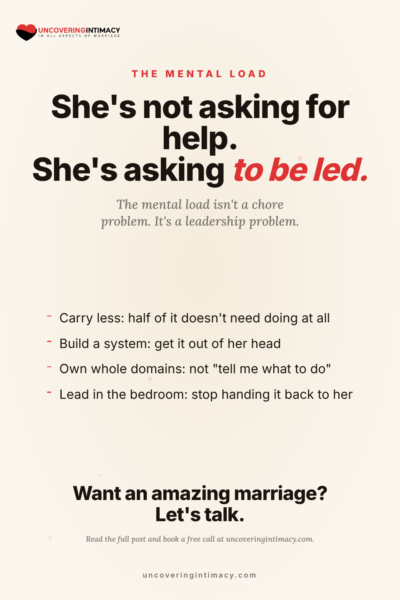
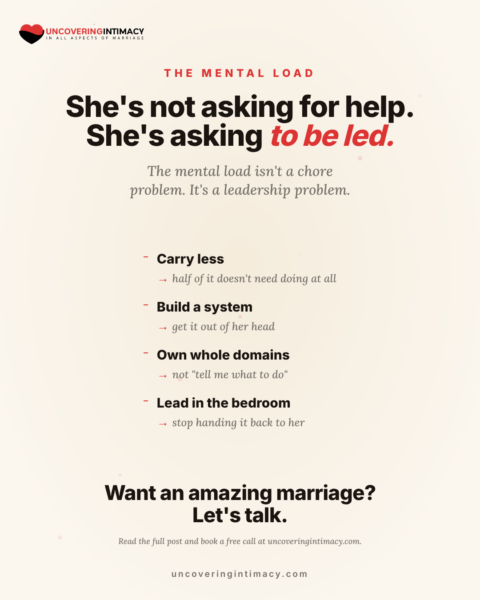
She is not asking for help. She is asking to be led.
When a wife says “I feel like I have another child to manage, not a partner,” she is not asking you to do more chores or tackle a to-do list. She is asking you to take some responsibility off of her. When she says “I just want him to see what needs doing and handle it without me asking,” she is describing, almost word for word, the difference between an employee and a leader.
An employee waits to be told. A leader notices, decides, and owns the outcome. An employee adds to her load, because she has to manage him. A leader removes it, because he carries it himself.
This is what biblical headship actually is, and it is almost the opposite of what most men do.
Most men say, “No problem, give me a list and I’ll do all the things you want.” They don’t actually lead. They read this:
Husbands, love your wives, as Christ loved the church and gave himself up for her. (Ephesians 5:25)
And they “sacrifice” by giving up their time and acting like an employee – asking to be managed, asking for a to-do list, asking for what they can do, asking how it needs to be done.
And the help is helpful, no one is saying it isn’t, but it’s treating a symptom, not the actual underlying problem:
Most wives don’t want to lead. They don’t even want a co-leader. They want to be led.
The problem is, most don’t know how to say that. They don’t know that’s what they want, they don’t know how to ask for it, and our society has raised them up to tell them they don’t want it. I’d also argue that part of the curse from the fall is that they will rail against the very dynamic they were created to fulfill.
“But doesn’t the Bible say he will rule over her because of the fall?”
When God pronounces the consequences of sin in the garden, he says to the woman:
Your desire shall be contrary to your husband, but he shall rule over you. (Genesis 3:16)
People read that and conclude the whole idea of a husband leading is part of the curse, something we should be undoing. But that one word, “desire,” is the key. It is the same word God uses one chapter later, warning Cain that sin is crouching at the door:
Its desire is contrary to you, but you must rule over it. (Genesis 4:7)
That is not romantic desire. It is the desire to consume, to master, to control. So the curse does not describe the invention of husbands leading. It describes its corruption. After sin, the wife’s good calling as a follower curdles into a craving to seize control, and the husband’s good calling as a leader curdles into one of two failures: harsh domination, or cowardly abdication. The battle of the sexes is born. Not husband-leadership, but the corruption and rejection of God’s plan in the marriage.
The problem was never leadership itself. It is the failure of it, on both sides: husbands who will not lead, and wives who reject it when they do. Abdication is every bit as much the curse as domination is. A husband who refuses to lead is not being humble or being self-sacrificing. He leaves a vacuum, and a vacuum gets filled. So she fills it, by default, because the alternative is chaos, and then she resents the load she never wanted and the man who left her holding it.
This is true, even if she fights for this power and belittles him into giving it up. This is one of the surest ways to kill attraction in a marriage.
Because leadership in marriage was not invented by the fall. It came before it, and the evidence is all over the first two chapters of Genesis:
- God formed Adam first, and Paul points back to that order as a reason for how he structures the home (1 Timothy 2:13).
- God gave the command about the tree to Adam before Eve existed (Genesis 2:16-17), making him responsible to lead and teach her.
- Eve was made as a helper suited to Adam’s task (Genesis 2:18), and Paul says plainly that woman was created for man, not man for woman (1 Corinthians 11:8-9).
- Adam named her “Woman” before the fall (Genesis 2:23), the same way he had just exercised his God-given authority by naming the animals.
- And after the fall, even though Eve sinned first, God calls out to Adam: “Where are you?” (Genesis 3:9). Scripture lays the fall at Adam’s feet (Romans 5:12-19), not because his bite of the fruit was worse in some way, but because he was the head, and the head bears responsibility.
- Then after the fall, Adam again names his wife Eve.
So no, a husband leading his wife is not the curse. The curse is the struggle for power that breaks out when he leads badly, stops leading at all, or she refuses to let him lead. The gospel is the repair: a husband who leads the way Christ leads, yes, sacrificially, but still leading, and a wife set free to follow without fear.
The relief she is actually craving
The world has stumbled onto this without realizing what it found.
Step into the corners of secular culture that explore power dynamics in relationships, what they label dominance and submission, or power exchange, and you will hear people describe something that should sound familiar to anyone who has read Ephesians 5. Ask a woman there what she actually gets out of being the one who submits, and she rarely leads with the dramatic stuff. She talks about relief. The relief of not having to hold everything. The relief of trusting someone else to carry the weight so she can finally let go.
That is the exact relief the exhausted wife says she is craving.
One woman who answered our survey said it better than I could:
There is a great burden that comes with leadership, and there should be great freedom that is poured out on the follower.
The burden goes up; the freedom comes down. The leader takes on more so the follower can carry less. That is not oppression, it’s covering. I’d argue it’s the original design. It’s what Christ does for us, and it’s what husbands should do for their wives. But we’ve gone so far from what God intended for us, that that’s now considered kinky and taboo.
Another wife described what changed when she and her husband finally embraced a clear leader-and-follower dynamic. For most of their marriage, she said, sex had been “duty centered,” something to endure. “Such a waste of time,” were her words. Once her husband actually led, and she was free to respond instead of manage, she became, in her words, “a willing, responsive wife” who genuinely enjoyed their intimacy.
Secular culture thinks it discovered something new. It did not. It backed into something our faith has held for thousands of years and called headship. Same human reality, two names: being led well by someone who loves you is not a loss of dignity. It is a gift.
This gets abused, so hear me clearly. None of it works, and none of it is biblical, if the leadership is selfish or forced. Biblical leadership is an invitation to those that would follow. It’s not pushed on them.
The submission Scripture describes is always voluntary; a husband is told he will “give an account” for how he leads, and is warned in the plainest terms against domineering over those in his charge. This is not permission to dominate your wife or to treat her as anything less than your full equal in worth and dignity. This passage has sometimes been twisted into “wives must submit and husbands must forcibly dominate,” and that is a lie. Christ does not lead His church by force. He leads by laying down His life. If your leadership costs you nothing, it is not biblical leadership. If you have to make people follow you, then it’s not biblical leadership. It is just control with a Jesus sticker slapped on it.
So how do you actually solve it?
If the mental load is the problem and leadership is the solution, that leadership works on three levels, and most couples skip the first two.
1. Carry less. Some of it should not be on anyone’s list.
The fastest way to lighten a load is to stop carrying so much of it. Before you reorganize who does what, ask an honest question: does half of this even need to be done?
A surprising amount of the mental load is self-imposed. The elaborate birthday parties, an activity for every child every night of the week, the commitments said yes to out of guilt, the standard of “clean” that no one is actually requiring of you. We treat it all as non-negotiable when most of it is a choice.
I often come back to a simple rule with the couples I coach: do not do things for people that make you resent them. Resentment is the warning light that you have taken on more than you can carry in love, and love that curdles into resentment has stopped being love. Whatever is quietly turning your heart against the people you are doing it for has to change.
Start with the kids, because that is where most of the invented load lives. Be honest about how much of what exhausts you is what your children actually need, and how much is what our culture recently decided they should have. Forty years ago, kids were kicked out of the house after breakfast and not expected home until the street lights turned on. They’d maybe come back for a quick sandwich at lunch, or a drink from the hose. Parents did a fraction of what we do now, and we grew up fine. A hundred years ago, parents did even less, and children were expected to contribute more, and they were fine.
Jesus’ parents travelled a full day back from Jerusalem to Nazareth before they realized Jesus wasn’t with them in the group. They weren’t watching him every moment of every day. They were the opposite of helicopter parents.
We invented a long list of things children supposedly require, then run ourselves into the ground providing them, then resent our own kids for the exhaustion. Doing more for your children than you can do without resenting them or burning out is not the more loving choice. It is the less loving one. They would trade every program on the calendar for a mom who is not burned out and a dad who is present.
Now, if you struggle to provide basic needs (food, clothing, shelter, love), then please, get help. They do have some needs … just not iPads, noise-cancelling headphones, and brand-name clothing.
Even Jesus did not meet every need in front of Him. He did not heal every sick person in Israel. He withdrew to rest, He kept the Sabbath, He let some things go undone. If the sinless Son of God did not say yes to everything, you do not have to either.
Note: Most of the men I know in ministry don’t keep a Sabbath, and they’re burnt out. It’s no wonder why. We don’t do ourselves favours when we violate God’s commands and don’t experience His rest ourselves while trying to teach others that God’s burden is light.
And wives, the same rule lands on you. If you are doing something for your husband that makes you hate him, the answer is not to grit your teeth and keep doing it while the resentment grows. If his laundry makes you hate him, stop doing his laundry. He can do it. If you weren’t there, he’d learn to.
But do not stop there, because that resentment is information. Ask where it is coming from. If you both work careers, the household work split might need to be renegotiated. If one of you earns and the other keeps the home, the job is to fit the real work into the hours you actually have, in a way that still leaves both of you room to rest and connect. And if the honest math does not work, if there is no way to fit it all into a day and still have a marriage, then one of two things is true: you have too much going on, or you need more help, whether from him or from outside, a housekeeper, a sitter, whatever fits your life and budget. That is yours to work out together.
What is not fair, is to load your own plate past what you can carry and then demand your spouse carry the overflow. If the resentment comes from commitments you chose, the honest move is to cut them or get help, not to hand your spouse the bill for your decision. I know that cuts against a lot of what gets said online. But fairness runs in both directions.
Which brings it back to him. Husband, this is the first place you lead: by being the one with the courage to look at the calendar and say, “We are doing too much, and some of this is coming off.” A wife buried under obligations often cannot make that cut, because she feels responsible for every item on the list and is worried about what people will think. You can. That is leadership. You have to do that with wisdom, compassion and love, but sometimes it needs to be done. The Bible is clear – take care of your own family before you try to save the world (1 Timothy 3:4-5, 5:8).
2. Get it out of her head and into a system.
Every business figured this out long ago, and most families never do: you do not run an organization out of one person’s memory, and a family is an organization. Even a two person company doesn’t keep everything in their head. You build systems. A shared calendar. A shared task list. A place where the recurring things live so nobody has to hold them in their head.
The reason we call it the mental load is that it is stored in someone’s working memory, often hers, all day and half the night. Move it out of her head and onto a system the whole household can see, and you can actually set the load down somewhere instead of leaving it to rattle around inside one exhausted person.
I do not run my own life out of my memory. As I write this, I have more than sixty open tasks sitting in my personal task-management system, and far more that are going to come up in the near future. I have another system for my day job. There is no version of me that holds all of that in my head, and I would be a wreck if I tried. When my day job is done, that task list gets closed and I don’t think about it until the next business day. Because I trust the system, my mind is free. Your wife deserves that same freedom, and building that system, and keeping it running, is one more way you lead, especially if you have experience with those types of systems. It doesn’t have to be complex – a paper journal will do.
It just needs to work, and you both need to use it and trust it.
3. Own it.
The first two are not enough on their own, because a system still needs an owner. A shared calendar nobody drives is just a list of things getting ignored. Cutting commitments still takes someone willing to make the call and absorb the disappointment. This is the part no app and no chore chart can do for you.
So take whole domains off her plate. Not “tell me what to do and I’ll do it,” which only makes you one more item on her list. I mean: “I own the finances now. You will never have to think about a bill again.”
Note: You have to figure out what works for your marriage. Some wives want to be informed, some want to be involved. My wife is far less stressed by not knowing.
“Kid’s bedtime is mine, start to finish.” “I am planning our anniversary, and you do not need to know a single detail.” Pick a category and take the whole thing, the noticing and the deciding and the doing, and carry it completely.
Ask her what level of involvement she wants, from completely hands off, to wanting to be in the loop, to “no, I actually like doing this, I want to do it.”
Use this as your test: does she have to manage you, or can she trust you? If she still has to check whether you did it, remind you how, or quietly redo it afterward, you have not taken the load off her. You have only relocated it. The classic dodge is doing a job so badly she stops asking, what people now call weaponized incompetence. That is not leadership. That is abdication, the curse rather than the cure.
Wives, this is the “let go of your preferences” point again, now with teeth. If you want the freedom of not being responsible for something, you cannot also berate him for how he does it. Do that, and don’t be surprised when he hands it back. That is the curse creeping back in, and if you give in to it, you will feel the weight of it. Also, don’t accuse him of weaponized incompetence just because he has different preferences than you. That’s not the same thing, and it’s as underhanded as calling someone a narcissist when they’re not (a pet peeve of mine).
And do not stop at the household. Lead the relationship, lead the connection, and yes, lead in the bedroom. If you wait for her to initiate and carry your sex life the way she carries everything else, you have just handed it back to her.
Too many men give up on initiating sex, leaving it to their lower-drive / responsive desire wives, which is an incredible amount of pressure and responsibility for someone who doesn’t naturally think about sex. And then they wonder why sex rarely happens, because you made it a burden. You made sex another item on the to-do list. Don’t do that.
Leading her into arousal, setting the tone, pursuing her, building the safety and connection she needs to respond, that is part of carrying the load too. She cannot lead herself into desire while she is still managing everything else. Even when she’s not, it’s still unlikely she’s going to create that context on her own. That is your job, not hers.
Note: Now, if your dynamic is reversed and she has the higher drive or more spontaneous desire, then this is going to need to shift. But I almost guarantee she’s still not going to want to be fully responsible for it.
It will cost you, and that is the point. You are not taking charge so your life gets easier; you are taking the heavier load so hers gets lighter.
What is waiting on the other side
When a husband truly leads, something happens to his wife that he may not have seen in years, maybe not since they were dating. She relaxes.
The load lifts. Not because the work vanished, the bills still have to be paid and the kids still have to be fed, but because she is no longer holding all of it alone, scanning and tracking and directing from sunup to sundown. For the first time in a long time, she is not the manager of everything. She is cared for. She can rest.
And a woman who can finally rest, who feels genuinely safe and held and led, has room for something she has not had room for in a long time: desire.
So, does the Bible have a solution to the mental load? It does, and it is the same one it has offered all along, the one the world is only now fumbling toward in the dark. The great burden of leadership, poured out as the great freedom of the follower. A husband who lays his life down, and a wife set free to respond.
That is not a chore chart. That is the gospel, lived out in a marriage.
Come to me, all who labor and are heavy laden, and I will give you rest. … For my yoke is easy, and my burden is light. – Matthew 11:28-30
That should be our model. If it looks like something else, then it’s not biblical.
Husbands, go lead your wife. Wives, let him lead. See what life is like if you do.
And if you need help figuring it out, shoot me an email. I would love to help you have an amazing marriage.
This is precisely what my wife and I have been learning over the past several months. Thank you!
I’ll also add that I’m skeptical as to whether there would be any cases of the wife being the higher desire spouse left remaining if known issues are addressed. I mean, are there really cases where there are no medical issues or porn addiction/masterbation and psychological issues (e.g., depression, trauma, etc.) have been addressed, and she is still the higher desire spouse? I’m not someone who talks regularly with people who struggle with that kind of thing, so I could be wrong. But my expectation would be that once all the known moral, medical, and psychological problems have been addressed, he would become the higher/spontaneous desire spouse and she would become the lower/responsive desire spouse.
You’re very welcome.
As for the rest, I don’t think I see this reflected in reality. In about 1/4 to 1/3 of marriages, the wife is the higher drive spouse, and there’s not always some medical issue, porn issue (in fact, often the low drive husbands aren’t interested in porn), psychological issues that we’re aware of. They’re just lower drive than their wife.
Now, I agree, sometimes there are reasons, like low-T and such – but that’s not always the case. I don’t even know that it’s usually the case.