A free guide for Christian couples · PDF, 29 pages
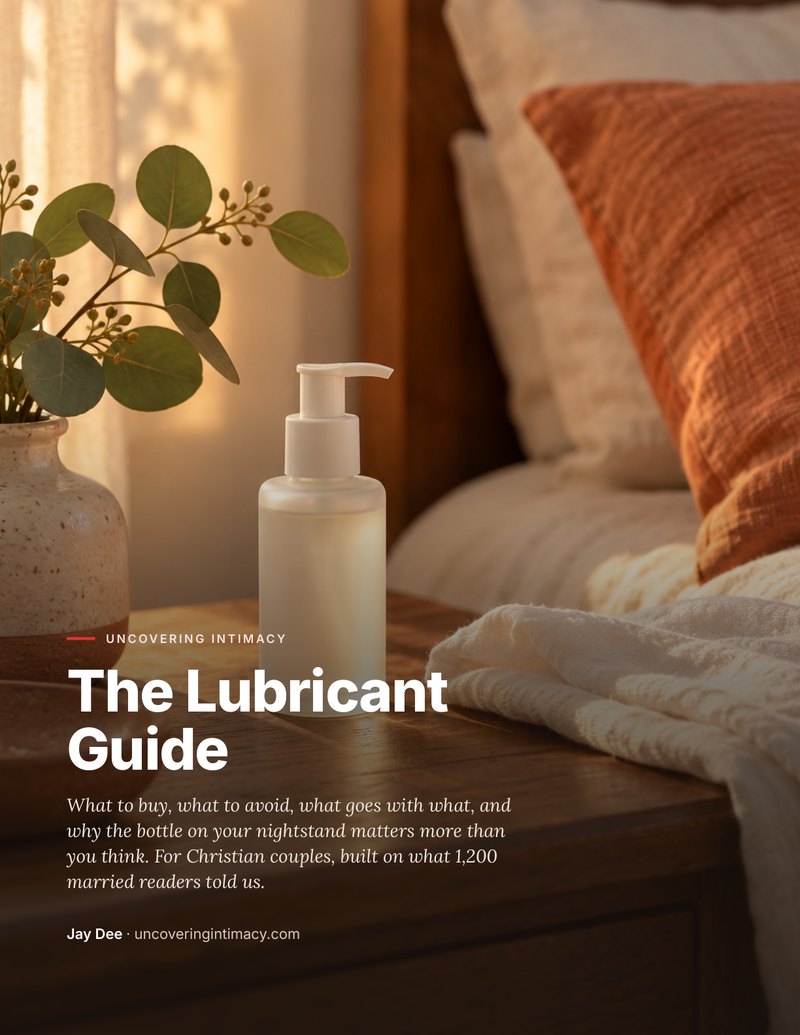
The Lubricant Guide
The right lubricant makes sex comfortable. The wrong one causes the burning and infections most wives blame on themselves. This free guide shows you which is which, built on what 1,200 married readers told us.
Free. We email you a link to the PDF, and you join our weekly note for married couples. Unsubscribe any time.
Why a whole guide about a bottle
The cheapest thing in your marriage bed, and the one most couples get wrong.
Some couples never buy lubricant because they think needing it means something is broken. Others buy whatever is on the pharmacy shelf and spend years with burning, yeast infections and dryness they blame on themselves. Both problems have the same fix: know what you are buying.
God designed a wife’s body to change with her cycle, with breastfeeding, with medication, with stress and with age. None of that is a verdict on her desire for her husband. Using a good lubricant is working with the body He gave you, in the season you are in.
Left alone, the wrong bottle keeps doing its quiet damage: sex that stings, infections that keep coming back, and nights you both start to avoid.
From the Uncovering Intimacy Manual Sex and Masturbation survey (2025, n=1,047 and 879). Our readers are not a random sample; the guide explains the caveats.
What is inside
How to read a label, and nine products we checked ourselves.
If you only have ten minutes, read Chapter 1, the compatibility table in Chapter 5 and the picks in Chapter 9.
How it works
Three steps, about ten minutes.
- Enter your email and open the guide from the email we send you.
- Read the compatibility table in Chapter 5 and the label checklist at the back.
- Pick one of the nine products and try it this week.
Who wrote it
Jay Dee, Uncovering Intimacy
Since 2012 we have written about sex in Christian marriage, and “what lubricant should we use?” comes in more often than almost any other practical question. Usually it arrives attached to something else: perimenopause, the months after a baby, sex that stings, or trying to conceive. This guide is the answer we wish we could send every one of them.
This guide is education, not medical advice. If sex is painful, please see your doctor.
Get the free guide
Ten minutes of reading, and you will never stand confused in the pharmacy aisle again.
PDF, 29 pages. Enter your email and we send you the link.
Your address is never shared, and you can unsubscribe any time. Questions? Ask us.